Faber Jakob A, Udani Janav P, Riley Katherine S, Studart André R, Arrieta Andres F
School of Mechanical Engineering Purdue University 585 Purdue Mall West Lafayette IN 47907 USA.
Department of Materials Complex Materials ETH Zürich Vladimir-Prelog-Weg 5 Zürich 8093 Switzerland.
Adv Sci (Weinh). 2020 Oct 7;7(22):2001955. doi: 10.1002/advs.202001955. eCollection 2020 Nov.
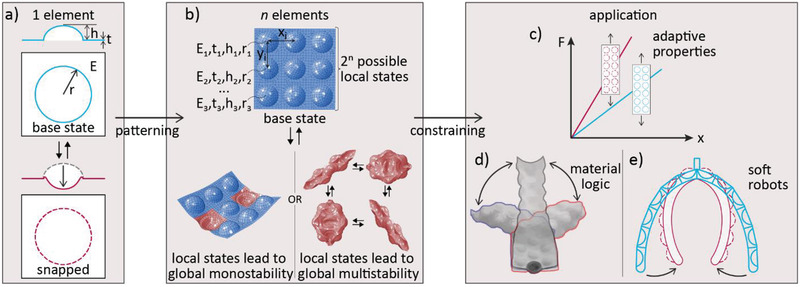
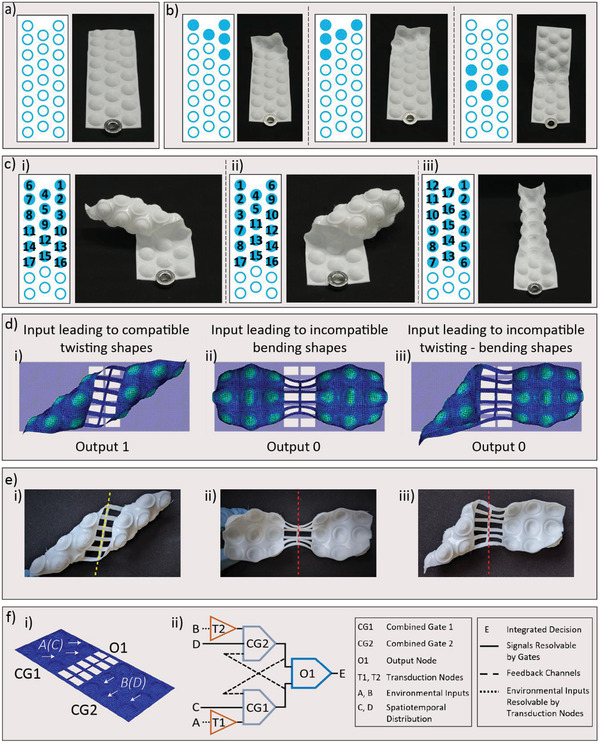
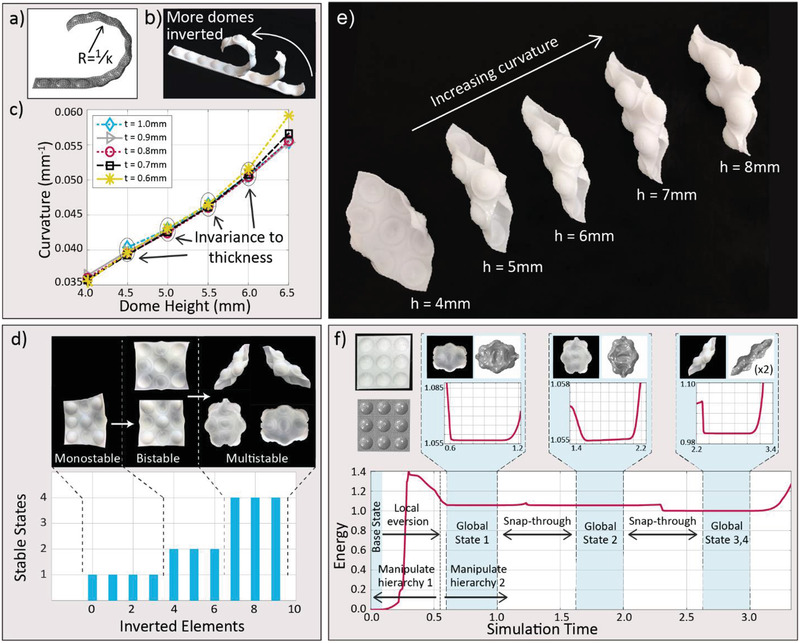
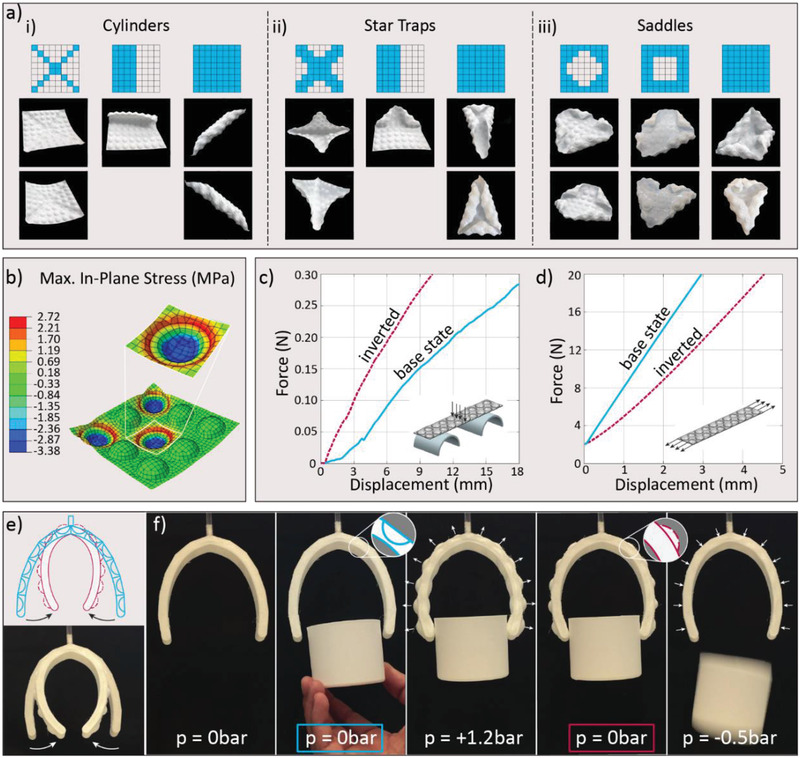
The properties of conventional materials result from the arrangement of and the interaction between atoms at the nanoscale. Metamaterials have shifted this paradigm by offering property control through structural design at the mesoscale, thus broadening the design space beyond the limits of traditional materials. A family of mechanical metamaterials consisting of soft sheets featuring a patterned array of reconfigurable bistable domes is reported here. The domes in this metamaterial architecture can be reversibly inverted at the local scale to generate programmable multistable shapes and tunable mechanical responses at the global scale. By 3D printing a robotic gripper with energy-storing skin and a structure that can memorize and compute spatially-distributed mechanical signals, it is shown that these metamaterials are an attractive platform for novel mechanologic concepts and open new design opportunities for structures used in robotics, architecture, and biomedical applications.
传统材料的特性源于纳米尺度下原子的排列及其相互作用。超材料通过在中尺度上进行结构设计来实现性能控制,从而改变了这一范式,将设计空间拓展到传统材料的极限之外。本文报道了一类由柔软薄板构成的机械超材料,薄板上具有可重构双稳态穹顶的图案阵列。这种超材料结构中的穹顶能够在局部尺度上可逆地翻转,从而在全局尺度上产生可编程的多稳态形状和可调谐的机械响应。通过3D打印一个带有储能表皮和能够记忆并计算空间分布机械信号的结构的机器人抓手,结果表明这些超材料是用于新颖力学概念的极具吸引力的平台,并为机器人技术、建筑和生物医学应用中的结构开辟了新的设计机会。