Department of Computer Science, Khwaja Fareed University of Engineering and Information Technology, Rahim Yar Khan 64200, Pakistan.
Department of Computer Science Information Technology, The Islamia University of Bahawalpur, Bahawalpur 63100, Pakistan.
Sensors (Basel). 2022 Mar 22;22(7):2431. doi: 10.3390/s22072431.
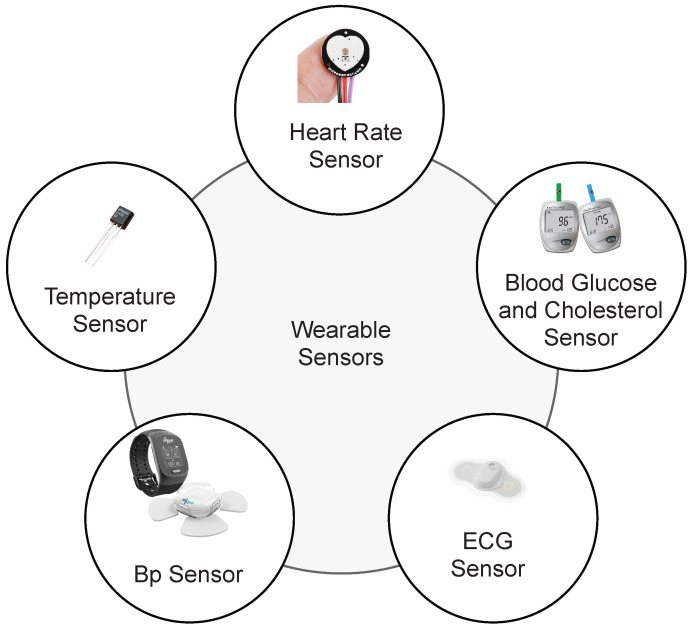
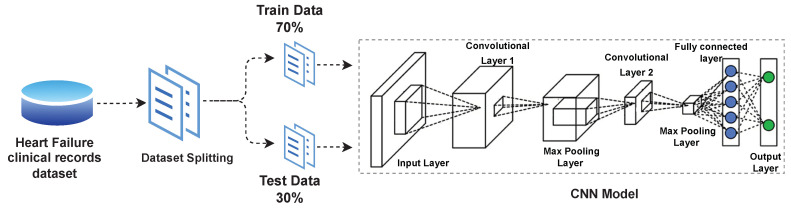
The prediction of heart failure survivors is a challenging task and helps medical professionals to make the right decisions about patients. Expertise and experience of medical professionals are required to care for heart failure patients. Machine Learning models can help with understanding symptoms of cardiac disease. However, manual feature engineering is challenging and requires expertise to select the appropriate technique. This study proposes a smart healthcare framework using the Internet-of-Things (IoT) and cloud technologies that improve heart failure patients' survival prediction without considering manual feature engineering. The smart IoT-based framework monitors patients on the basis of real-time data and provides timely, effective, and quality healthcare services to heart failure patients. The proposed model also investigates deep learning models in classifying heart failure patients as alive or deceased. The framework employs IoT-based sensors to obtain signals and send them to the cloud web server for processing. These signals are further processed by deep learning models to determine the state of patients. Patients' health records and processing results are shared with a medical professional who will provide emergency help if required. The dataset used in this study contains 13 features and was attained from the UCI repository known as Heart Failure Clinical Records. The experimental results revealed that the CNN model is superior to other deep learning and machine learning models with a 0.9289 accuracy value.
心力衰竭幸存者的预测是一项具有挑战性的任务,可以帮助医疗专业人员为患者做出正确的决策。需要医学专业人员的专业知识和经验来照顾心力衰竭患者。机器学习模型可以帮助了解心脏病的症状。但是,手动特征工程具有挑战性,需要专业知识来选择合适的技术。本研究提出了一种使用物联网 (IoT) 和云技术的智能医疗保健框架,无需考虑手动特征工程即可改善心力衰竭患者的生存预测。基于智能 IoT 的框架根据实时数据监测患者,并为心力衰竭患者提供及时、有效和高质量的医疗保健服务。所提出的模型还研究了深度学习模型在将心力衰竭患者分类为存活或死亡方面的应用。该框架使用基于物联网的传感器获取信号,并将其发送到云 Web 服务器进行处理。这些信号进一步由深度学习模型处理,以确定患者的状态。将患者的健康记录和处理结果与医疗专业人员共享,如果需要,医疗专业人员将提供紧急帮助。本研究使用的数据集包含 13 个特征,来自 UCI 存储库,称为心力衰竭临床记录。实验结果表明,CNN 模型的准确率为 0.9289,优于其他深度学习和机器学习模型。