Department of Physics "E. Pancini", University of Naples Federico II, 80126 Naples, Italy.
National Research Council-National Institute of Optics (CNR-INO), 80078 Pozzuoli, Italy.
Sensors (Basel). 2022 Apr 3;22(7):2764. doi: 10.3390/s22072764.
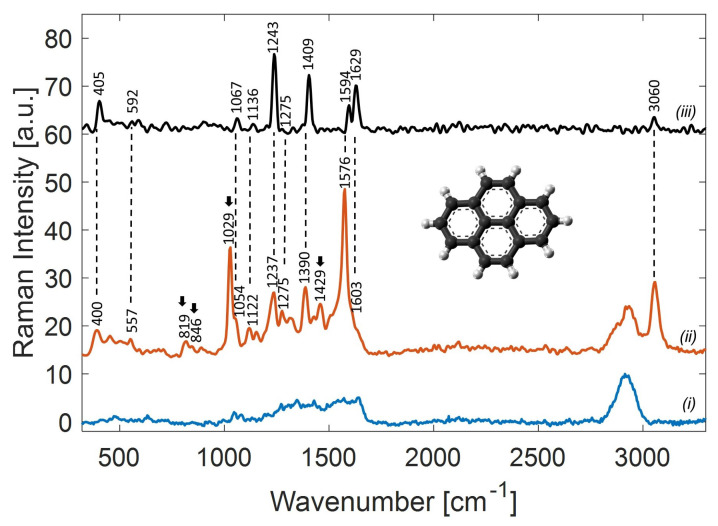
Polycyclic aromatic hydrocarbons (PAHs) are ubiquitous pollutants that are typically released into the environment during the incomplete combustion of fossil fuels. Due to their relevant carcinogenicity, mutagenicity, and teratogenicity, it is urgent to develop sensitive and cost-effective strategies for monitoring them, especially in aqueous environments. Surface-enhanced Raman spectroscopy (SERS) can potentially be used as a reliable approach for this purpose, as it constitutes a valid alternative to traditional techniques, such as liquid and gas chromatography. Nevertheless, the development of an SERS-based platform for detection PAHs has so far been hindered by the poor adsorption of PAHs onto silver- and gold-based SERS-active substrates. To overcome this limitation, several research efforts have been directed towards the development of functionalized SERS substrates for the improvement of PAH adsorption. However, these strategies suffer from the interference that functionalizing molecules can produce in SERS detection. Herein, we demonstrate the feasibility of label-free detection of pyrene by using a highly porous 3D-SERS substrate produced by an inductively coupled plasma (ICP). Thanks to the coral-like nanopattern exhibited by our substrate, clear signals ascribable to pyrene molecules can be observed with a limit of detection of 23 nM. The observed performance can be attributed to the nanoporous character of our substrate, which combines a high density of hotspots and a certain capability of trapping molecules and favoring their adhesion to the Ag nanopattern. The obtained results demonstrate the potential of our substrates as a large-area, label-free SERS-based platform for chemical sensing and environmental control applications.
多环芳烃(PAHs)是普遍存在的污染物,通常在化石燃料不完全燃烧过程中释放到环境中。由于其相关的致癌性、致突变性和致畸性,因此迫切需要开发敏感且具有成本效益的监测策略,特别是在水环境中。表面增强拉曼光谱(SERS)可以作为一种可靠的方法来实现这一目标,因为它是传统技术(如液相色谱和气相色谱)的有效替代方法。然而,迄今为止,开发基于 SERS 的 PAHs 检测平台一直受到 PAHs 在银和金基 SERS 活性衬底上吸附能力差的限制。为了克服这一限制,已经有几项研究致力于开发功能化的 SERS 基底,以改善 PAH 的吸附。然而,这些策略受到功能化分子在 SERS 检测中产生干扰的影响。在此,我们通过使用感应耦合等离子体(ICP)产生的高度多孔 3D-SERS 基底,证明了无标记检测芘的可行性。由于我们的基底表现出珊瑚状的纳米图案,因此可以观察到可归因于芘分子的清晰信号,其检测限为 23 nM。观察到的性能可归因于我们基底的纳米多孔特性,它结合了高密度热点和一定的分子捕获能力,并有利于它们与 Ag 纳米图案的粘附。所得结果表明,我们的基底作为一种用于化学传感和环境控制应用的大面积、无标记的基于 SERS 的平台具有潜力。