
游离赖氨酸及其甲酯在磷酸盐缓冲液(100mM,pH7.4)中与乙二醛和甲基乙二醛反应,形成γ-羧甲基赖氨酸、γ-羧乙基赖氨酸和羟甲基赖氨酸。
Free L-Lysine and Its Methyl Ester React with Glyoxal and Methylglyoxal in Phosphate Buffer (100 mM, pH 7.4) to Form -Carboxymethyl-Lysine, -Carboxyethyl-Lysine and -Hydroxymethyl-Lysine.
机构信息
Core Unit Proteomics, Institute of Toxicology, Hannover Medical School, 30623 Hannover, Germany.
出版信息
Int J Mol Sci. 2022 Mar 22;23(7):3446. doi: 10.3390/ijms23073446.
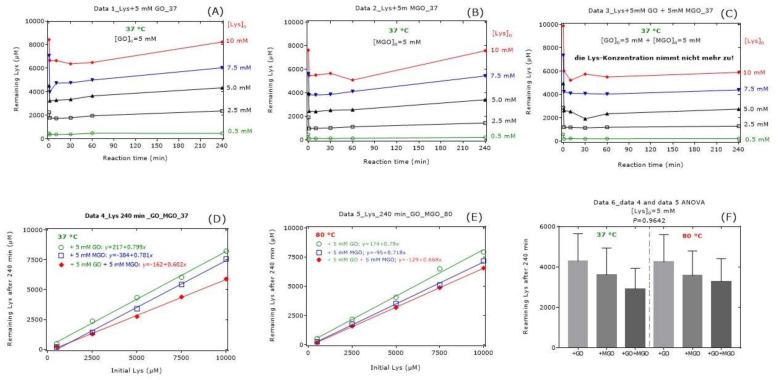
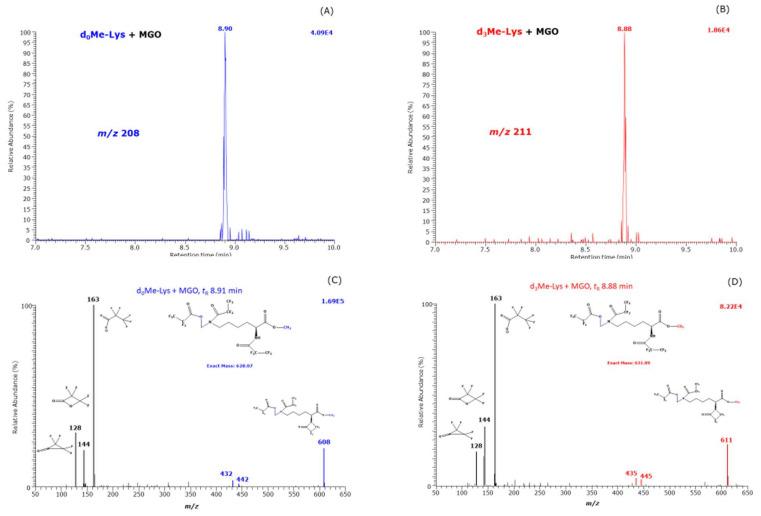
Glyoxal (GO) and methylglyoxal (MGO) are highly reactive species formed in carbohydrate metabolism. -Carboxymethyllysine (CML) and -carboxyethyllysine (CEL) are considered to be the advanced glycation end-products (AGEs) of L-lysine (Lys) with GO and MGO, respectively. Here, we investigated the reaction of free L-lysine (Lys) with GO and MGO in phosphate buffer (pH 7.4) at 37 °C and 80 °C in detail in the absence of any other chemicals which are widely used to reduce Schiff bases. The concentrations of Lys, GO and MGO used in the experiments were 0.5, 2.5, 5.0, 7.5 and 10 mM. The reaction time ranged between 0 and 240 min. Experiments were performed in triplicate. The concentrations of remaining Lys and of CML and CEL formed in the reaction mixtures were measured by stable-isotope dilution gas chromatography-mass spectrometry (GC-MS). Our experiments showed that CML and CEL were formed at higher concentrations at 80 °C compared to 37 °C. CML was found to be the major reaction product. In mixtures of GO and MGO, MGO inhibited the formation of CML from Lys (5 mM) in a concentration-dependent manner. The highest CML concentration was about 300 µM corresponding to a reaction yield of 6% with respect to Lys. An addition of Lys to GO, MGO and their mixtures resulted in strong reversible decreases in the Lys concentration up to 50%. It is assumed that free Lys reacts rapidly with GO and MGO to form many not yet identified reaction products. Reaction mixtures of Lys and MGO were stronger colored than those of Lys and GO, notably at 80 °C, indicating higher reactivity of MGO towards Lys that leads to polymeric colored MGO species. We have a strong indication of the formation of -(hydroxymethyl)-lysine (HML) as a novel reaction product of Lys methyl ester with MGO. A mechanism is proposed for the formation of HML from Lys and MGO. This mechanism may explain why Lys and GO do not react to form a related product. Preliminary analyses show that HML is formed at higher concentrations than CEL from Lys methyl ester and MGO. No Schiff bases or their hydroxylic precursors were identified as reaction products. In their reactions with Lys, GO and MGO are likely to act both as chemical oxidants on the terminal aldehyde group to a carboxylic group (i.e., R-CHO to R-COOH) and as chemical reductors on labile Schiff bases (R-CH=N-R to R-CH-NH-R) presumably via disproportionation and hydride transfer. Our study shows that free non-proteinic Lys reacts with GO and MGO to form CML, CEL and HML in very low yield. Whether proteinic Lys also reacts with MGO to form HML residues in proteins remains to be investigated. The physiological occurrence and concentration of HML in biological fluids and tissues and its relation to CML and CEL are elusive and warrant further investigations in health and disease. Chemical synthesis and structural characterization of HML are expected to advance and accelerate the scientific research in this topic.
乙二醛(GO)和甲基乙二醛(MGO)是糖代谢过程中形成的高反应性物质。 -羧甲基赖氨酸(CML)和 -羧乙基赖氨酸(CEL)被认为是 L-赖氨酸(Lys)与 GO 和 MGO 的高级糖基化终产物(AGEs),分别。在这里,我们详细研究了游离 L-赖氨酸(Lys)与 GO 和 MGO 在磷酸盐缓冲液(pH 7.4)中的反应,在 37°C 和 80°C 下,在没有任何其他广泛用于还原希夫碱的化学物质的情况下进行反应。实验中使用的 Lys、GO 和 MGO 的浓度分别为 0.5、2.5、5.0、7.5 和 10 mM。反应时间在 0 到 240 分钟之间。实验重复了三次。通过稳定同位素稀释气相色谱-质谱联用仪(GC-MS)测量反应混合物中剩余 Lys 和 CML 和 CEL 的浓度。我们的实验表明,与 37°C 相比,80°C 时 CML 和 CEL 的形成浓度更高。发现 CML 是主要的反应产物。在 GO 和 MGO 的混合物中,MGO 以浓度依赖的方式抑制 Lys(5 mM)形成 CML。CML 的最高浓度约为 300 µM,相对于 Lys 的反应产率为 6%。向 GO、MGO 及其混合物中添加 Lys 会导致 Lys 浓度迅速可逆下降,最高可达 50%。据推测,游离 Lys 与 GO 和 MGO 快速反应,形成许多尚未确定的反应产物。Lys 和 MGO 的反应混合物比 Lys 和 GO 的反应混合物颜色更深,尤其是在 80°C 时,表明 MGO 对 Lys 的反应性更高,导致聚合有色 MGO 物质。我们强烈表明,Lys 甲酯与 MGO 形成了一种新的反应产物,即 -(羟甲基)赖氨酸(HML)。提出了 Lys 和 MGO 形成 HML 的反应机制。该机制可以解释为什么 Lys 和 GO 不会反应形成相关产物。初步分析表明,HML 是由 Lys 甲酯和 MGO 形成的,其浓度高于 CEL。未鉴定出希夫碱或其羟基前体作为反应产物。在与 Lys 的反应中,GO 和 MGO 可能既作为化学氧化剂作用于末端醛基形成羧酸基团(即 R-CHO 到 R-COOH),又作为不稳定的希夫碱的化学还原剂(R-CH=N-R 到 R-CH-NH-R)通过歧化和氢化物转移。我们的研究表明,游离的非蛋白赖氨酸与 GO 和 MGO 反应,以非常低的产率形成 CML、CEL 和 HML。蛋白质中的蛋白赖氨酸是否也与 MGO 反应形成蛋白质中的 HML 残基还有待研究。HML 在生物体液和组织中的生理发生和浓度及其与 CML 和 CEL 的关系尚不清楚,值得在健康和疾病方面进一步研究。HML 的化学合成和结构表征有望促进和加速该主题的科学研究。





 Zotero 插件