Bianchini Matteo, Giambelluca Maria, Scavuzzo Maria Concetta, Di Franco Gregorio, Guadagni Simone, Palmeri Matteo, Furbetta Niccolò, Gianardi Desirée, Costa Aurelio, Gentiluomo Manuel, Gaeta Raffaele, Pollina Luca Emanuele, Falcone Alfredo, Vivaldi Caterina, Di Candio Giulio, Biagioni Francesca, Busceti Carla Letizia, Soldani Paola, Puglisi-Allegra Stefano, Morelli Luca, Fornai Francesco
General Surgery Unit, Department of Translational Research and New Technologies in Medicine and Surgery, University of Pisa, 56124 Pisa, Italy.
Human Anatomy, Department of Translational Research and New Technologies in Medicine and Surgery, University of Pisa, 56124 Pisa, Italy.
Int J Mol Sci. 2022 Mar 29;23(7):3775. doi: 10.3390/ijms23073775.
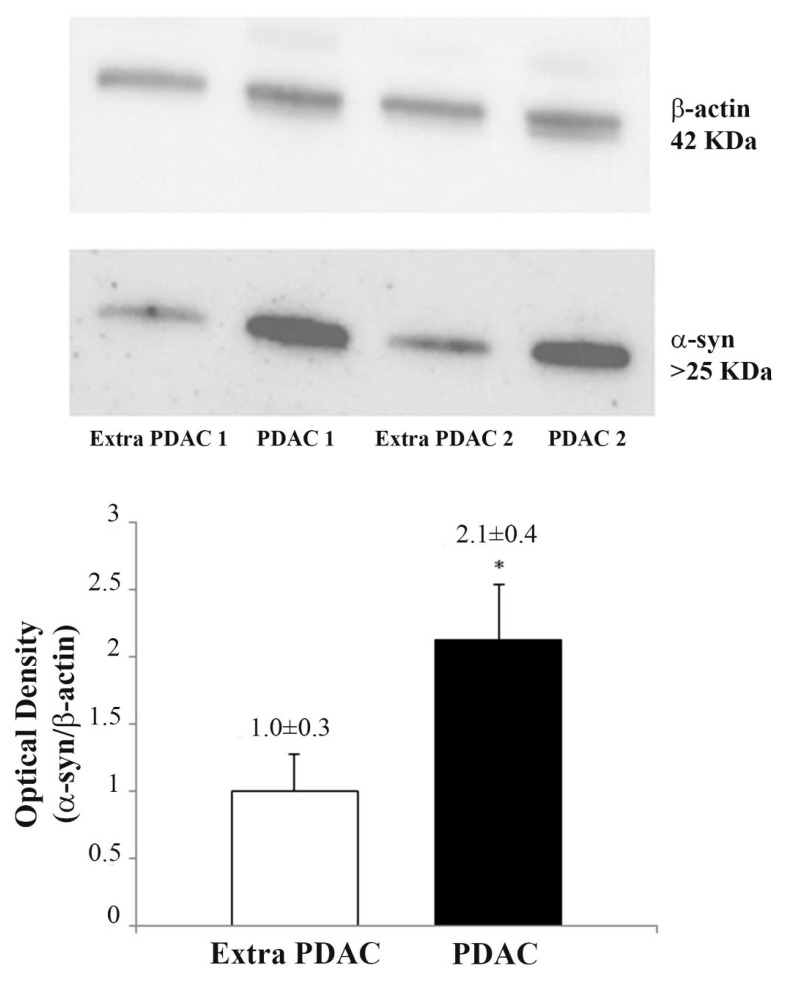
α-Synuclein (α-syn) is a protein involved in neuronal degeneration. However, the family of synucleins has recently been demonstrated to be involved in the mechanisms of oncogenesis by selectively accelerating cellular processes leading to cancer. Pancreatic ductal adenocarcinoma (PDAC) is one of the most lethal human cancers, with a specifically high neurotropism. The molecular bases of this biological behavior are currently poorly understood. Here, α-synuclein was analyzed concerning the protein expression in PDAC and the potential association with PDAC neurotropism. Tumor (PDAC) and extra-tumor (extra-PDAC) samples from 20 patients affected by PDAC following pancreatic resections were collected at the General Surgery Unit, University of Pisa. All patients were affected by moderately or poorly differentiated PDAC. The amount of α-syn was compared between tumor and extra-tumor specimen (sampled from non-affected neighboring pancreatic areas) by using in situ immuno-staining with peroxidase anti-α-syn immunohistochemistry, α-syn detection by using Western blotting, and electron microscopy by using α-syn-conjugated immuno-gold particles. All the methods consistently indicate that each PDAC sample possesses a higher amount of α-syn compared with extra-PDAC tissue. Moreover, the expression of α-syn was much higher in those PDAC samples from tumors with perineural infiltration compared with tumors without perineural infiltration.
α-突触核蛋白(α-syn)是一种与神经元变性有关的蛋白质。然而,最近已证明突触核蛋白家族通过选择性加速导致癌症的细胞进程而参与肿瘤发生机制。胰腺导管腺癌(PDAC)是最致命的人类癌症之一,具有特别高的嗜神经性。这种生物学行为的分子基础目前了解甚少。在此,对α-突触核蛋白在PDAC中的蛋白表达及其与PDAC嗜神经性的潜在关联进行了分析。在比萨大学普通外科收集了20例接受胰腺切除术后患PDAC患者的肿瘤(PDAC)和肿瘤外(肿瘤外PDAC)样本。所有患者均患有中分化或低分化PDAC。通过使用抗α-突触核蛋白过氧化物酶免疫组织化学原位免疫染色、蛋白质印迹法检测α-突触核蛋白以及使用α-突触核蛋白偶联免疫金颗粒的电子显微镜,比较肿瘤和肿瘤外标本(取自未受影响的邻近胰腺区域)中α-突触核蛋白的含量。所有方法均一致表明,与肿瘤外PDAC组织相比,每个PDAC样本的α-突触核蛋白含量更高。此外,与无神经周围浸润的肿瘤相比,神经周围浸润肿瘤的PDAC样本中α-突触核蛋白的表达要高得多。