Department of Psychology, University of Turin, 10124 Torino, Italy.
Int J Environ Res Public Health. 2022 Mar 23;19(7):3833. doi: 10.3390/ijerph19073833.
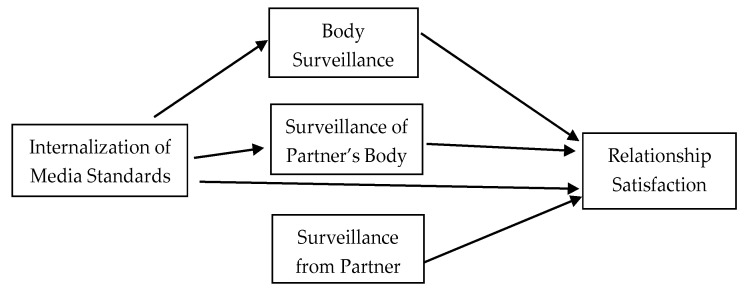
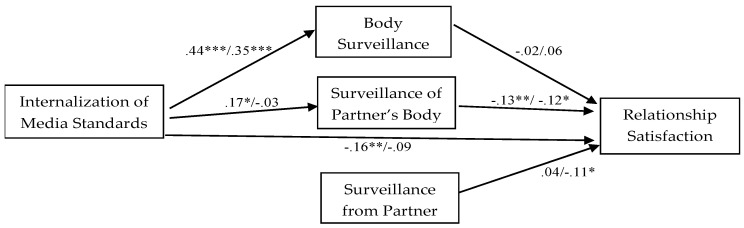
As part of objectification processes, individuals engage in body surveillance, whereby they constantly assess the extent to which their external appearance conforms to culturally valued ideals. Mass media play a key role in fostering the objectification and internalization of media beauty standards and increases body surveillance. At the individual level, the literature has largely demonstrated that body surveillance leads to a variety of negative psychological outcomes, but little research has focused on the consequences of body surveillance in the context of romantic relationships. Using dyadic data from couples who identified as heterosexual, the present study examined relations among internalization of media standards, body surveillance, surveillance of the partner's body, surveillance from the partner, and relationship satisfaction. There were 438 participants (219 couples) recruited using snowball sampling. They were surveyed with an anonymous online questionnaire. Results showed that internalization of media standards was related to body surveillance in both men and women, and to surveillance of the partner's body and relationship satisfaction in men only. For both sexes, surveillance of the partner's body was negatively associated with relationship satisfaction. For women only, surveillance from the partner was also negatively related to relationship satisfaction. Implications are discussed.
作为客体化过程的一部分,个体进行身体监控,即他们不断评估自己的外表与文化所重视的理想标准相符的程度。大众媒体在促进对媒体审美标准的客体化和内化以及增加身体监控方面发挥着关键作用。在个体层面上,文献主要表明身体监控会导致各种负面的心理后果,但很少有研究关注身体监控在浪漫关系背景下的后果。本研究使用来自异性恋伴侣的对偶数据,检验了媒体标准内化、身体监控、伴侣身体监控、来自伴侣的监控与关系满意度之间的关系。使用雪球抽样招募了 438 名参与者(219 对夫妇)。他们通过匿名在线问卷进行了调查。结果表明,媒体标准内化与男性和女性的身体监控有关,仅与男性的伴侣身体监控和关系满意度有关。对于两性来说,伴侣身体监控与关系满意度呈负相关。仅对女性而言,来自伴侣的监控也与关系满意度呈负相关。讨论了这些结果的含义。