Wangsan Kampanat, Upaphong Phit, Assavanopakun Pheerasak, Sapbamrer Ratana, Sirikul Wachiranun, Kitro Amornphat, Sirimaharaj Naphasorn, Kuanprasert Sawita, Saenpo Maneekarn, Saetiao Suchada, Khamphichai Thitichaya
Department of Community Medicine, Faculty of Medicine, Chiang Mai University, Chiang Mai 50200, Thailand.
Department of Ophthalmology, Faculty of Medicine, Chiang Mai University, Chiang Mai 50200, Thailand.
Int J Environ Res Public Health. 2022 Mar 28;19(7):3996. doi: 10.3390/ijerph19073996.
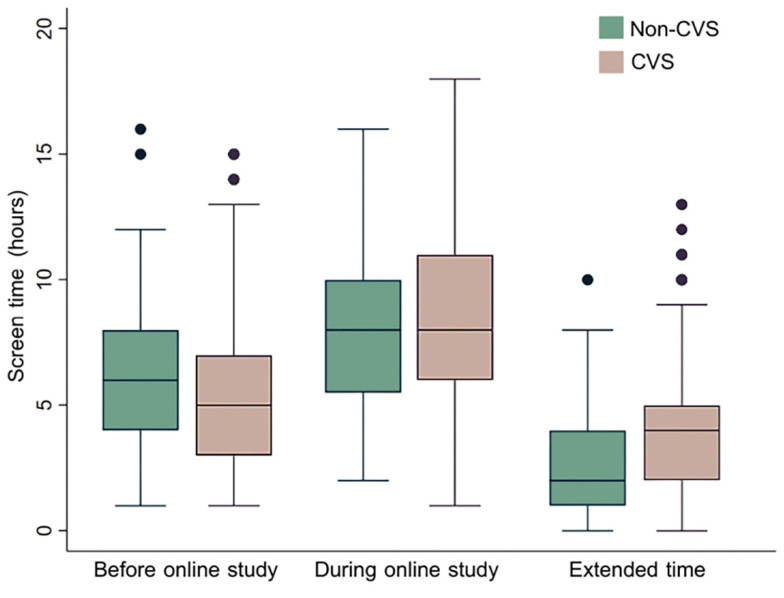
During the COVID-19 pandemic, computer vision syndrome (CVS) related to online classrooms were unavoidable. This cross-sectional study aimed to explore the prevalence, characteristics and associated factors of CVS. A total of 527 students who were currently studying in a virtual classroom (70.40% female, mean (standard deviation; SD) age of 20.04 (2.17) years) were included. The prevalence of CVS assessed by an online CVS-Questionnaire was 81.0% (427/527). Comparing with those in the period before the online study, an increase in screen time (interquartile range) in students with and without CVS was 3 (0−3) and 2 (1−5) h, respectively. Overall, 516 students (97.9%) experienced at least one symptom. The most frequent symptom in CVS subjects was eye pain (96.5%). The most intense symptoms were the feeling of worsening eyesight (15.9%). The factors associated with CVS were female (p < 0.001), age (p = 0.010), atopic diseases (p = 0.020), prior ocular symptoms (p < 0.001), astigmatism (p = 0.033), distance from display <20 cm (p = 0.023), presence of glare or reflection on screen (p < 0.001), low screen brightness (p = 0.045), sleep duration (p = 0.030), inadequate break time between classes (p < 0.001) and increased screen time usage during online study (p < 0.001). Recommendations to prevent CVS based on the adjustable factors might reduce the burden of online study.
在新冠疫情期间,与在线课堂相关的计算机视觉综合征(CVS)难以避免。这项横断面研究旨在探讨CVS的患病率、特征及相关因素。共纳入527名正在虚拟课堂学习的学生(女性占70.40%,平均(标准差;SD)年龄为20.04(2.17)岁)。通过在线CVS问卷评估的CVS患病率为81.0%(427/527)。与在线学习前相比,有CVS和无CVS的学生屏幕使用时间(四分位间距)增加分别为3(0 - 3)小时和2(1 - 5)小时。总体而言,516名学生(97.9%)至少出现一种症状。CVS受试者最常见的症状是眼痛(96.5%)。最严重的症状是视力下降感(15.9%)。与CVS相关的因素有女性(p < 0.001)、年龄(p = 0.010)、特应性疾病(p = 0.020)、既往眼部症状(p < 0.001)、散光(p = 0.033)、显示器距离<20 cm(p = 0.023)、屏幕有眩光或反光(p < 0.001)、屏幕亮度低(p = 0.045)、睡眠时间(p = 0.030)、课间休息时间不足(p < 0.001)以及在线学习期间屏幕使用时间增加(p < 0.001)。基于可调节因素预防CVS的建议可能会减轻在线学习的负担。