Department of Basic Neurosciences, University of Geneva, 1211, Geneva, Switzerland.
Department of Neurology, University Medical Center Heidelberg, Heidelberg, Germany.
Sci Rep. 2022 Apr 11;12(1):6022. doi: 10.1038/s41598-022-09740-6.
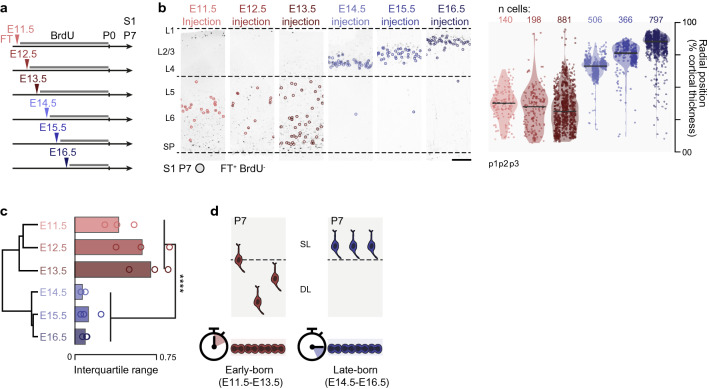
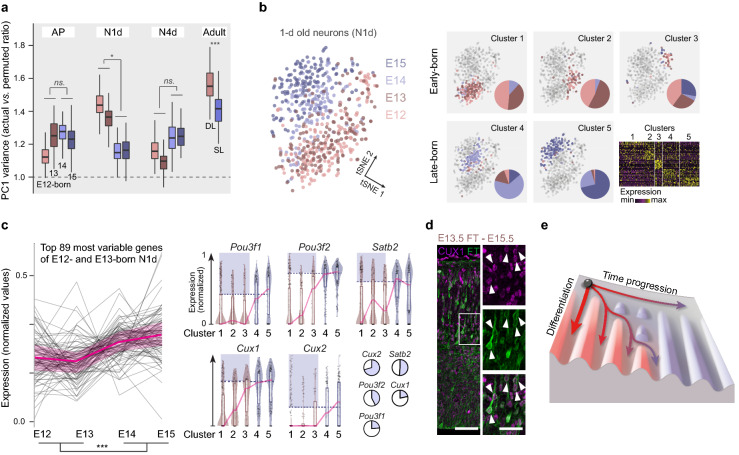
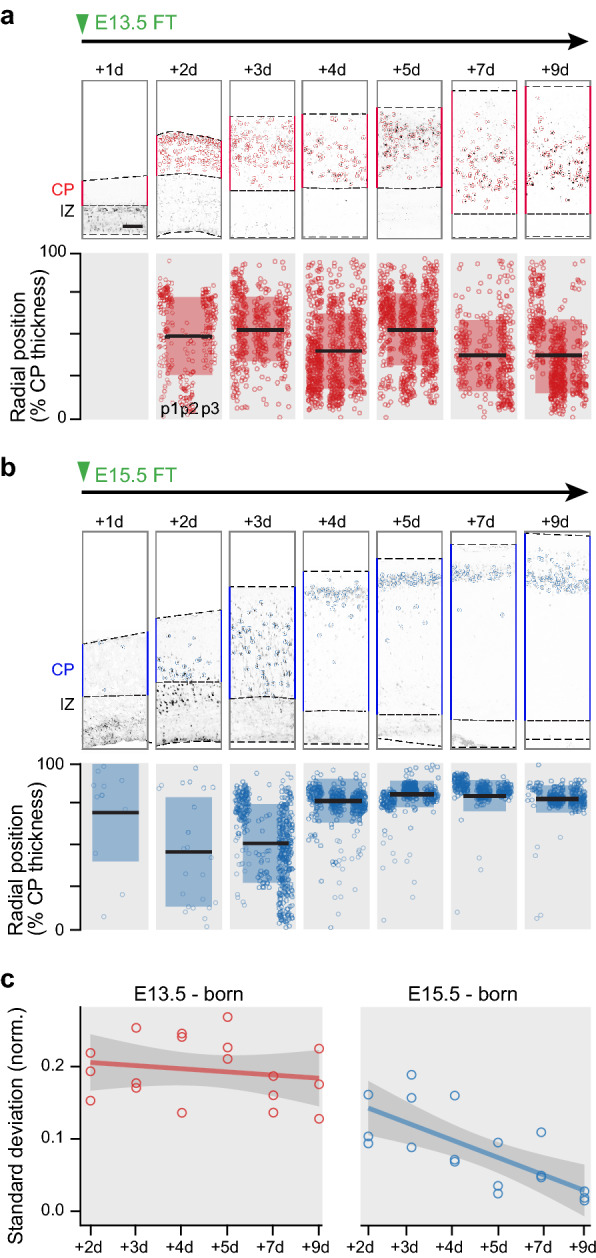
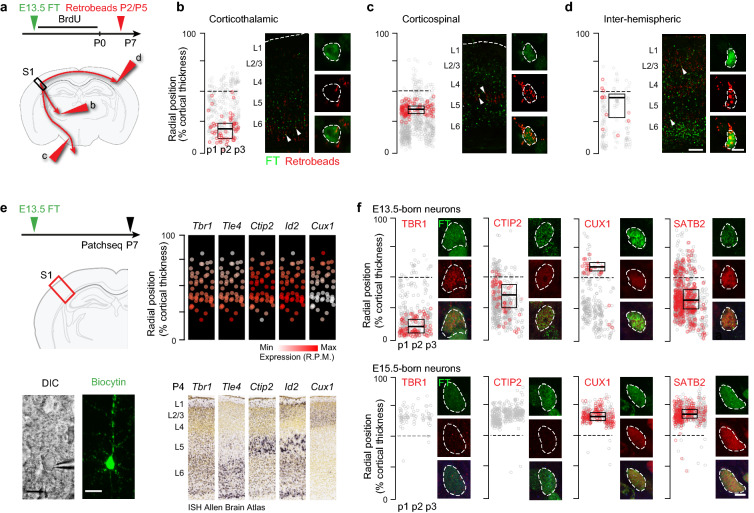
Neocortical excitatory neurons belong to diverse cell types, which can be distinguished by their dates of birth, laminar location, connectivity, and molecular identities. During embryogenesis, apical progenitors (APs) located in the ventricular zone first give birth to deep-layer neurons, and next to superficial-layer neurons. While the overall sequential construction of neocortical layers is well-established, whether APs produce multiple neuron types at single time points of corticogenesis is unknown. To address this question, here we used FlashTag to fate-map simultaneously-born (i.e. isochronic) cohorts of AP daughter neurons at successive stages of corticogenesis. We reveal that early in corticogenesis, isochronic neurons differentiate into heterogeneous laminar, hodological and molecular cell types. Later on, instead, simultaneously-born neurons have more homogeneous fates. Using single-cell gene expression analyses, we identify an early postmitotic surge in the molecular heterogeneity of nascent neurons during which some early-born neurons initiate and partially execute late-born neuron transcriptional programs. Together, these findings suggest that as corticogenesis unfolds, mechanisms allowing increased homogeneity in neuronal output are progressively implemented, resulting in progressively more predictable neuronal identities.
新皮层兴奋性神经元属于不同的细胞类型,可以通过它们的出生日期、层位、连接和分子特征来区分。在胚胎发生过程中,位于脑室区的顶端祖细胞(APs)首先产生深层神经元,然后产生浅层神经元。虽然新皮层层的总体顺序构建已经得到很好的证实,但 APs 是否在皮质发生的单一时间点产生多种神经元类型尚不清楚。为了解决这个问题,我们在这里使用 FlashTag 同时标记皮质发生过程中连续阶段的同时出生(即等时)的 APs 子细胞群体。我们揭示了在皮质发生的早期,等时神经元分化为异质的层、同源性和分子细胞类型。后来,同时出生的神经元具有更同质的命运。通过单细胞基因表达分析,我们发现在新神经元的分子异质性中存在一个早期的有丝分裂后激增期,在此期间,一些早期出生的神经元启动并部分执行晚期出生的神经元转录程序。总之,这些发现表明,随着皮质发生的展开,允许神经元输出更加同质的机制逐渐得到实施,从而导致神经元身份的可预测性逐渐增加。