Zhu Wang-Yong, Guo Jiaxin, Yang Wei-Fa, Tao Zhuo-Ying, Lan Xinmiao, Wang Leilei, Xu Jiankun, Qin Ling, Su Yu-Xiong
Division of Oral and Maxillofacial Surgery, Faculty of Dentistry, The University of Hong Kong, Hong Kong Special Administrative Region.
Musculoskeletal Research Laboratory of Department of Orthopaedics & Traumatology and Innovative Orthopaedic Biomaterial and Drug Translational Research Laboratory, Li Ka Shing Institute of Health, The Chinese University of Hong Kong, Hong Kong Special Administrative Region, China.
J Orthop Translat. 2022 Mar 28;33:153-161. doi: 10.1016/j.jot.2022.03.004. eCollection 2022 Mar.
Medication-related osteonecrosis of the jaw (MRONJ) is a serious complication associated with antiresorptive and antiangiogenic medications, of which impaired angiogenesis is a key pathological alteration. Since Magnesium (Mg)-based implants possess proangiogenic effects, we hypothesized that the biodegradable Mg implant could alleviate the development of MRONJ via enhancing angiogenesis.
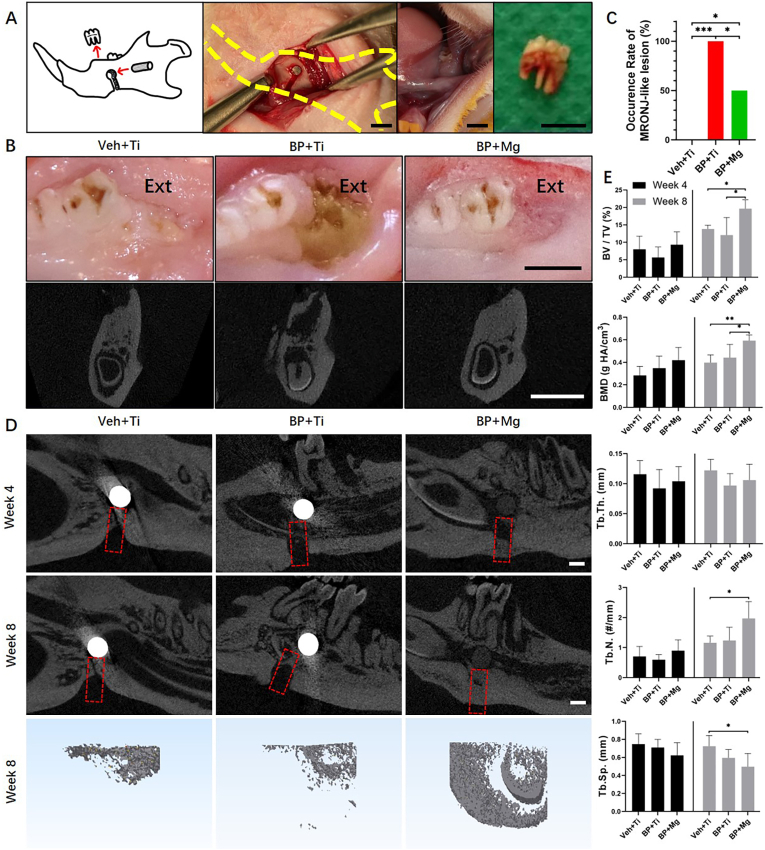
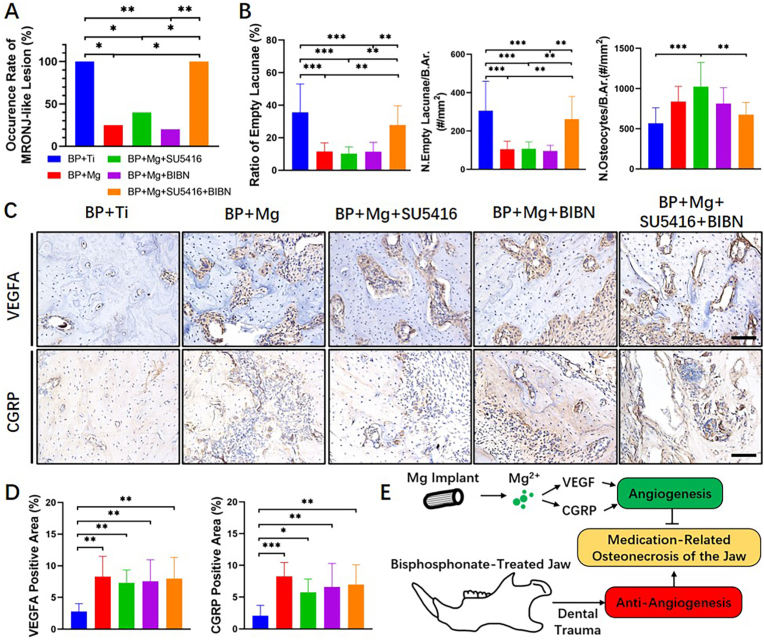
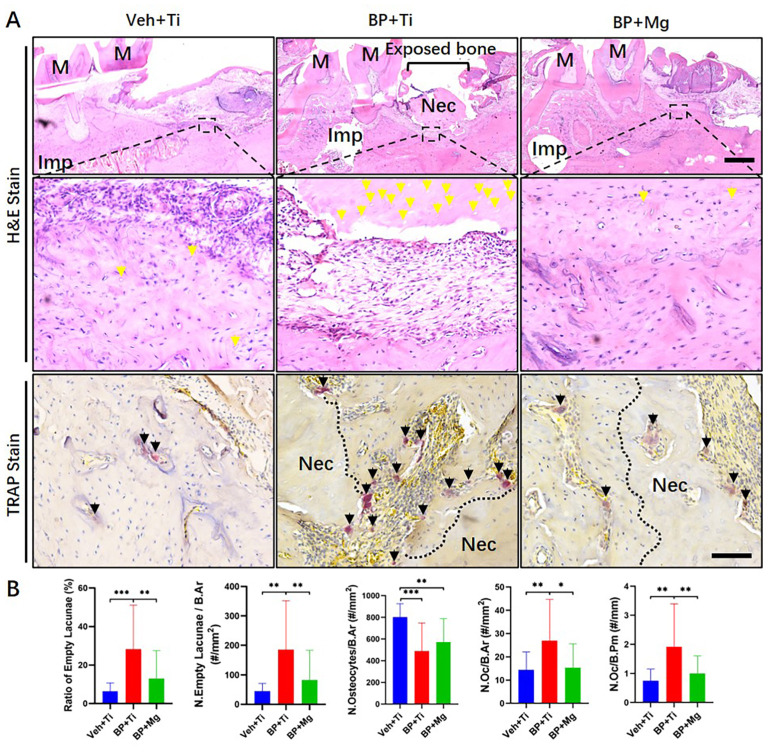
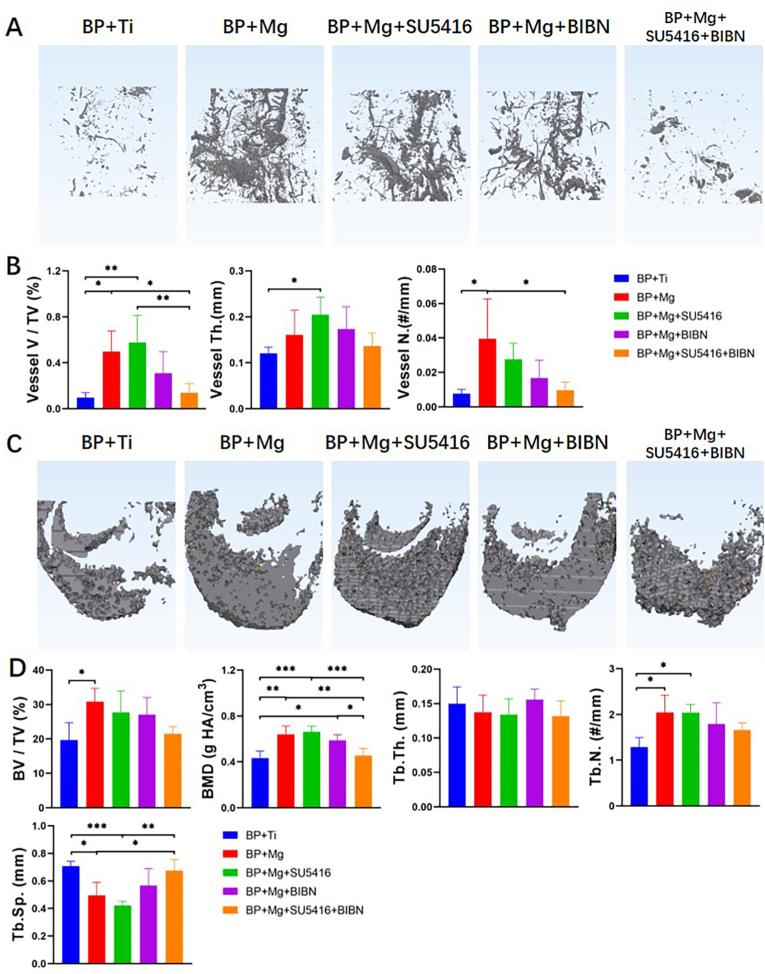
MRONJ model was established and divided into the Veh + Ti group (Vehicle-treated rat, with Titanium (Ti) implant), BP + Ti group (Bisphosphonate (BP)-treated rat, with Ti implant), BP + Mg group (BP-treated rat, with Mg implant), BP + Mg + SU5416 group (BP-treated rat, with Mg implant and vascular endothelial growth factor (VEGF) receptor-2 inhibitor), BP + Mg + BIBN group (BP-treated rat, with Mg implant and calcitonin gene-related peptide (CGRP) receptor antagonist), and BP + Mg + SU5416+BIBN group (BP-treated rat, with Mg implant and VEGF receptor-2 inhibitor and CGRP receptor antagonist). The occurrence of MRONJ, alveolar bone necrosis, new bone formation and vessel formation were assessed by histomorphometry, immunohistochemistry, and micro-CT analysis.
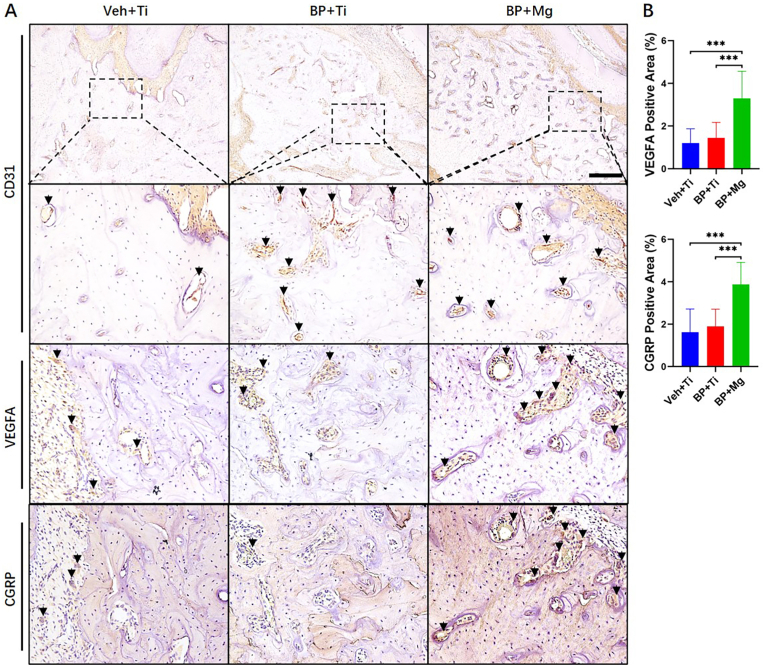
Eight weeks after surgery, the BP + Mg group had significantly reduced occurrence of MRONJ-like lesion and histological osteonecrosis, increased bone microstructural parameters, and increased expressions of VEGFA and CGRP, than the BP + Ti group. By simultaneously blocking VEGF receptor-2 and CGRP receptor, the vessel volume and new bone formation in the BP + Mg group were significantly decreased, meanwhile the occurrence of MRONJ-like lesion and histological bone necrosis were significantly increased.
Biodegradable Mg implant could alleviate the development of MRONJ-like lesion, possibly via upregulating VEGF- and CGRP-mediated angiogenesis. Mg-based implants have the translational potential to be developed as a novel internal fixation device for patients with the risk of MRONJ.
This work reports a biodegradable Mg implant which ameliorates the development of MRONJ-like lesions possibly due to its angiogenic property. Mg-based implants have the potential to be developed as a novel internal fixation device for patients at the risk of MRONJ.
药物相关性颌骨坏死(MRONJ)是一种与抗吸收和抗血管生成药物相关的严重并发症,其中血管生成受损是关键的病理改变。由于镁(Mg)基植入物具有促血管生成作用,我们推测可生物降解的镁植入物可通过促进血管生成来减轻MRONJ的发展。
建立MRONJ模型,并分为Veh + Ti组(生理盐水处理的大鼠,植入钛(Ti)植入物)、BP + Ti组(双膦酸盐(BP)处理的大鼠,植入Ti植入物)、BP + Mg组(BP处理的大鼠,植入Mg植入物)、BP + Mg + SU5416组(BP处理的大鼠,植入Mg植入物和血管内皮生长因子(VEGF)受体-2抑制剂)、BP + Mg + BIBN组(BP处理的大鼠,植入Mg植入物和降钙素基因相关肽(CGRP)受体拮抗剂)以及BP + Mg + SU5416+BIBN组(BP处理的大鼠,植入Mg植入物以及VEGF受体-2抑制剂和CGRP受体拮抗剂)。通过组织形态计量学、免疫组织化学和微型计算机断层扫描(micro-CT)分析评估MRONJ的发生情况、牙槽骨坏死、新骨形成和血管形成。
术后8周,与BP + Ti组相比,BP + Mg组MRONJ样病变和组织学骨坏死的发生率显著降低,骨微结构参数增加,VEGFA和CGRP的表达增加。通过同时阻断VEGF受体-2和CGRP受体,BP + Mg组的血管体积和新骨形成显著减少,同时MRONJ样病变和组织学骨坏死的发生率显著增加。
可生物降解的镁植入物可能通过上调VEGF和CGRP介导的血管生成来减轻MRONJ样病变的发展。镁基植入物有潜力被开发成为一种针对有MRONJ风险患者的新型内固定装置。
本研究报道了一种可生物降解的镁植入物,其可能因其血管生成特性改善了MRONJ样病变的发展。镁基植入物有潜力被开发成为一种针对有MRONJ风险患者的新型内固定装置。