
钙黏蛋白-3(Calsyntenin-3)的缺失会抑制小脑的抑制性突触,但会增加兴奋性平行纤维突触。
Deletion of Calsyntenin-3, an atypical cadherin, suppresses inhibitory synapses but increases excitatory parallel-fiber synapses in cerebellum.
机构信息
Department of Molecular and Cellular Physiology, Stanford University, Stanford, United States.
Howard Hughes Medical Institute, Stanford University, Stanford, United States.
出版信息
Elife. 2022 Apr 14;11:e70664. doi: 10.7554/eLife.70664.
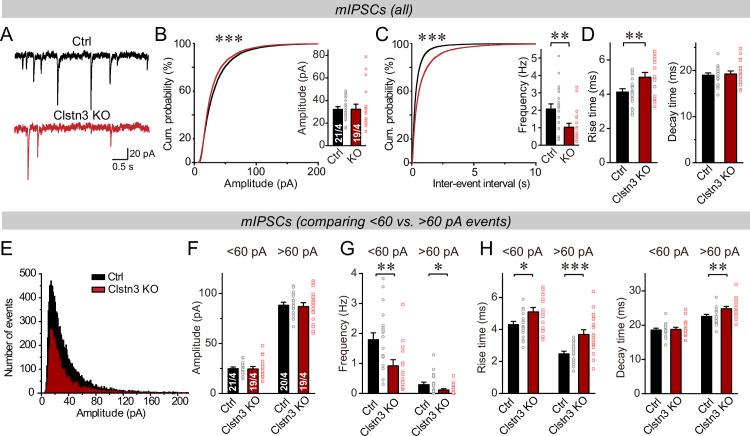
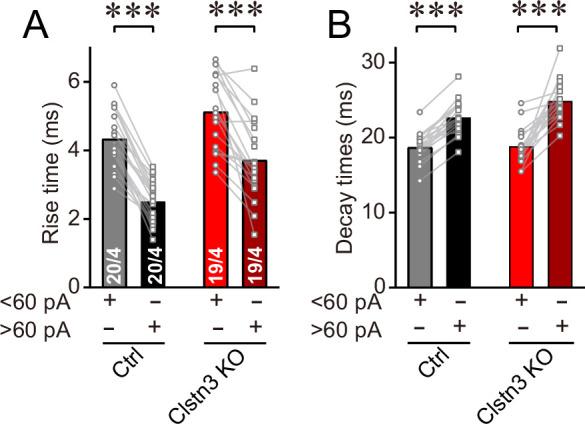
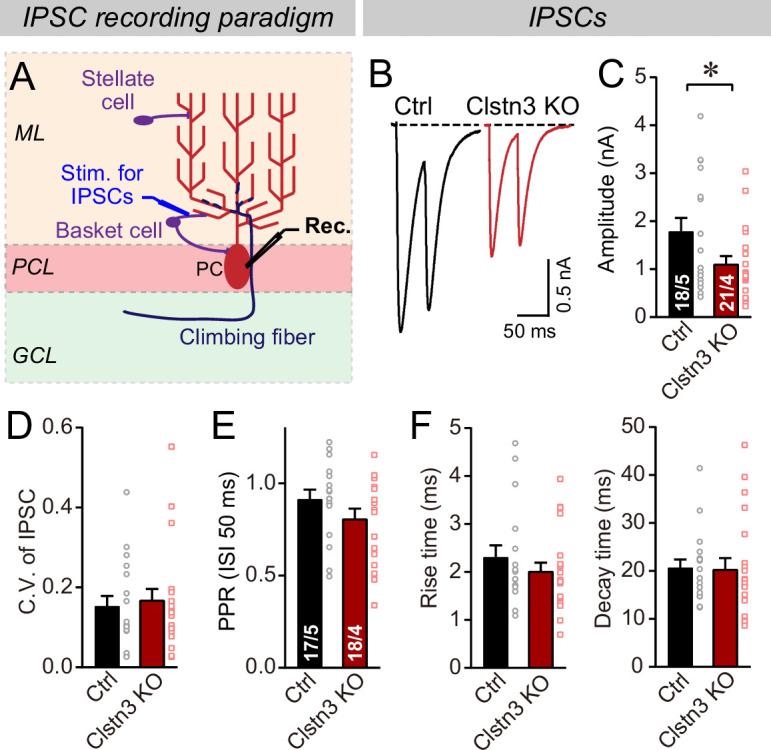
Cadherins contribute to the organization of nearly all tissues, but the functions of several evolutionarily conserved cadherins, including those of calsyntenins, remain enigmatic. Puzzlingly, two distinct, non-overlapping functions for calsyntenins were proposed: As postsynaptic neurexin ligands in synapse formation, or as presynaptic kinesin adaptors in vesicular transport. Here, we show that, surprisingly, acute CRISPR-mediated deletion of calsyntenin-3 in mouse cerebellum in vivo causes a large decrease in inhibitory synapse, but a robust increase in excitatory parallel-fiber synapses in Purkinje cells. As a result, inhibitory synaptic transmission was suppressed, whereas parallel-fiber synaptic transmission was enhanced in Purkinje cells by the calsyntenin-3 deletion. No changes in the dendritic architecture of Purkinje cells or in climbing-fiber synapses were detected. Sparse selective deletion of calsyntenin-3 only in Purkinje cells recapitulated the synaptic phenotype, indicating that calsyntenin-3 acts by a cell-autonomous postsynaptic mechanism in cerebellum. Thus, by inhibiting formation of excitatory parallel-fiber synapses and promoting formation of inhibitory synapses in the same neuron, calsyntenin-3 functions as a postsynaptic adhesion molecule that regulates the excitatory/inhibitory balance in Purkinje cells.
钙黏蛋白有助于组织的构建,但包括钙黏蛋白结合蛋白在内的几种进化保守的钙黏蛋白的功能仍然是个谜。令人费解的是,钙黏蛋白结合蛋白提出了两种截然不同、不重叠的功能:作为突触形成中的突触后神经连接素配体,或作为囊泡运输中的突触前驱动蛋白适配器。在这里,我们惊讶地发现,体内急性 CRISPR 介导的钙黏蛋白结合蛋白-3 在小鼠小脑中的缺失导致抑制性突触大量减少,而浦肯野细胞中的兴奋性平行纤维突触显著增加。结果,抑制性突触传递被抑制,而平行纤维突触传递在浦肯野细胞中被钙黏蛋白结合蛋白-3 的缺失增强。未检测到浦肯野细胞树突结构或攀爬纤维突触的变化。浦肯野细胞中稀疏选择性地删除钙黏蛋白结合蛋白-3 重现了突触表型,表明钙黏蛋白结合蛋白-3 通过小脑中的细胞自主突触后机制发挥作用。因此,钙黏蛋白结合蛋白-3 通过抑制同一神经元中兴奋性平行纤维突触的形成和促进抑制性突触的形成,作为一种调节浦肯野细胞中兴奋性/抑制性平衡的突触后粘附分子发挥作用。





 Zotero 插件