Ballester Belen R, Winstein Carolee, Schweighofer Nicolas
Synthetic, Perceptive, Emotive and Cognitive Systems Laboratory, Institute for Bioengineering in Catalonia, Barcelona, Spain.
Division of Biokinesiology and Physical Therapy, University of Southern California, Los Angeles, CA, United States.
Front Neurol. 2022 Mar 29;13:804211. doi: 10.3389/fneur.2022.804211. eCollection 2022.
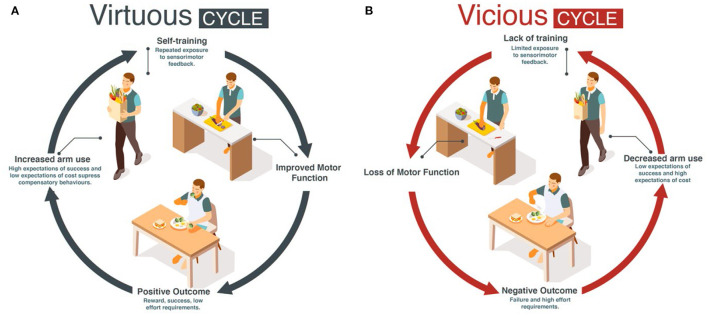
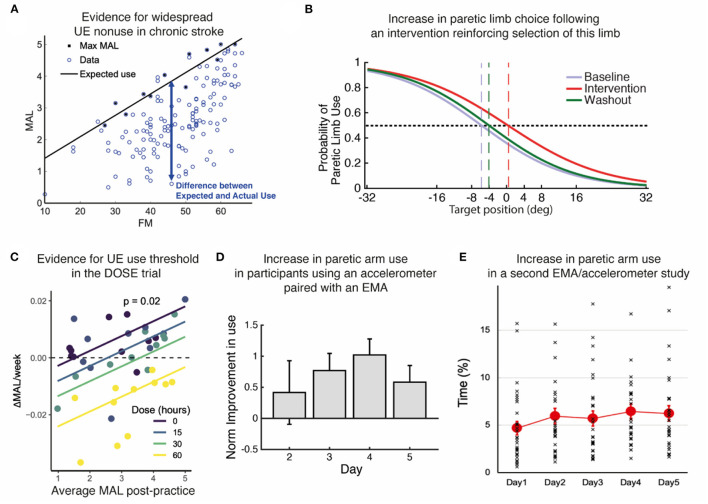
Large doses of movement practice have been shown to restore upper extremities' motor function in a significant subset of individuals post-stroke. However, such large doses are both difficult to implement in the clinic and highly inefficient. In addition, an important reduction in upper extremity function and use is commonly seen following rehabilitation-induced gains, resulting in "rehabilitation in vain". For those with mild to moderate sensorimotor impairment, the limited spontaneous use of the more affected limb during activities of daily living has been previously proposed to cause a decline of motor function, initiating a vicious cycle of recovery, in which non-use and poor performance reinforce each other. Here, we review computational, experimental, and clinical studies that support the view that if arm use is raised above an effective threshold, one enters a virtuous cycle in which arm use and function can reinforce each other via self-practice in the wild. If not, one enters a vicious cycle of declining arm use and function. In turn, and in line with best practice therapy recommendations, this virtuous/vicious cycle model advocates for a paradigm shift in neurorehabilitation whereby rehabilitation be embedded in activities of daily living such that self-practice with the aid of wearable technology that reminds and motivates can enhance paretic limb use of those who possess adequate residual sensorimotor capacity. Altogether, this model points to a user-centered approach to recovery post-stroke that is tailored to the participant's level of arm use and designed to motivate and engage in self-practice through progressive success in accomplishing meaningful activities in the wild.
大剂量的运动练习已被证明能在相当一部分中风后的个体中恢复上肢运动功能。然而,如此大的剂量在临床中既难以实施,效率又极低。此外,在康复取得进展后,上肢功能和使用情况通常会出现显著下降,导致“康复徒劳”。对于那些有轻度至中度感觉运动障碍的患者,此前有观点认为,在日常生活活动中受影响更严重的肢体自发使用受限会导致运动功能下降,从而引发恢复的恶性循环,即不使用和表现不佳相互强化。在此,我们回顾了计算、实验和临床研究,这些研究支持以下观点:如果手臂的使用量提高到有效阈值以上,个体就会进入一个良性循环,即手臂的使用和功能可以通过在自然环境中的自我练习相互强化。如果没有达到该阈值,个体就会进入手臂使用和功能下降的恶性循环。相应地,与最佳实践治疗建议一致,这种良性/恶性循环模型主张神经康复模式的转变,即将康复融入日常生活活动中,这样借助可提醒和激励的可穿戴技术进行自我练习,可以增加那些具有足够残余感觉运动能力的患者对瘫痪肢体的使用。总之,该模型指出了一种以用户为中心的中风后恢复方法,该方法根据参与者的手臂使用水平进行调整,旨在通过在自然环境中成功完成有意义的活动来激励并促使其进行自我练习。