Ali Arif, Banerjee Somesh, Kamaal Saima, Usman Mohammad, Das Neeladrisingha, Afzal Mohd, Alarifi Abdullah, Sepay Nayim, Roy Partha, Ahmad Musheer
Department of Applied Chemistry, ZHCET, Faculty of Engineering and Technology, Aligarh Muslim University Aligarh-202002 India
Molecular Endocrinology Laboratory, Department of Biotechnology, Indian Institute of Technology Roorkee Roorkee Uttarakhand-247667 India.
RSC Adv. 2021 Apr 16;11(24):14362-14373. doi: 10.1039/d1ra00172h. eCollection 2021 Apr 15.
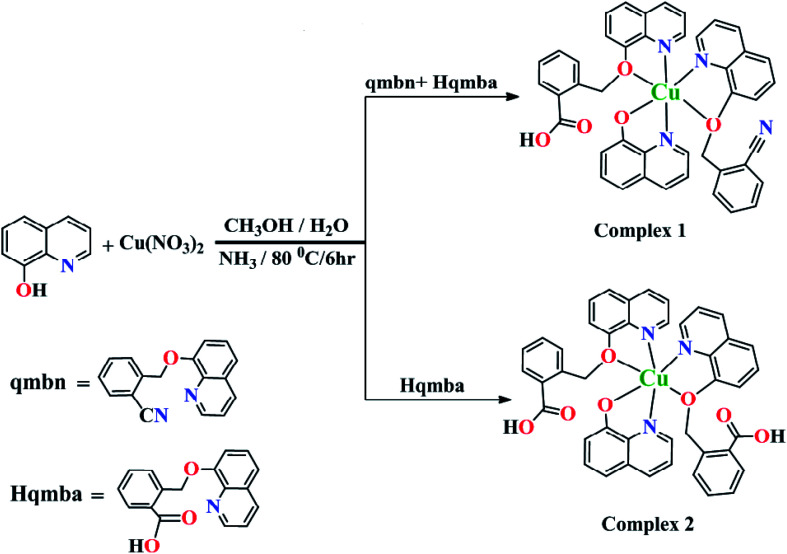
In this study, we have examined the effect of ligand substituent on the structure-cytotoxicity relationships of the MCF-7 cancer cell line (human breast cancer), by two copper(ii) complexes {[Cu(qmbn)(Hqmba)(q)]·NO·2HO} (1) and {[Cu(Hqmba)(q)]·NO·2HO} (2) (where, qmbn = 2-(quinolin-8-yloxy)(methyl) benzonitrile (L1); Hqmba = 2-((quinolin-8-yloxy)methyl)benzoic acid (L2) and q = quinolin-8-olate). The structural analysis reveals that both the complexes exhibit distorted octahedral (CuNO) configuration which is further corroborated by density functional theory (DFT) calculations. The cytotoxicity impact of ligands (L1 and L2) and complexes (1 and 2) was screened against the MCF-7 cell line (human breast cancer). The MTT assay uptake indicated that the presence of -COOH functionality in complex 2 leads to higher cytotoxicity (lower IC) than that observed for complex 1 containing a -CN group. This could be due to the strong H-bonding forming propensity of the carboxylic acids. Incubation of MCF-7 cancer cells with IC concentrations of 1 and 2 promoted cellular detachments nuclear condensation and membrane destabilization followed by apoptosis as a result of metal-assisted generation of reactive oxygen species. Flow cytometry analysis showed that 1 and 2 might prompt early apoptosis in MCF-7 cells as the maximum percentage of cells appeared in the LR quadrant. Furthermore, mRNA expression analysis confirmed that both the complexes induced apoptosis in MCF-7 cells. Comparative mRNA expression analysis of complexes with their respective ligands also confirmed the enhanced apoptotic behavior of complexes. Furthermore, molecular docking studies of the complexes have also been performed with the active site of EGFR kinase receptors (major target for any cancer causing agent) due to similar analogues with FDA-approved EGFR inhibitors in order to rationalize its promising cytotoxicity activity.
在本研究中,我们通过两种铜(II)配合物{[Cu(qmbn)(Hqmba)(q)]·NO·2H₂O}(1)和{[Cu(Hqmba)(q)]·NO·2H₂O}(2)(其中,qmbn = 2-(喹啉-8-氧基)(甲基)苯甲腈(L1);Hqmba = 2-((喹啉-8-氧基)甲基)苯甲酸(L2)且q = 喹啉-8-醇盐)研究了配体取代基对MCF-7癌细胞系(人乳腺癌)结构-细胞毒性关系的影响。结构分析表明,这两种配合物均呈现扭曲的八面体(CuNO)构型,密度泛函理论(DFT)计算进一步证实了这一点。针对MCF-7细胞系(人乳腺癌)筛选了配体(L1和L2)及配合物(1和2)的细胞毒性影响。MTT法摄取表明,配合物2中-COOH官能团的存在导致其细胞毒性(更低的IC₅₀)高于含有-CN基团的配合物1。这可能是由于羧酸形成强氢键的倾向。用IC₅₀浓度的1和2孵育MCF-7癌细胞会促进细胞脱离、核浓缩和膜不稳定,随后由于金属辅助产生活性氧而导致细胞凋亡。流式细胞术分析表明,1和2可能促使MCF-7细胞早期凋亡,因为最大比例的细胞出现在LR象限。此外,mRNA表达分析证实这两种配合物均诱导MCF-7细胞凋亡。配合物与其各自配体的比较mRNA表达分析也证实了配合物增强的凋亡行为。此外,由于与FDA批准的EGFR抑制剂有相似类似物,还对配合物与EGFR激酶受体的活性位点(任何致癌剂的主要靶点)进行了分子对接研究,以阐明其有前景的细胞毒性活性的合理性。