Popova Marina, Borowski Tomasz, Elsberg Josiah G D, Dederich C Taylor, Berreau Lisa M
Department of Chemistry and Biochemistry, Utah State University 0300 Old Main Hill Logan UT 84322-0300 USA
Jerzy Haber Institute of Catalysis and Surface Chemistry, Polish Academy of Science Niezapominajek 8 Krakow 30-239 Poland.
RSC Adv. 2022 Jan 20;12(5):2751-2758. doi: 10.1039/d1ra07527f. eCollection 2022 Jan 18.
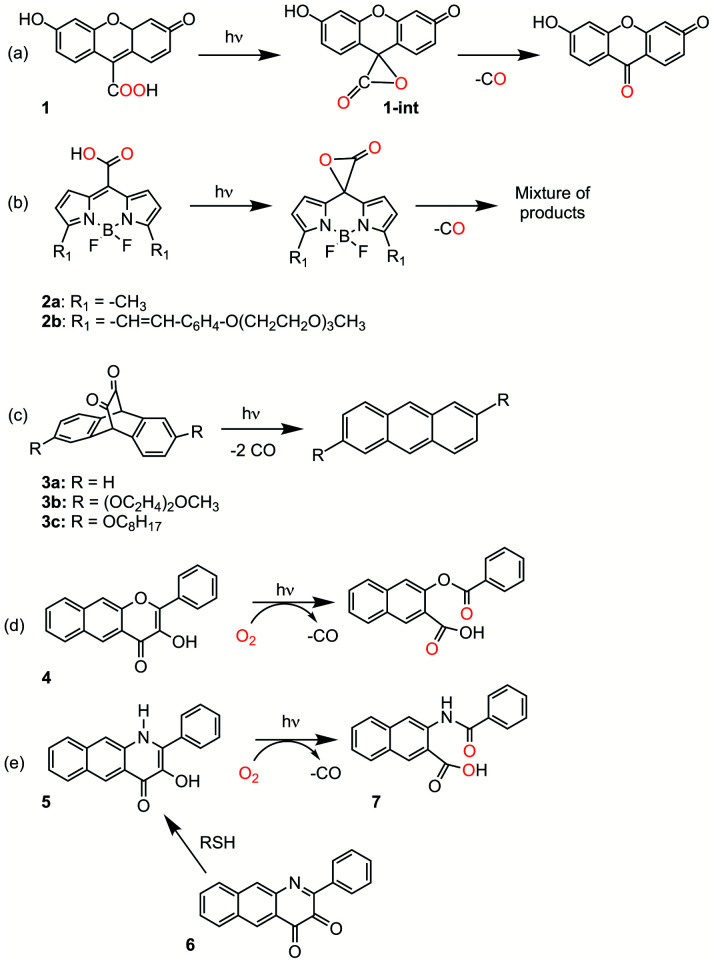
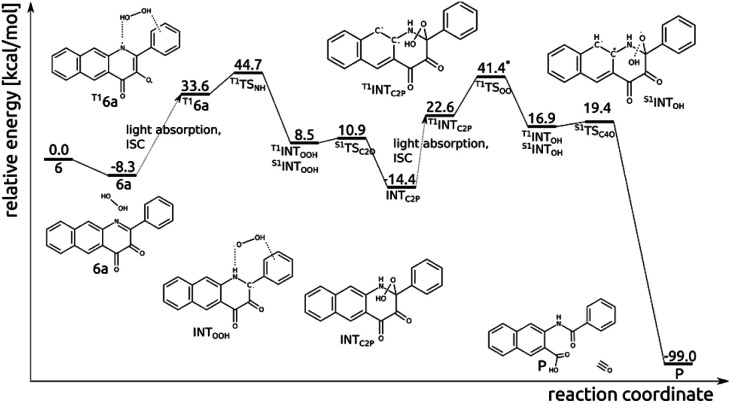
Organic compounds that can be triggered using light to release CO in biological environments are of significant current interest to probe the role of CO in biology and as potential therapeutics. We recently reported that a 3-hydroxybenzo[]quinolone (5) can be used as a CO delivery molecule to produce anticancer and potent anti-inflammatory effects. Herein we report mechanistic studies of the visible light-induced CO release reaction of this compound. In wet CHCN under aerobic conditions, 5 releases 0.90(2) equivalents of CO upon illumination with visible light (419 nm) to give a single depside product. Performing the same reaction under an O atmosphere results in quantitative incorporation of two labeled oxygen atoms in the depside product. Monitoring H NMR and UV-vis during the illumination of 5 in CHCN using 419 nm light revealed the substoichiometric formation of a diketone (6) in the reaction mixture. HO formation was detected in the same reaction mixtures. DFT studies indicate that upon light absorption an efficient pathway exists for the formation of a triplet excited state species (5b) that can undergo reaction with O resulting in CO release. DFT investigations also provide insight into diketone (6) and HO formation and subsequent reactivity. The presence of water and exposure to visible light play an important role in lowering activation barriers in the reaction between 6 and HO to give CO. Overall, two reaction pathways have been identified for CO release from a 3-hydroxybenzo[]quinolone.
能够通过光照在生物环境中释放一氧化碳的有机化合物,目前对于探究一氧化碳在生物学中的作用以及作为潜在治疗药物具有重大意义。我们最近报道了一种3-羟基苯并[]喹诺酮(5)可作为一氧化碳供体分子,产生抗癌和强效抗炎作用。在此,我们报道了该化合物可见光诱导的一氧化碳释放反应的机理研究。在有氧条件下的湿乙腈中,5在可见光(419 nm)照射下释放出0.90(2)当量的一氧化碳,生成单一的缩酚酸酯产物。在氧气气氛下进行相同反应,会使缩酚酸酯产物中定量掺入两个标记的氧原子。在乙腈中用419 nm光照射5的过程中监测核磁共振氢谱和紫外可见光谱,发现在反应混合物中以亚化学计量形成了一种二酮(6)。在相同反应混合物中检测到了羟基自由基的形成。密度泛函理论研究表明,光吸收后存在一条有效的途径来形成三重态激发态物种(5b),该物种可与氧气反应导致一氧化碳释放。密度泛函理论研究还深入了解了二酮(6)和羟基自由基的形成以及后续反应活性。水的存在和可见光照射在降低6与羟基自由基反应生成一氧化碳的活化能垒方面起着重要作用。总体而言,已确定了从3-羟基苯并[]喹诺酮释放一氧化碳的两条反应途径。