Guo Xuying, Hu Zhiyong, Dong Yanrong, Fu Saiou, Li Ying
College of Mining, Liaoning Technical University Fuxin 123000 Liaoning China.
College of Science, Liaoning Technical University Fuxin 123000 Liaoning China.
RSC Adv. 2022 Feb 5;12(8):4595-4604. doi: 10.1039/d1ra08709f. eCollection 2022 Feb 3.
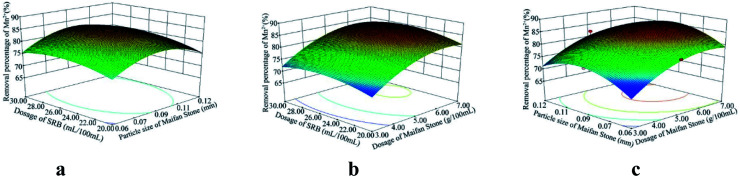
The problems of acid mine drainage (AMD) in coal mine acidic wastewaters arise from a range of sources, including severe pollution with heavy metals and SO and difficulties during treatment. Based on the ability of Maifan stone to adsorb heavy metals and the dissimilatory reduction of SO by sulfate-reducing bacteria (SRB), Maifan stone-sulfate-reducing bacterium-immobilized particles were prepared immobilization techniques using Shandong Maifan stone as the experimental material. A single factor experiment was used to investigate the influences of the dosage of Maifan stone, the particle size of Maifan stone and the dosage of SRB on the pH improvement effect and the removal rates of SO , Fe and Mn. The Box-Behnken response surface method was used to determine the optimal preparation conditions for the Maifan stone and SRB immobilized particles in accordance with the ion removal rate and pH improvement effect when dealing with AMD. The results show that: (1) the optimal preparation conditions for Maifan stone synergistic SRB immobilized particles are determined by single factor experiment: the dosage of Maifan stone is 5 g, the particle size of Maifan stone is 0.075-0.106 mm, and the dosage of SRB is 25 mL per 100 mL; the removal rates of SO , Fe and Mn from AMD by the Maifan stone and SRB immobilized particles prepared under these conditions were 92.22%, 95.41% and 86.05%, and the pH was increased from 4.08 to 7.45. (2) From the variance analysis of the response surface model, it can be seen that the model effectively predicts the SO removal rate, Fe removal rate, Mn removal rate and pH change. (3) After further optimization using the response surface method, the optimal preparation conditions of Maifan stone and SRB immobilized particles are determined as follows: Maifan stone dosage is 5 g, Maifan stone particle size is 0.075-0.106 mm, and SRB dosage is 25 mL per 100 mL. Through experiments, the removal rates of SO , Fe and Mn from AMD by the Maifan stone and SRB immobilized particles prepared under these conditions were 92.12%, 95.93% and 87.14%, respectively, and the pH was increased from 4.08 to 7.49.
煤矿酸性废水中的酸性矿山排水(AMD)问题源于多种来源,包括重金属和SO的严重污染以及处理过程中的困难。基于麦饭石吸附重金属的能力以及硫酸盐还原菌(SRB)对SO的异化还原作用,以山东麦饭石为实验材料,采用固定化技术制备了麦饭石-硫酸盐还原菌固定化颗粒。采用单因素实验研究了麦饭石用量、麦饭石粒径和SRB用量对pH改善效果以及SO、Fe和Mn去除率的影响。利用Box-Behnken响应面法,根据处理AMD时的离子去除率和pH改善效果,确定了麦饭石和SRB固定化颗粒的最佳制备条件。结果表明:(1)通过单因素实验确定了麦饭石协同SRB固定化颗粒的最佳制备条件:麦饭石用量为5 g,麦饭石粒径为0.075 - 0.106 mm,SRB用量为每100 mL 25 mL;在此条件下制备的麦饭石和SRB固定化颗粒对AMD中SO、Fe和Mn的去除率分别为92.22%、95.41%和86.05%,pH从4.08升高到7.45。(2)从响应面模型的方差分析可以看出,该模型有效地预测了SO去除率、Fe去除率、Mn去除率和pH变化。(3)利用响应面法进一步优化后,确定麦饭石和SRB固定化颗粒的最佳制备条件如下:麦饭石用量为5 g,麦饭石粒径为0.075 - 0.106 mm,SRB用量为每100 mL 25 mL。通过实验,在此条件下制备的麦饭石和SRB固定化颗粒对AMD中SO、Fe和Mn的去除率分别为92.12%、95.93%和87.14%,pH从4.08升高到7.49。