Institute for Regenerative Medicine, Shanghai East Hospital, Shanghai Key Laboratory of Signaling and Disease Research, Frontier Science Center for Stem Cell Research, School of Life Sciences and Technology, Tongji University, Shanghai, China.
Department of Urology, Tongji Hospital, Frontier Science Center for Stem Cells, School of Life Science and Technology, Tongji University, Shanghai, China.
Cell Res. 2022 Sep;32(9):801-813. doi: 10.1038/s41422-022-00652-8. Epub 2022 Apr 15.
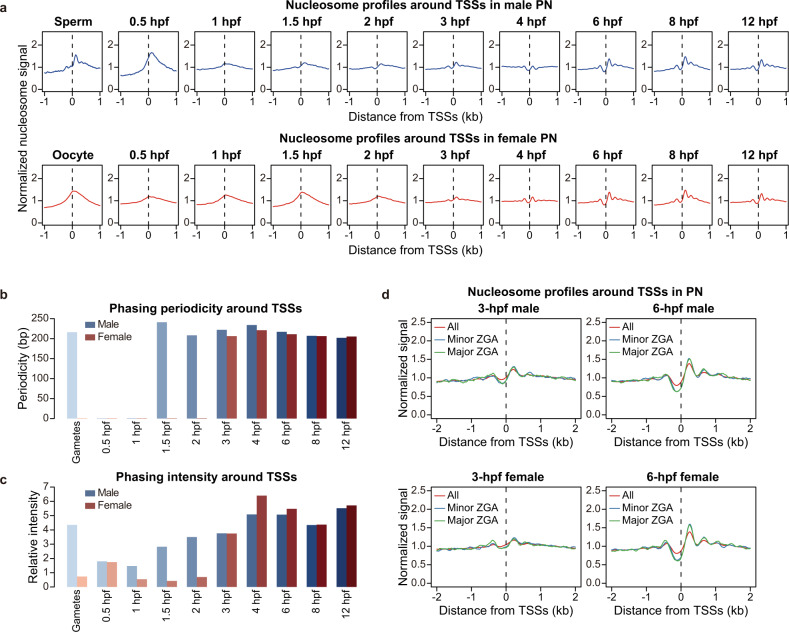
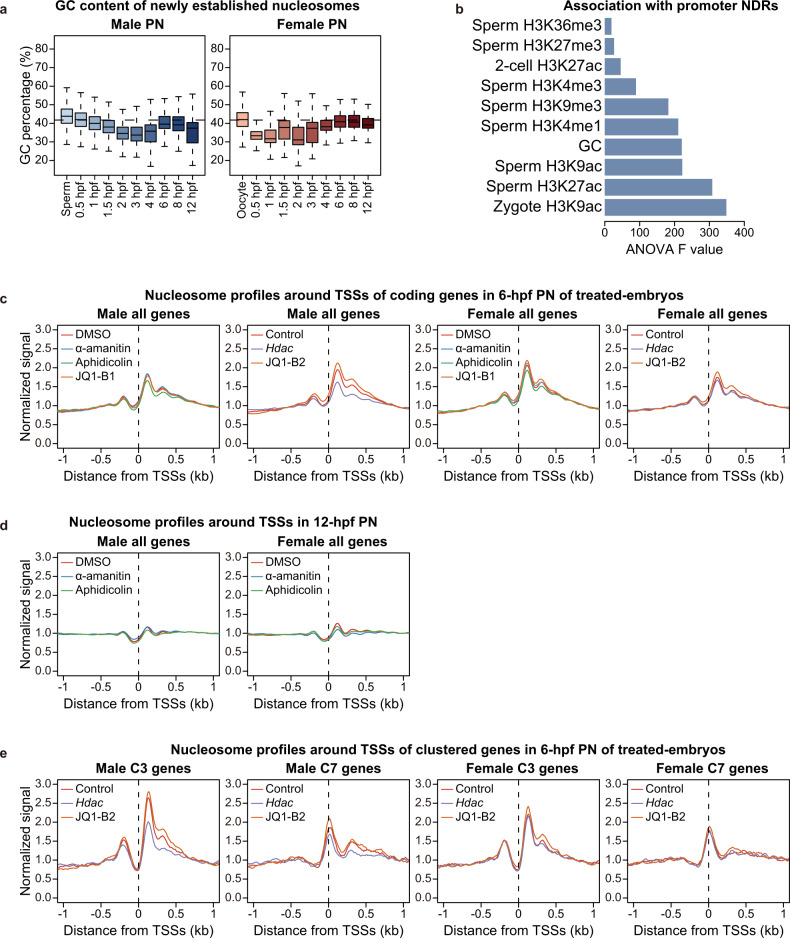
Chromatin remodeling is essential for epigenome reprogramming after fertilization. However, the underlying mechanisms of chromatin remodeling remain to be explored. Here, we investigated the dynamic changes in nucleosome occupancy and positioning in pronucleus-stage zygotes using ultra low-input MNase-seq. We observed distinct features of inheritance and reconstruction of nucleosome positioning in both paternal and maternal genomes. Genome-wide de novo nucleosome occupancy in the paternal genome was observed as early as 1 h after the injection of sperm into ooplasm. The nucleosome positioning pattern was continually rebuilt to form nucleosome-depleted regions (NDRs) at promoters and transcription factor (TF) binding sites with differential dynamics in paternal and maternal genomes. NDRs formed more quickly on the promoters of genes involved in zygotic genome activation (ZGA), and this formation is closely linked to histone acetylation, but not transcription elongation or DNA replication. Importantly, we found that NDR establishment on the binding motifs of specific TFs might be associated with their potential pioneer functions in ZGA. Further investigations suggested that the predicted factors MLX and RFX1 played important roles in regulating minor and major ZGA, respectively. Our data not only elucidate the nucleosome positioning dynamics in both male and female pronuclei following fertilization, but also provide an efficient method for identifying key transcription regulators during development.
染色质重塑对于受精后表观基因组重编程至关重要。然而,染色质重塑的潜在机制仍有待探索。在这里,我们使用超低输入 MNase-seq 研究了原核期胚胎中核小体占据和定位的动态变化。我们观察到父本和母本基因组中核小体定位的继承和重建具有明显的特征。在精子注入卵母细胞后 1 小时,就观察到父本基因组中全基因组新生核小体的占据。核小体定位模式不断重建,在启动子和转录因子(TF)结合位点形成核小体缺失区域(NDR),在父本和母本基因组中具有不同的动力学。参与合子基因组激活(ZGA)的基因启动子上的 NDR 更快形成,这种形成与组蛋白乙酰化密切相关,但与转录延伸或 DNA 复制无关。重要的是,我们发现特定 TF 的结合基序上的 NDR 建立可能与其在 ZGA 中的潜在先驱功能有关。进一步的研究表明,预测因子 MLX 和 RFX1 分别在调节次要和主要 ZGA 中发挥重要作用。我们的数据不仅阐明了受精后雄性和雌性原核中核小体定位的动力学,还提供了一种在发育过程中识别关键转录调节剂的有效方法。