University Hospital Center Zagreb, Department of Neurology, Referral Center for Autonomic Nervous System Disorders, Zagreb, Croatia; School of Medicine, University of Zagreb, Zagreb, Croatia.
School of Medicine, University of Zagreb, Zagreb, Croatia.
Mult Scler Relat Disord. 2022 Jun;62:103798. doi: 10.1016/j.msard.2022.103798. Epub 2022 Apr 10.
To determine the influence of immunoglobulins (Ig) level on the rate of infections in people with multiple sclerosis (pwMS) treated with ocrelizumab.
We enrolled 109 consecutive pwMS treated with ocrelizumab with a mean follow-up of 2.69±0.56 (1.36-4.27) years. We have retrospectively searched our electronic database and the following information was collected: age, sex, MS characteristics, number of ocrelizumab cycles, infections, duration of the infection, hospitalization due to infection, treatment of the infection, and COVID-19 characteristics. Ig levels were measured within 14 days before each ocrelizumab infusion.
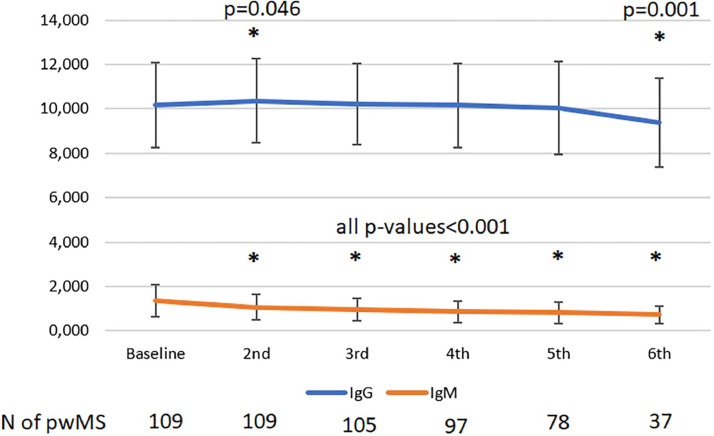
Number of pwMS with values of IgM and IgG below lower level of normal at baseline was 3 (2.8%) and 2 (2.8%), respectively; and before 6 cycle of ocrelizumab 5 (13.5%) and 5 (13.5%), respectively. Levels of IgM were steadily decreasing over time, while levels of IgG started to show statistically significant drop only after 5 cycle of ocrelizumab. 58.7% pwMS experienced infection during treatment, with a median number of infections per pwMS being 1, range 0-4. Female sex increased the risk of any infection (HR 2.561, 95%CI 1.382-4.774, p=0.003). Higher age and smaller drop in IgM before 3 ocrelizumab cycle increased the risk for infection requiring hospitalization (HR 1.086, 95%CI 1.018-1.159, p=0.013 and HR 9.216, 95%CI 1.124-75.558, p=0.039, respectively). Longer disease duration increased the risk for COVID-19 (HR 1.075, 95%CI 1.002-1.154, p=0.045).
The present findings broaden limited real-world data on infection and COVID-19 risk in pwMS treated with ocrelizumab.
确定免疫球蛋白 (Ig) 水平对接受奥瑞珠单抗治疗的多发性硬化症 (pwMS) 患者感染率的影响。
我们纳入了 109 例连续接受奥瑞珠单抗治疗的 pwMS,平均随访 2.69±0.56(1.36-4.27)年。我们回顾性地搜索了我们的电子数据库,并收集了以下信息:年龄、性别、MS 特征、奥瑞珠单抗周期数、感染、感染持续时间、因感染住院、感染治疗和 COVID-19 特征。在每次奥瑞珠单抗输注前 14 天内测量 Ig 水平。
基线时 IgM 和 IgG 值低于正常值下限的 pwMS 分别为 3(2.8%)和 2(2.8%);在接受奥瑞珠单抗治疗前 6 个周期时,分别为 5(13.5%)和 5(13.5%)。IgM 水平随时间逐渐下降,而 IgG 水平仅在接受奥瑞珠单抗治疗 5 个周期后才开始出现统计学显著下降。58.7%的 pwMS 在治疗期间发生感染,每位 pwMS 的中位数感染数为 1 次,范围为 0-4 次。女性增加了任何感染的风险(HR 2.561,95%CI 1.382-4.774,p=0.003)。年龄较大和前 3 个奥瑞珠单抗周期 IgM 下降幅度较小,增加了感染需要住院治疗的风险(HR 1.086,95%CI 1.018-1.159,p=0.013 和 HR 9.216,95%CI 1.124-75.558,p=0.039,分别)。疾病持续时间较长增加了 COVID-19 的风险(HR 1.075,95%CI 1.002-1.154,p=0.045)。
本研究结果扩展了接受奥瑞珠单抗治疗的 pwMS 感染和 COVID-19 风险的有限真实世界数据。