Institute for Modelling and Simulation of Biomechanical Systems, Stuttgart Center for Simulation Science, University of Stuttgart, Stuttgart, Germany.
Biomed Eng Online. 2022 Apr 16;21(1):25. doi: 10.1186/s12938-022-00994-9.
Reflexive responses to head-neck perturbations affect the injury risk in many different situations ranging from sports-related impact to car accident scenarios. Although several experiments have been conducted to investigate these head-neck responses to various perturbations, it is still unclear why and how individuals react differently and what the implications of these different responses across subjects on the potential injuries might be. Therefore, we see a need for both experimental data and biophysically valid computational Human Body Models with bio-inspired muscle control strategies to understand individual reflex responses better.
To address this issue, we conducted perturbation experiments of the head-neck complex and used this data to examine control strategies in a simulation model. In the experiments, which we call 'falling heads' experiments, volunteers were placed in a supine and a prone position on a table with an additional trapdoor supporting the head. This trapdoor was suddenly released, leading to a free-fall movement of the head until reflexive responses of muscles stopped the downwards movement.
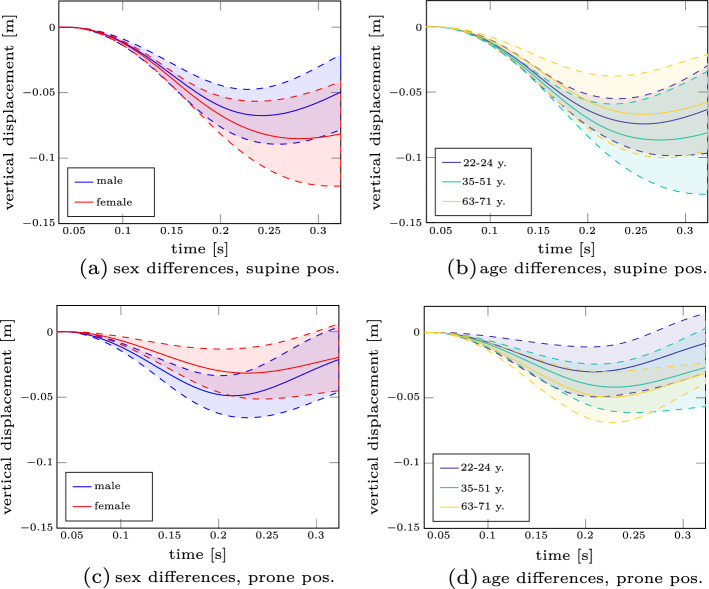
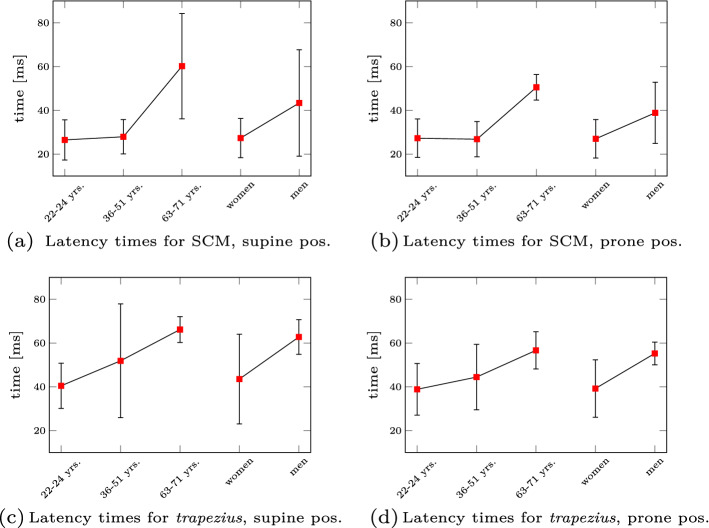
We analysed the kinematic, neuronal and dynamic responses for all individuals and show their differences for separate age and sex groups. We show that these results can be used to validate two simple reflex controllers which are able to predict human biophysical movement and modulate the response necessary to represent a large variability of participants.
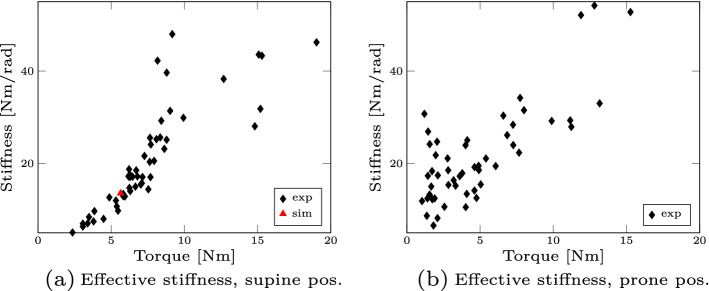
We present characteristic parameters such as joint stiffness, peak accelerations and latency times. Based on this data, we show that there is a large difference in the individual reflexive responses between participants. Furthermore, we show that the perturbation direction (supine vs. prone) significantly influences the measured kinematic quantities. Finally, 'falling heads' experiments data are provided open-source to be used as a benchmark test to compare different muscle control strategies and to validate existing active Human Body Models directly.
头颈部对扰动的反射性反应会影响许多不同情况的受伤风险,从与运动相关的撞击到车祸场景。尽管已经进行了几项实验来研究这些对头颈部的各种扰动的反应,但仍不清楚为什么以及为什么个体的反应不同,以及这些不同反应在个体之间对潜在伤害的可能影响。因此,我们需要既有实验数据又有具有生物启发肌肉控制策略的生物物理有效计算人体模型,以便更好地理解个体反射反应。
为了解决这个问题,我们对头颈复合体进行了扰动实验,并使用这些数据在模拟模型中检查控制策略。在我们称之为“摔倒头”的实验中,志愿者被放置在桌子上的仰卧和俯卧位置,桌子上有一个额外的活门支撑头部。这个活门突然被释放,导致头部自由下落,直到肌肉的反射反应阻止了向下的运动。
我们分析了所有个体的运动学、神经和动态反应,并展示了它们在不同年龄和性别组之间的差异。我们表明,这些结果可用于验证两个简单的反射控制器,它们能够预测人体的生物物理运动,并调节必要的反应,以代表大量参与者的变化。
我们提出了特征参数,如关节刚度、峰值加速度和潜伏期。基于这些数据,我们表明参与者之间的个体反射反应有很大差异。此外,我们表明,扰动方向(仰卧位与俯卧位)显著影响所测量的运动学量。最后,提供了“摔倒头”实验数据作为基准测试,以比较不同的肌肉控制策略,并直接验证现有的主动人体模型。