Institute of Biotechnology and Molecular Medicine, Kampinoska 25, 80-180, Gdańsk, Poland.
Gdańsk University of Technology, 11/12 G. Narutowicza St, 80-233, Gdańsk, Poland.
Biosens Bioelectron. 2022 Aug 1;209:114222. doi: 10.1016/j.bios.2022.114222. Epub 2022 Apr 8.
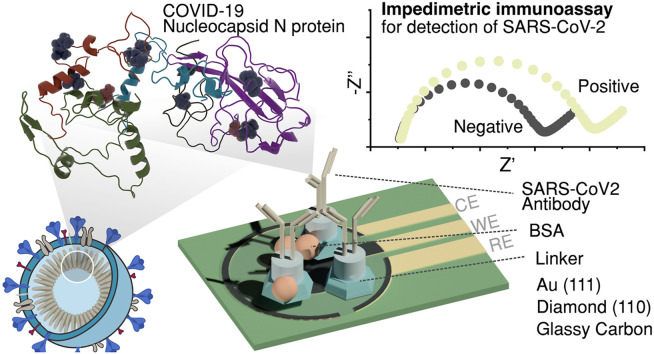
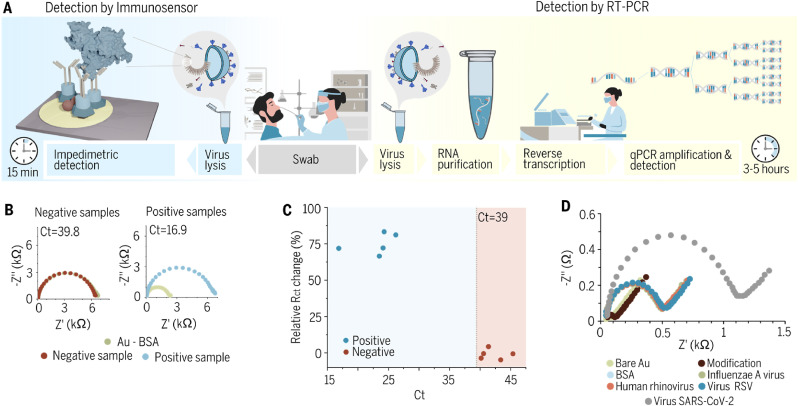
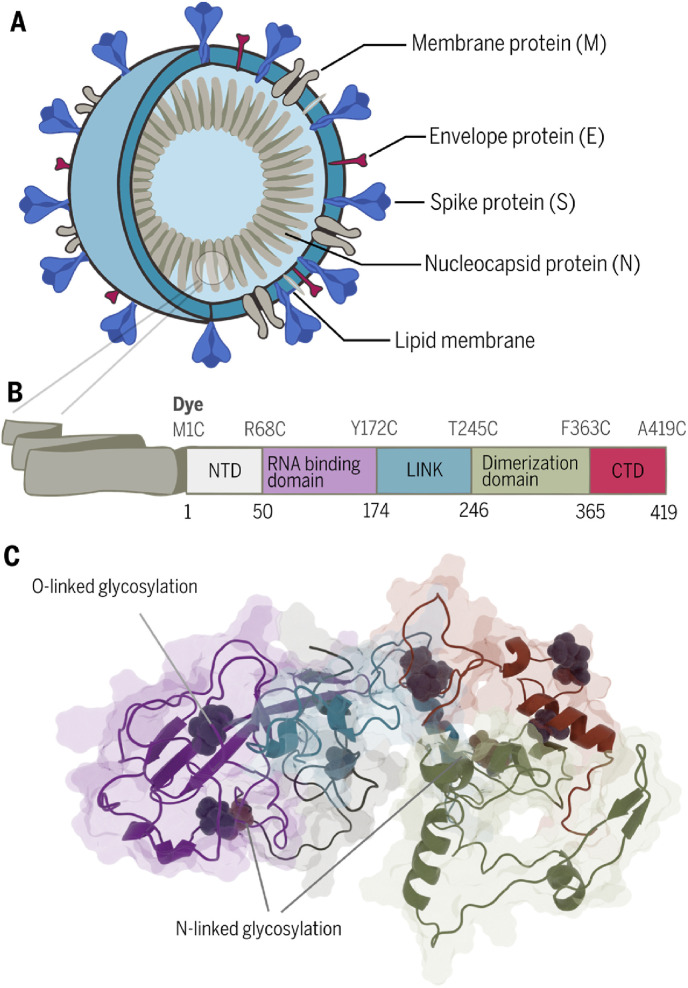
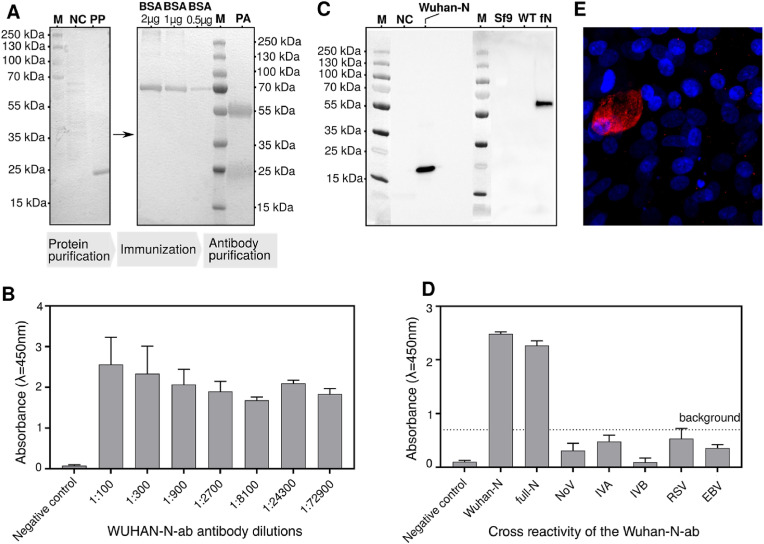
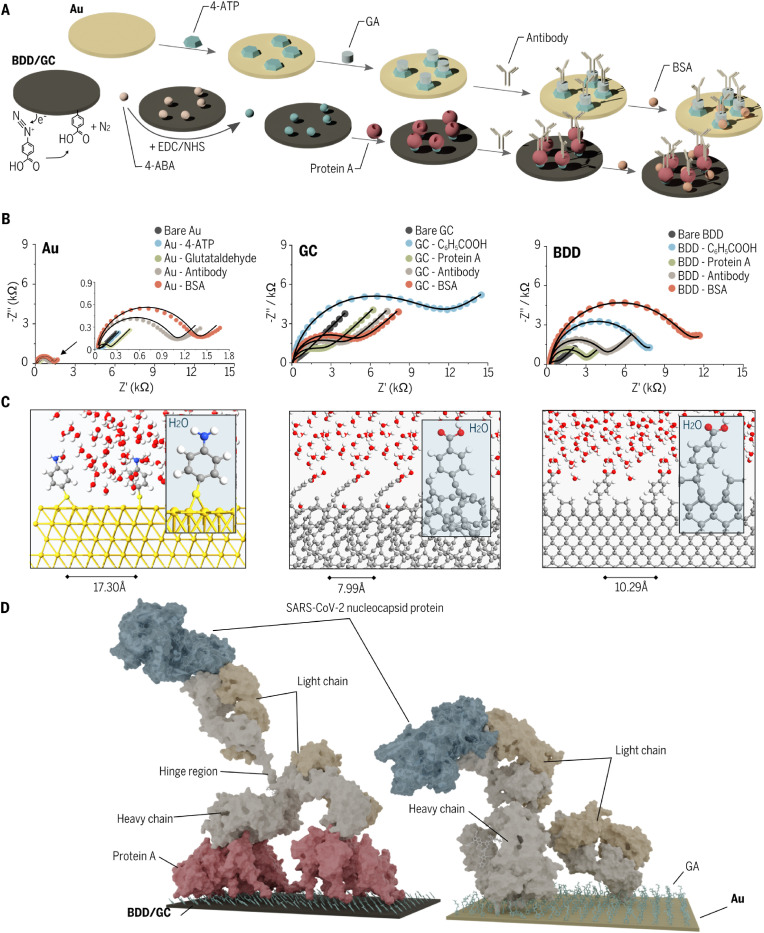
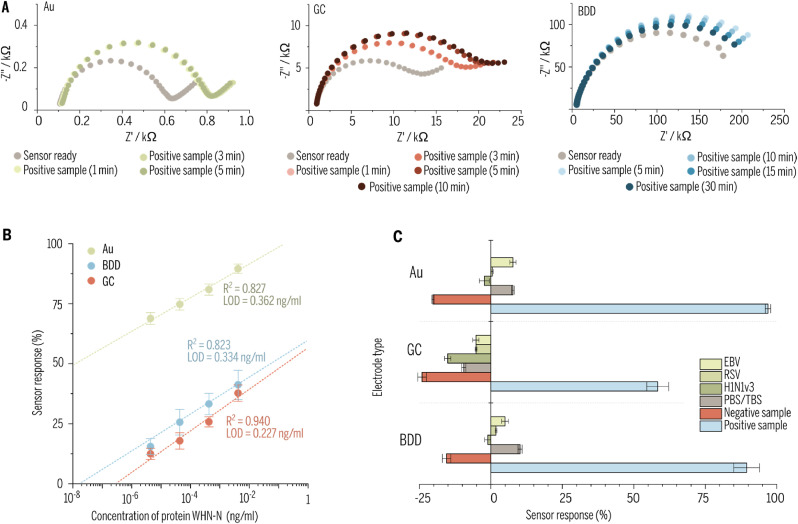
The 21st century has already brought us a plethora of new threats related to viruses that emerge in humans after zoonotic transmission or drastically change their geographic distribution or prevalence. Severe acute respiratory syndrome coronavirus 2 (SARS-CoV-2) was first spotted at the end of 2019 to rapidly spread in southwest Asia and later cause a global pandemic, which paralyzes the world since then. We have designed novel immunosensors targeting conserved protein sequences of the N protein of SARS-CoV-2 based on lab-produced and purified anti-SARS-CoV-2 nucleocapsid antibodies that are densely grafted onto various surfaces (diamond/gold/glassy carbon). Titration of antibodies shows very strong reactions up to 1:72 900 dilution. Next, we showed the mechanism of interactions of our immunoassay with nucleocapsid N protein revealing molecular recognition by impedimetric measurements supported by hybrid modeling results with both density functional theory and molecular dynamics methods. Biosensors allowed for a fast (in less than 10 min) detection of SARS-CoV-2 virus with a limit of detection from 0.227 ng/ml through 0.334 ng/ml to 0.362 ng/ml for glassy carbon, boron-doped diamond, and gold surfaces, respectively. For all tested surfaces, we obtained a wide linear range of concentrations from 4.4 ng/ml to 4.4 pg/ml. Furthermore, our sensor leads to a highly specific response to SARS-CoV-2 clinical samples versus other upper respiratory tract viruses such as influenza, respiratory syncytial virus, or Epstein-Barr virus. All clinical samples were tested simultaneously on biosensors and real-time polymerase chain reactions.
21 世纪已经给我们带来了大量新的威胁,这些威胁与人类中出现的动物源性病毒有关,这些病毒在动物源性传播后会极大地改变其地理分布或流行程度。严重急性呼吸系统综合征冠状病毒 2(SARS-CoV-2)于 2019 年底首次被发现,并迅速在西亚传播,后来导致了全球大流行,自那时以来,全球一直处于瘫痪状态。我们基于实验室生产和纯化的抗 SARS-CoV-2 核衣壳抗体,设计了针对 SARS-CoV-2 N 蛋白保守蛋白序列的新型免疫传感器,这些抗体密集地嫁接在各种表面(钻石/金/玻碳)上。抗体滴定显示出非常强的反应,最高可达 1:72900 稀释度。接下来,我们展示了我们的免疫分析与核衣壳 N 蛋白相互作用的机制,通过阻抗测量证实了分子识别,并结合密度泛函理论和分子动力学方法的混合建模结果。生物传感器允许快速(不到 10 分钟)检测 SARS-CoV-2 病毒,检测限分别为玻璃碳、掺硼金刚石和金表面的 0.227ng/ml 至 0.334ng/ml 至 0.362ng/ml。对于所有测试的表面,我们获得了从 4.4ng/ml 到 4.4pg/ml 的宽浓度线性范围。此外,我们的传感器对 SARS-CoV-2 临床样本具有高度特异性的反应,而对其他上呼吸道病毒如流感、呼吸道合胞病毒或爱泼斯坦-巴尔病毒的反应则较低。所有临床样本都同时在生物传感器和实时聚合酶链反应上进行了测试。