Lee Boram, Kwon Chan-Young, Lee Sun Haeng, Chang Gyu Tae
KM Science Research Division, Korea Institute of Oriental Medicine, Daejeon, South Korea.
Department of Oriental Neuropsychiatry, Dong-eui University College of Korean Medicine, Busan, South Korea.
Front Pharmacol. 2022 Apr 1;13:839668. doi: 10.3389/fphar.2022.839668. eCollection 2022.
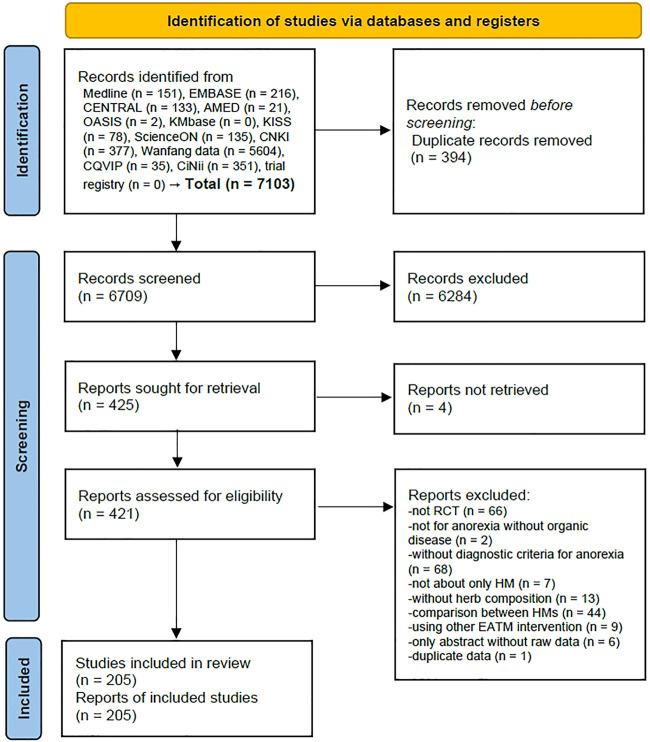
Anorexia is a common obstacle to adequate nutrition in childhood, a critical period for physical growth. East Asian traditional medicine treatment modalities including herbal medicine (HM) a re considered an attractive therapeutic option, especially in East Asian countries. The purpose of this systematic review was to comprehensively examine the efficacy and safety of HM for anorexia in children. A total of 12 electronic databases from their inception date to June 2021 were searched for randomized controlled trials (RCTs) assessing the efficacy of HM for the treatment of anorexia in children. The primary outcome was an improvement in anorexia clinical symptoms after treatment. In this meta-analysis, continuous and binary outcomes were assessed, and the data are presented as the mean difference or standardized mean difference and risk ratio (RR) with their 95% confidence intervals (CIs). The risk of bias and quality of evidence were assessed using the Cochrane Collaboration's risk of bias tool and Grading of Recommendations, Assessment, Development, and Evaluations tool. A total of 205 RCTs were included. A comparison of HM with placebo revealed that the total effective rate based on anorexia symptom improvement was significantly higher in the HM group (RR 1.58, 95% CI 1.34, 1.85). In comparison with controls, HM as monotherapy or adjunctive therapy to dietary supplements or conventional medications led to significant improvements in anorexia symptoms, body measurements, levels of blood biomarkers related to gastrointestinal function, and nutrition indices, with a lower recurrence rate of anorexia. No serious adverse events related to HM were reported. The risk of bias of the included studies was generally unclear, and the quality of evidence was generally low to moderate. Our study showed that HM could improve clinical symptoms, some anthropometric outcomes, and some biological markers related to appetite and growth in children with anorexia. However, considering the high risk of bias of the included studies and the heterogeneity of the HMs used, future research should focus on the use of standardized HMs and the implementation of methodologically robust clinical trials. : https://www.crd.york.ac.uk/prosperodisplay_record.php?ID=CRD42021274376, identifier CRD42021274376.
厌食症是儿童充足营养摄入的常见障碍,而儿童期是身体生长的关键时期。包括草药(HM)在内的东亚传统医学治疗方式被认为是一种有吸引力的治疗选择,尤其是在东亚国家。本系统评价的目的是全面考察草药治疗儿童厌食症的疗效和安全性。检索了共12个电子数据库,从其建库日期至2021年6月,以查找评估草药治疗儿童厌食症疗效的随机对照试验(RCT)。主要结局是治疗后厌食症临床症状的改善。在这项荟萃分析中,对连续和二分结局进行了评估,数据以平均差或标准化平均差以及风险比(RR)及其95%置信区间(CI)呈现。使用Cochrane协作网的偏倚风险工具和推荐分级、评估、制定与评价工具对偏倚风险和证据质量进行评估。共纳入205项随机对照试验。草药与安慰剂的比较显示,基于厌食症症状改善的总有效率在草药组显著更高(RR 1.58,95%CI 1.34,1.85)。与对照组相比,草药作为单一疗法或作为膳食补充剂或传统药物辅助疗法,可使厌食症症状、身体测量指标、与胃肠功能相关的血液生物标志物水平以及营养指标得到显著改善,且厌食症复发率更低。未报告与草药相关的严重不良事件。纳入研究的偏倚风险总体不明确,证据质量总体为低到中等。我们的研究表明,草药可改善厌食症儿童的临床症状、一些人体测量结果以及一些与食欲和生长相关的生物标志物。然而,考虑到纳入研究的高偏倚风险以及所用草药的异质性,未来研究应聚焦于使用标准化草药以及开展方法学严谨的临床试验。:https://www.crd.york.ac.uk/prosperodisplay_record.php?ID=CRD42021274376,标识符CRD42021274376