Tharmaraja Thahesh, Ho Jamie S Y, Sia Ching-Hui, Lim Nicole-Ann, Chong Yao Feng, Lim Amanda Y L, Rathakrishnan Rahul R, Yeo Leonard L L, Sharma Vijay K, Tan Benjamin Y Q
Intensive Care Unit, University College Hospital, University College London Hospitals NHS Foundation Trust, London, UK.
Intensive Care Unit, Royal Free Hospital, Royal Free London NHS Foundation Trust, London, UK.
Ther Adv Chronic Dis. 2022 Apr 11;13:20406223221086996. doi: 10.1177/20406223221086996. eCollection 2022.
Sodium-glucose cotransporter 2 inhibitors (SGLT2i) are a group of antidiabetic medications with a favourable cardiovascular, renal and overall safety profile. Given the limited treatment options available for neurological disorders, it is important to determine whether the pleiotropic effects of SGLT2i can be utilised in their prevention and management.
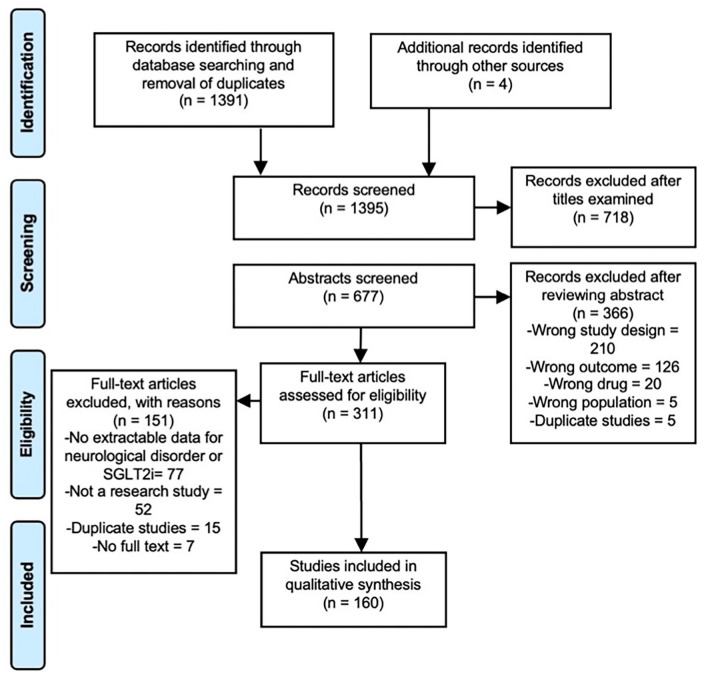
All articles published before 20 March 2021 were systematically searched in MEDLINE, EMBASE, Scopus, Web of Science, APA PsycINFO and ClinicalTrials.gov. Overall, 1395 titles were screened, ultimately resulting in 160 articles being included in the qualitative analysis. Screening and data extraction were conducted by two independent authors and studies were excluded if they were not an original research study.
Of the 160 studies, 134 addressed stroke, 19 cognitive impairment, 4 epilepsy and 4 movement disorders, encompassing a range from systematic reviews and randomised controlled trials to bioinformatic and animal studies. Most animal studies demonstrated significant improvements in behavioural and neurological deficits, which were reflected in beneficial changes in neurovascular units, synaptogenesis, neurotransmitter levels and target receptors' docking energies. The evidence from the minority clinical literature was conflicting and many studies did not reach statistical significance.
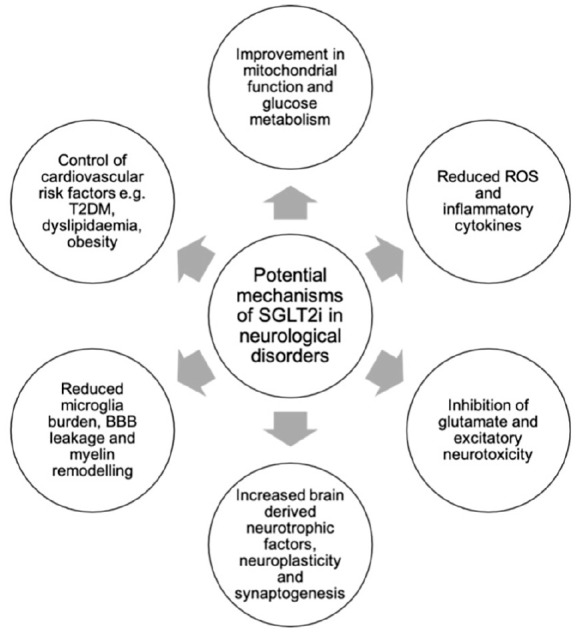
SGLT2i may exert neurological benefits through three mechanisms: reduction in cardiovascular risk factors, augmentation of ketogenesis and anti-inflammatory pathways. Most clinical studies were observational, meaning that a causal relationship could not be established, while randomised controlled trials were heterogeneous and powered to detect cardiovascular or renal outcomes. We suggest that a longitudinal study should be conducted and specifically powered to detect neurological outcomes.
钠-葡萄糖协同转运蛋白2抑制剂(SGLT2i)是一类抗糖尿病药物,具有良好的心血管、肾脏及整体安全性。鉴于神经疾病的治疗选择有限,确定SGLT2i的多效性是否可用于其预防和管理非常重要。
在MEDLINE、EMBASE、Scopus、科学网、美国心理学会心理学文摘数据库和临床试验.gov中系统检索了2021年3月20日前发表的所有文章。总体而言,筛选了1395个标题,最终有160篇文章纳入定性分析。筛选和数据提取由两名独立作者进行,非原创研究的文章被排除。
在这160项研究中,134项涉及中风,19项涉及认知障碍,4项涉及癫痫,4项涉及运动障碍,涵盖从系统评价和随机对照试验到生物信息学和动物研究等范围。大多数动物研究表明行为和神经功能缺损有显著改善,这反映在神经血管单元、突触形成、神经递质水平和靶受体对接能的有益变化上。少数临床文献的证据相互矛盾,许多研究未达到统计学显著性。
SGLT2i可能通过三种机制发挥神经保护作用:降低心血管危险因素、增强生酮作用和抗炎途径。大多数临床研究为观察性研究,这意味着无法建立因果关系,而随机对照试验具有异质性,旨在检测心血管或肾脏结局。我们建议应开展一项纵向研究,并专门针对检测神经结局进行设计。