Director of Nursing and Neonatal Vascular Access Lead, Neonatal Intensive Care Unit, Women's Wellness and Research Center, Hamad Medical Corporation, Doha, Qatar.
Director of Nursing Education, Hamad Medical Corporation, Doha, Qatar.
J Vasc Access. 2023 Nov;24(6):1390-1397. doi: 10.1177/11297298221085480. Epub 2022 Apr 18.
Infants in neonatal units are susceptible to numerous potential iatrogenic risks. One key concern is central line-associated blood stream infection (CLABSI). To ensure patient safety and reduce the incidence of CLABSI toward zero, numerous evidence-based clinical interventions and product innovations have been implemented. Nevertheless, sustaining zero CLABSI for sustained periods remains challenging.
The purpose of this study was to evaluate the impact on CLABSI rates of introducing a preassembled closed intravenous (IV) administration set in a neonatal intensive care unit (NICU).
This was a retrospective observational analysis of routinely collected anonymized IV therapy infection data in a NICU. The study period was from January 2019 through June 2020.
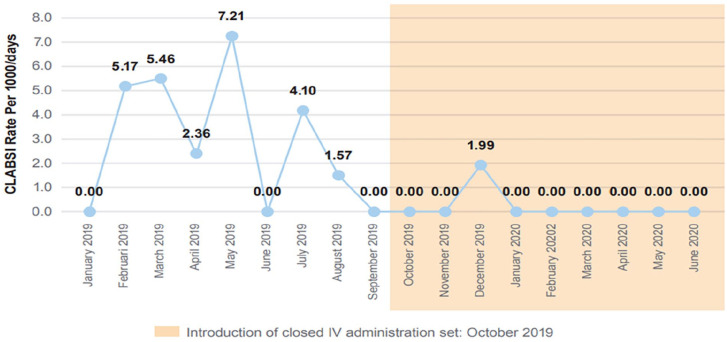
Nine-hundred eighty five patients with a Epicutaneo-Caval Catheter (ECC) were included (456 legacy IV set, 529 closed IV set). Patient demographics were comparable between the two groups. ECC dwell time was the only IV characteristic associated ( = 0.04) with CLABSI. Mann-Whitney U-test demonstrated significant differences between the two sets for CLABSI complication events ( = 0.031). Prior to using the closed IV administration sets (January 2019-September 2019) the mean monthly CLABSI rate was 2.87 (/1000 device days). This figure declined to 0.22 (/1000 device days) afterwards (October 2019-June 2020). Zero CLABSIs were observed during January to June 2020.
Utilization of a pre-assembled closed IV administration set was associated with a reduction in CLABSI rates. The study results suggest that using a pre-assembled closed IV set concurrently with evidence-based central line infection control interventions can help attain extended periods of zero CLABSI.
新生儿病房中的婴儿容易受到许多潜在的医源性风险的影响。一个主要关注点是中心静脉导管相关血流感染(CLABSI)。为了确保患者安全并将 CLABSI 的发生率降至零,已经实施了许多基于证据的临床干预措施和产品创新。然而,要持续长时间保持零 CLABSI 仍然具有挑战性。
本研究旨在评估在新生儿重症监护病房(NICU)中引入预组装密闭式静脉(IV)给药套件对 CLABSI 发生率的影响。
这是一项对 NICU 中常规收集的匿名 IV 治疗感染数据进行的回顾性观察性分析。研究期间为 2019 年 1 月至 2020 年 6 月。
共纳入 985 例带 Epicutaneo-Caval Catheter(ECC)的患者(456 例传统 IV 套件,529 例密闭式 IV 套件)。两组患者的人口统计学特征相似。ECC 留置时间是唯一与 CLABSI 相关的 IV 特征( = 0.04)。Mann-Whitney U 检验显示两组之间在 CLABSI 并发症事件方面存在显著差异( = 0.031)。在使用密闭式 IV 给药套件之前(2019 年 1 月至 2019 年 9 月),每月 CLABSI 发生率为 2.87(/1000 器械天数)。此后(2019 年 10 月至 2020 年 6 月),这一数字下降至 0.22(/1000 器械天数)。2020 年 1 月至 6 月期间未观察到零 CLABSIs。
使用预组装密闭式 IV 给药套件与 CLABSI 发生率降低相关。研究结果表明,同时使用预组装密闭式 IV 套件和基于证据的中心静脉感染控制干预措施有助于实现延长的零 CLABSI 期。