School of Biomedical Sciences, 7364University of West London, London, UK.
School of Biomedical Sciences, 7364University of West London, London, UK; 3286University of Exeter, Exeter, UK.
Dementia (London). 2022 Jul;21(5):1800-1824. doi: 10.1177/14713012221082377. Epub 2022 Apr 17.
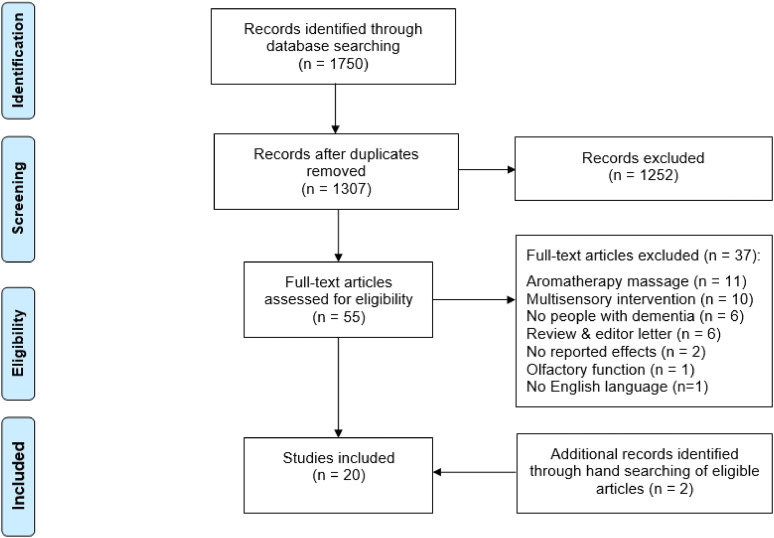
There is a growing interest in using olfactory (smell) stimulation in dementia care. This study aims to extend current knowledge by synthesising the evidence on the efficacy of interventions using olfactory stimulation for people with dementia and to assess the effects of different types of odours and administration methods using a mixed methods approach. The rapid review was conducted based on searches in six electronic databases. A narrative approach was applied to assess 20 studies included in the review. Fourteen studies used a quasi-experimental design, five studies used an experimental design and one was a case study. High heterogeneity was found on odours and methods of application used, with the majority of studies administering lavender oil using a diffuser. Mixed results were reported on the benefits of olfactory stimulation on responsive behaviours and cognitive function. Although the evidence available is limited, encouraging results were found regarding olfactory stimulation and increased sleep duration, food intake and improved balance. It was not possible to draw any overall conclusion in relation to the effect of olfactory stimulation. However, this review shows promising results that support further investigation of olfactory stimulation as a nonpharmacological intervention for people with dementia. The review is limited due to the low to moderate quality of studies included. Furthermore, the broad range of approaches was employed, and comparison between the studies was difficult. Further high-quality mixed method studies using robust and detailed protocols are needed to clarify the effects of olfactory stimuli and any other factors that may influence the responses of people with dementia.
人们对在痴呆症护理中使用嗅觉(气味)刺激越来越感兴趣。本研究旨在通过综合使用嗅觉刺激干预痴呆症患者的疗效证据来扩展现有知识,并采用混合方法评估不同类型的气味和给药方法的效果。快速审查是基于对六个电子数据库的搜索进行的。采用叙述方法评估了综述中包含的 20 项研究。其中 14 项研究使用了准实验设计,5 项研究使用了实验设计,1 项研究使用了案例研究。研究中使用的气味和应用方法存在高度异质性,大多数研究使用扩散器来施用薰衣草油。嗅觉刺激对反应性行为和认知功能的益处的报告结果喜忧参半。尽管现有证据有限,但关于嗅觉刺激对增加睡眠持续时间、食物摄入和改善平衡的有益结果令人鼓舞。由于纳入的研究质量较低,因此无法就嗅觉刺激的效果得出总体结论。然而,本综述显示了有希望的结果,支持进一步研究嗅觉刺激作为痴呆症患者的非药物干预措施。由于纳入的研究质量较低,因此该综述存在局限性。此外,还采用了广泛的方法,难以对研究进行比较。需要进一步进行高质量的混合方法研究,使用可靠和详细的方案,以阐明嗅觉刺激的效果以及可能影响痴呆症患者反应的任何其他因素。