Taborda Alejandra, Chamorro Cindy, Quintero Juliana, Carrasquilla Gabriel, Londoño Darío
Am J Trop Med Hyg. 2022 Apr 18;107(1):180-5. doi: 10.4269/ajtmh.20-0669.
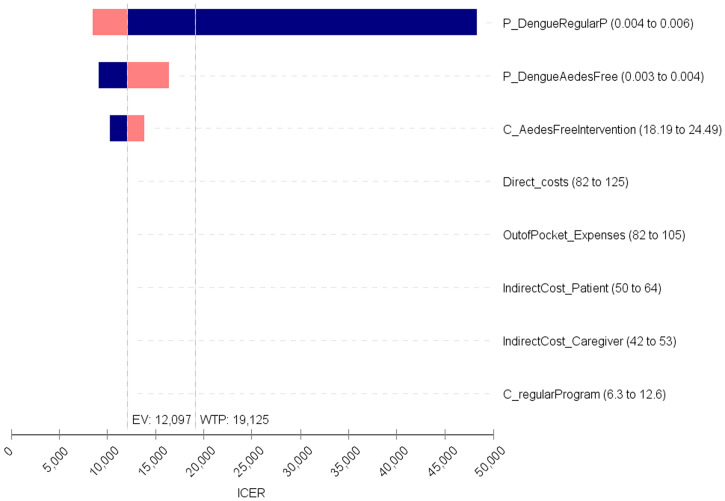
Dengue is a public health problem in Colombia and in the municipality of Girardot, an area of high risk for dengue transmission. We present the results of an economic evaluation from the societal perspective and 1-year time horizon comparing the regular control program for dengue prevention versus an intervention that comprised an environmental management strategy by covering the most Aedes aegypti productive breeding sites with insecticide covers, community actions, and educational activities. The effectiveness of the intervention was measured as the reduction in probability of dengue infection obtained from a community trial. Resource use was estimated from clinical records that were validated by clinical experts; unit costs were taken from national tariffs. Patient costs were obtained from a household survey. We found that the intervention generated an additional cost of USD20.9 per household and an incremental effectiveness of 0.00173 (reduction in the probability of reported dengue cases). Overall, both alternatives generate similar effectiveness, but the new intervention was associated with increasing costs. We conclude the new intervention is a potentially cost-effective option in areas where high prevalence of dengue exists.
登革热是哥伦比亚以及吉拉尔多市的一个公共卫生问题,该地区是登革热传播的高风险区域。我们从社会角度和1年的时间跨度呈现了一项经济评估的结果,比较了登革热预防常规控制项目与一项干预措施,该干预措施包括一项环境管理策略,即通过用杀虫剂覆盖物覆盖埃及伊蚊最主要的繁殖场所、开展社区行动和教育活动。干预措施的有效性通过社区试验得出的登革热感染概率降低情况来衡量。资源使用从经临床专家验证的临床记录中估算得出;单位成本取自国家收费标准。患者成本通过家庭调查获得。我们发现,该干预措施每户产生了20.9美元的额外成本,增量有效性为0.00173(报告的登革热病例概率降低)。总体而言,两种方案产生的有效性相似,但新的干预措施与成本增加相关。我们得出结论,在登革热高流行地区,新的干预措施是一个潜在的具有成本效益的选择。