Eje de Salud Poblacional, Fundación Santa Fe de Bogotá, Bogotá, Colombia.
Universidad Santo Tomas, Bogotá, Colombia.
PLoS One. 2020 Apr 1;15(4):e0230486. doi: 10.1371/journal.pone.0230486. eCollection 2020.
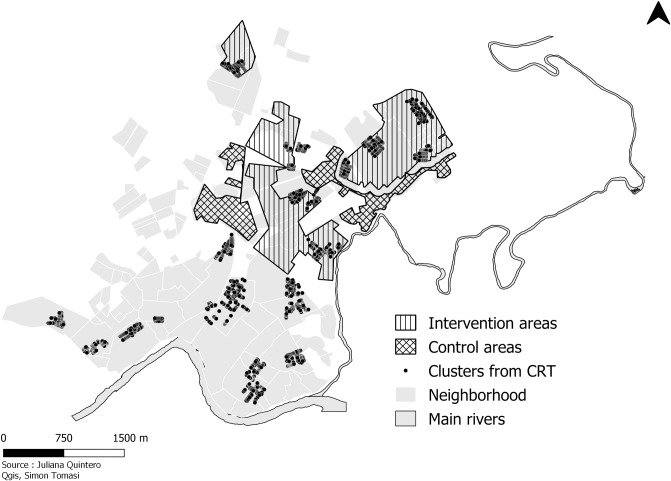
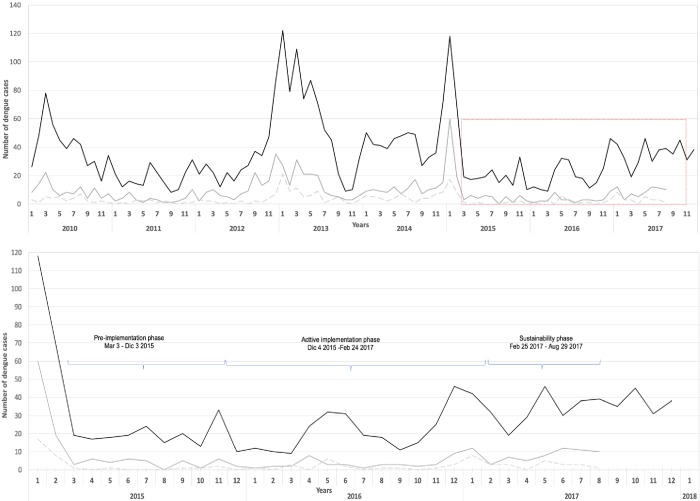
Aedes aegypti transmitted arboviral diseases are of significant importance in Colombia, particularly since the 2014/2015 introduction of chikungunya and Zika in the Americas and the increasing spread of dengue. In response, the Colombian government initiated the scaling-up of a community-based intervention under inter and multi-sector partnerships in two out of four sectors in Girardot, one of the most hyper-endemic dengue cities in the country. Using a quasi-experimental research design a scaled-up community-led Aedes control intervention was assessed for its capacity to reduce dengue from January 2010 to August 2017 in Girardot, Colombia. Reported dengue cases, and associated factors were analysed from available data sets from the Colombian disease surveillance systems. We estimated the reduction in dengue cases before and after the intervention using, Propensity Score Matching and an Autoregressive Moving Average model for robustness. In addition, the differences in dengue incidence among scaling-up phases (pre-implementation vs sustainability) and between treatment groups (intervention and control areas) were modelled. Evidence was found in favour of the intervention, although to maximise impact the scaling-up of the intervention should continue until it covers the remaining sectors. It is expected that a greater impact of the intervention can be documented in the next outbreak of dengue in Girardot.
埃及伊蚊传播的虫媒病毒疾病在哥伦比亚具有重要意义,特别是自 2014/2015 年在美洲引入基孔肯雅热和寨卡病毒以及登革热的传播不断增加以来。有鉴于此,哥伦比亚政府在 Girardot 的四个区中的两个区启动了一项基于社区的干预措施,该措施是通过跨部门和多部门伙伴关系开展的,该城市是该国登革热高度流行的城市之一。采用准实验研究设计,评估了 2010 年 1 月至 2017 年 8 月在哥伦比亚 Girardot 实施的扩大规模的以社区为主导的蚊虫控制干预措施,以减少登革热的发生。利用哥伦比亚疾病监测系统的现有数据集分析报告的登革热病例和相关因素。使用倾向评分匹配和自回归移动平均模型来估计干预前后登革热病例的减少量,以确保稳健性。此外,还对扩大规模阶段(实施前与可持续性阶段)和治疗组(干预区和对照区)之间的登革热发病率差异进行了建模。研究结果支持干预措施,但为了最大程度地发挥其影响,应继续扩大干预措施的覆盖范围,直至覆盖其余的区。预计在下一次 Girardot 登革热疫情爆发时,可以记录到该干预措施的更大影响。