Emergency Telephone Consultation Centre, Tokyo Medical Association, 2-5 Kandasurugadai, Chiyoda-ku, Tokyo, 101-8328, Japan.
Division of Emergency and Critical Care Medicine, Department of Acute Medicine, Nihon University School of Medicine, Oyaguchikamichou 30-1, Itabashi-ku, Tokyo, 173-8610, Japan.
BMC Emerg Med. 2022 Apr 19;22(1):66. doi: 10.1186/s12873-022-00625-5.
The algorithm and protocol of the #7119 telephone triage in Tokyo, Japan, had been originally established and consists of three steps. In this study, we investigated the outcome of patients treated with physiological abnormality (ABCD approach: A, airway; B, breathing; C, circulation, and D, dysfunction of central nervous system) in step 2 during the #7119 telephone triage and clarified the meaning of evaluation of this approach.
We retrospectively reviewed data from the Tokyo Fire Department from January 2016 to December 2017. Almost all the patients triaged using the ABCD approach were transferred to the hospital by ambulance and assigned severity by a physician. We divided patients into groups with combinations of 15 patterns including A, B, C, D, AB, AC, AD, BC, BD, CD, ABC, ABD, ACD, BCD, and ABCD. We compared the proportion of severe cases in each group using a Fisher's exact test, followed by residual analysis.
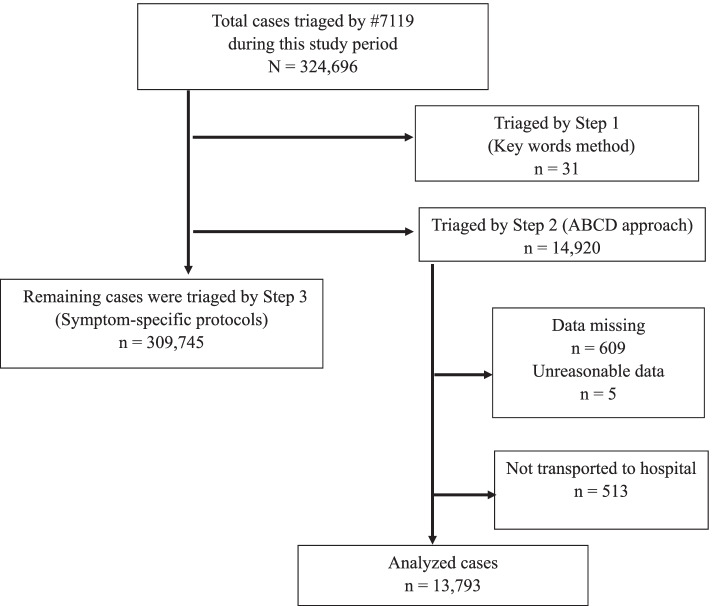
We analyzed 13,793 cases triaged using the ABCD approach. In this analysis, 31% of total cases were assessed as severe cases. Groupwise analysis showed that the proportion of severe cases was significantly higher in the AD, BC, CD, ABD, and ABCD groups, while it was significantly less in the C and AB groups than in the total cases.
At the #7119 telephone triage, we can pick up the severe cases by the ABCD approach. This may contribute to the prompt transportation of severe patients to hospitals by dispatching ambulance cars using the #7119 telephone triage methods.
日本东京的#7119 电话分诊算法和方案最初建立并包含三个步骤。在本研究中,我们调查了在#7119 电话分诊的第二步中,使用生理异常(ABCD 方法:A,气道;B,呼吸;C,循环和 D,中枢神经系统功能障碍)进行治疗的患者的结局,并阐明了这种方法评估的意义。
我们回顾性分析了 2016 年 1 月至 2017 年 12 月期间来自东京消防署的数据。几乎所有使用 ABCD 方法分诊的患者都通过救护车转送至医院,并由医生评估严重程度。我们将患者分为包括 A、B、C、D、AB、AC、AD、BC、BD、CD、ABC、ABD、ACD、BCD 和 ABCD 共 15 种模式组合的组。我们使用 Fisher 精确检验比较每组中严重病例的比例,然后进行残差分析。
我们分析了 13793 例使用 ABCD 方法分诊的病例。在这项分析中,31%的总病例被评估为严重病例。组间分析表明,AD、BC、CD、ABD 和 ABCD 组中严重病例的比例明显高于总病例,而 C 和 AB 组中严重病例的比例明显低于总病例。
在#7119 电话分诊中,我们可以通过 ABCD 方法识别严重病例。这可能有助于通过使用#7119 电话分诊方法派遣救护车迅速将严重患者送往医院。