• 文献检索
  • 文档翻译
  • 深度研究
  • 学术资讯
  • Suppr Zotero 插件Zotero 插件
  • 邀请有礼
  • 套餐&价格
  • 历史记录
应用&插件
Suppr Zotero 插件Zotero 插件浏览器插件Mac 客户端Windows 客户端微信小程序
定价
高级版会员购买积分包购买API积分包
服务
文献检索文档翻译深度研究API 文档MCP 服务
关于我们
关于 Suppr公司介绍联系我们用户协议隐私条款
关注我们

Suppr 超能文献

核心技术专利:CN118964589B侵权必究
粤ICP备2023148730 号-1Suppr @ 2026

文献检索

告别复杂PubMed语法,用中文像聊天一样搜索,搜遍4000万医学文献。AI智能推荐,让科研检索更轻松。

立即免费搜索

文件翻译

保留排版,准确专业,支持PDF/Word/PPT等文件格式,支持 12+语言互译。

免费翻译文档

深度研究

AI帮你快速写综述,25分钟生成高质量综述,智能提取关键信息,辅助科研写作。

立即免费体验

各类药物使用者的抑郁、焦虑、冲动和攻击特征以及发展为重度抑郁的因素:一项横断面研究。

Characteristics of depression, anxiety, impulsivity, and aggression among various types of drug users and factors for developing severe depression: a cross-sectional study.

机构信息

Mental Health Center, West China Hospital of Sichuan University, 28 Dian Xin Nan Jie, Chengdu, 610041, Sichuan, China.

Sleep Medicine Center, West China Hospital of Sichuan University, Chengdu, China.

出版信息

BMC Psychiatry. 2022 Apr 19;22(1):274. doi: 10.1186/s12888-022-03933-z.

DOI:10.1186/s12888-022-03933-z
PMID:35439968
原文链接:https://pmc.ncbi.nlm.nih.gov/articles/PMC9020049/
Abstract

BACKGROUND

Mood disorder, impulsivity and aggression are common in drug users compared to healthy controls. However, no study has focused on the difference in various types of drug users. Therefore, the objective of this study was to explore the differences in depression, anxiety, impulsivity, and aggression among methamphetamine, heroin and polysubstance users and to further explore the risk factors for severe depression in the three groups.

METHODS

Drug users over 18 years old who met the DSM-V diagnostic criteria for substance -related disorders were included in the study. All participants completed a general questionnaire, the Zung Self-Rating Depression Scale (SDS), the Zung Self-Rating Anxiety Scale (SAS), Barratt impulsiveness Scale Version 11 (BIS-11), and the Buss-Perry Aggression Questionnaire (BPAQ). One-way ANOVAs or Chi-square tests were used to test the differences among the groups, correlation analysis was used to test the relationship between drug use and other parameters, and multiple logistic regression was conducted to assess the risk factors for severe depression.

RESULTS

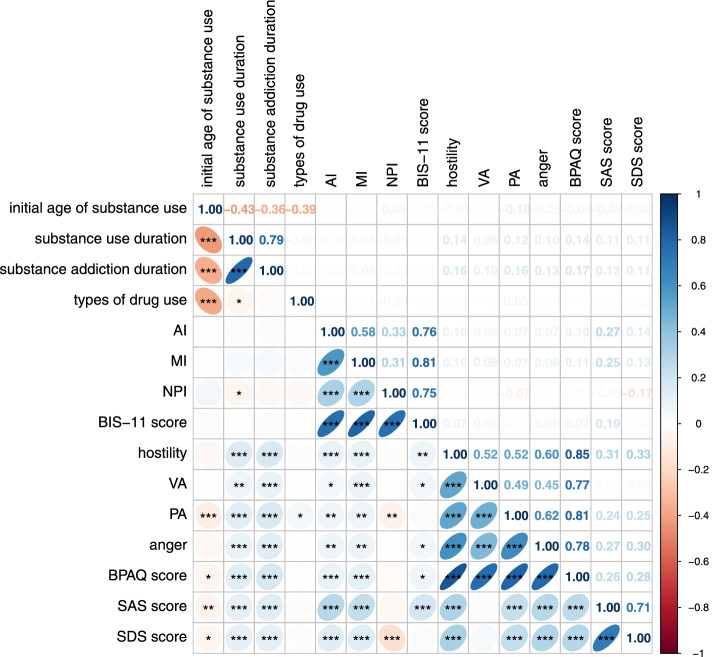
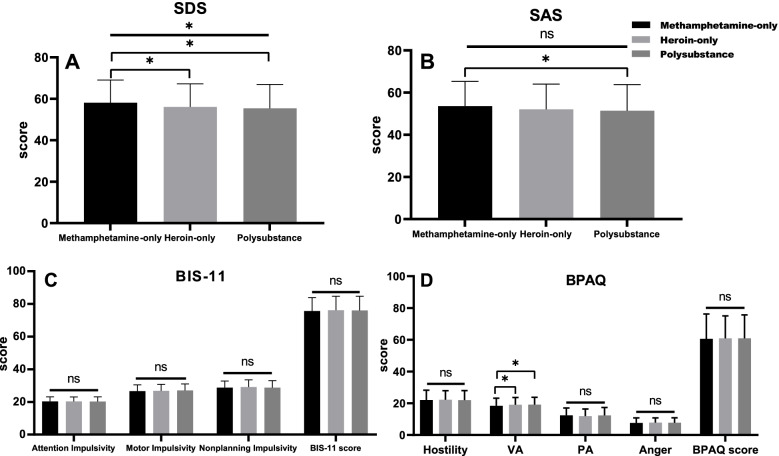
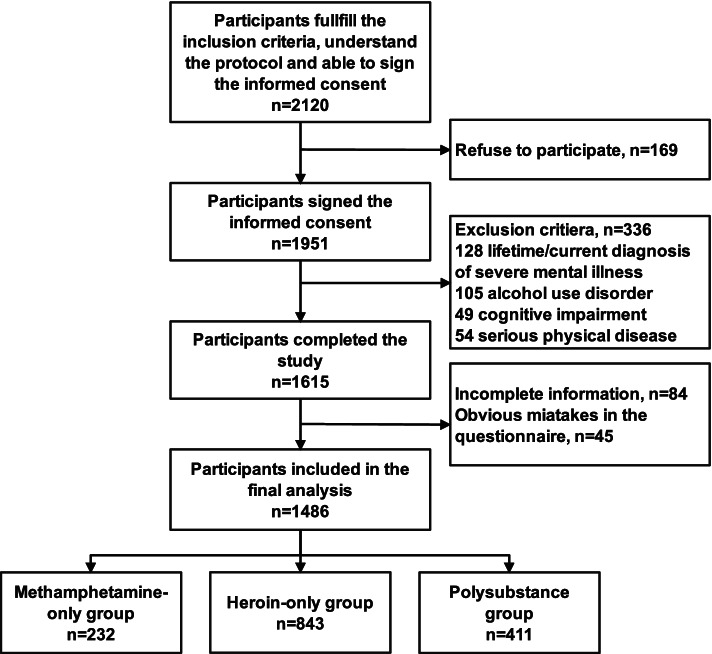
A total of 1,486 participants were included, comprising 86.3% males with a mean age of 38.97 years. There was a significant difference in the percentage of severe depression and SDS scores among the three groups, but no significant difference was found in SAS, BIS-11 and BPAQ scores. Using methamphetamines, hostility and anxiety were risk factors for developing severe depression in all the participants and anxiety remained constant in the other three groups. Moreover, methamphetamine use was 2.16 and 3.35 times more likely to cause severe depression than heroin and polysubstance use, respectively. The initial age of substance use was negatively correlated with BPAQ, SAS, and SDS scores, whereas the drug use duration and addiction duration were positively correlated.

CONCLUSIONS

In this study, we found that the highest prevalence of severe depression was in participants using methamphetamines and that using methamphetamines, hostility, and anxiety were risk factors for developing severe depression. This result addressed an important gap in our knowledge of the different characteristics of depression, anxiety, impulsivity and aggression in various types of substance users and provides clinicians and policy-makers with directions for intervention and preventing relapse.

摘要

背景

与健康对照组相比,情绪障碍、冲动和攻击行为在吸毒者中更为常见。然而,尚无研究专门关注不同类型吸毒者之间的差异。因此,本研究的目的是探讨苯丙胺、海洛因和多药物使用者之间抑郁、焦虑、冲动和攻击行为的差异,并进一步探讨三组重度抑郁的危险因素。

方法

纳入年龄在 18 岁以上且符合 DSM-V 物质相关障碍诊断标准的吸毒者。所有参与者完成一般问卷、zung 自评抑郁量表(SDS)、zung 自评焦虑量表(SAS)、巴瑞特冲动量表 11 版(BIS-11)和 Buss-Perry 攻击问卷(BPAQ)。采用单因素方差分析或卡方检验比较组间差异,采用相关性分析测试药物使用与其他参数的关系,采用多因素逻辑回归评估重度抑郁的危险因素。

结果

共纳入 1486 名参与者,男性占 86.3%,平均年龄 38.97 岁。三组重度抑郁和 SDS 评分的百分比存在显著差异,但 SAS、BIS-11 和 BPAQ 评分无显著差异。使用苯丙胺、敌意和焦虑是所有参与者发生重度抑郁的危险因素,在其他三组中焦虑保持不变。此外,与使用海洛因和多药物相比,使用苯丙胺导致重度抑郁的可能性分别高出 2.16 倍和 3.35 倍。物质使用的初始年龄与 BPAQ、SAS 和 SDS 评分呈负相关,而药物使用时间和成瘾时间与这些评分呈正相关。

结论

在这项研究中,我们发现使用苯丙胺的参与者中重度抑郁的患病率最高,使用苯丙胺、敌意和焦虑是发生重度抑郁的危险因素。该结果填补了我们对不同类型吸毒者抑郁、焦虑、冲动和攻击行为特征认识的空白,为临床医生和决策者提供了干预和预防复发的方向。
https://cdn.ncbi.nlm.nih.gov/pmc/blobs/a711/9020049/066db7773a47/12888_2022_3933_Fig3_HTML.jpg
https://cdn.ncbi.nlm.nih.gov/pmc/blobs/a711/9020049/657845f403ae/12888_2022_3933_Fig1_HTML.jpg
https://cdn.ncbi.nlm.nih.gov/pmc/blobs/a711/9020049/df63f2605a78/12888_2022_3933_Fig2_HTML.jpg
https://cdn.ncbi.nlm.nih.gov/pmc/blobs/a711/9020049/066db7773a47/12888_2022_3933_Fig3_HTML.jpg
https://cdn.ncbi.nlm.nih.gov/pmc/blobs/a711/9020049/657845f403ae/12888_2022_3933_Fig1_HTML.jpg
https://cdn.ncbi.nlm.nih.gov/pmc/blobs/a711/9020049/df63f2605a78/12888_2022_3933_Fig2_HTML.jpg
https://cdn.ncbi.nlm.nih.gov/pmc/blobs/a711/9020049/066db7773a47/12888_2022_3933_Fig3_HTML.jpg

相似文献

1
Characteristics of depression, anxiety, impulsivity, and aggression among various types of drug users and factors for developing severe depression: a cross-sectional study.各类药物使用者的抑郁、焦虑、冲动和攻击特征以及发展为重度抑郁的因素:一项横断面研究。
BMC Psychiatry. 2022 Apr 19;22(1):274. doi: 10.1186/s12888-022-03933-z.
2
The mediator roles of trait anxiety, hostility, and impulsivity in the association between childhood trauma and dissociation in male substance-dependent inpatients.特质焦虑、敌意和冲动在童年创伤与男性物质依赖住院患者分离之间的中介作用。
Compr Psychiatry. 2013 Feb;54(2):158-66. doi: 10.1016/j.comppsych.2012.06.013. Epub 2012 Aug 16.
3
Impulsiveness, suicide, and aggression in a sample of patients with disorders of methyl amphetamine use.甲基苯丙胺使用障碍患者样本中的冲动性、自杀及攻击行为
J Family Community Med. 2024 Jul-Sep;31(3):257-264. doi: 10.4103/jfcm.jfcm_4_24. Epub 2024 Jul 17.
4
[Impulsivity and aggression in patients at risk for schizophrenia at the stage of remission after the first depressive episode].[首次抑郁发作缓解期精神分裂症高危患者的冲动性与攻击性]
Zh Nevrol Psikhiatr Im S S Korsakova. 2023;123(12):83-92. doi: 10.17116/jnevro202312312183.
5
Association between drug craving and aggression in Chinese male methamphetamine-dependent patients with and without depressive symptoms.中文男性甲基苯丙胺依赖患者中有无抑郁症状者药物渴求与攻击行为的相关性。
Eur Arch Psychiatry Clin Neurosci. 2024 Mar;274(2):461-469. doi: 10.1007/s00406-023-01585-y. Epub 2023 Mar 13.
6
Increased self-reported impulsivity in methamphetamine users maintaining drug abstinence.在维持药物戒断的甲基苯丙胺使用者中,自我报告的冲动性增加。
Am J Drug Alcohol Abuse. 2016 Sep;42(5):500-506. doi: 10.1080/00952990.2016.1192639. Epub 2016 Jul 11.
7
Effects of resilience on impulsivity, cognition and depression during protracted withdrawal among Chinese male methamphetamine users.韧性对中国男性甲基苯丙胺使用者戒断期间冲动、认知和抑郁的影响。
BMC Psychiatry. 2022 Jun 21;22(1):414. doi: 10.1186/s12888-022-04041-8.
8
A comparison of impulsivity, depressive symptoms, lifetime stress and sensation seeking in healthy controls versus participants with cocaine or methamphetamine use disorders.健康对照组与可卡因或甲基苯丙胺使用障碍参与者在冲动性、抑郁症状、终生应激及感觉寻求方面的比较。
J Psychopharmacol. 2015 Jan;29(1):50-6. doi: 10.1177/0269881114560182. Epub 2014 Nov 25.
9
Low plasma eicosapentaenoic acid levels are associated with elevated trait aggression and impulsivity in major depressive disorder with a history of comorbid substance use disorder.血浆二十碳五烯酸水平低与伴有物质使用障碍共病病史的重度抑郁症患者的特质攻击性和冲动性升高有关。
J Psychiatr Res. 2014 Oct;57:133-40. doi: 10.1016/j.jpsychires.2014.06.012. Epub 2014 Jun 26.
10
Anxiety, depression, impulsivity and substance misuse in violent and non-violent adolescent boys in detention in China.在中国被拘留的暴力和非暴力青少年男孩中,焦虑、抑郁、冲动和物质滥用。
Psychiatry Res. 2014 May 30;216(3):379-84. doi: 10.1016/j.psychres.2014.01.024. Epub 2014 Jan 23.

引用本文的文献

1
Resilience in methamphetamine use disorder: A cross-sectional study on the role of childhood trauma, aggression, and temperament.甲基苯丙胺使用障碍中的心理韧性:一项关于童年创伤、攻击性和气质作用的横断面研究。
Medicine (Baltimore). 2025 Aug 22;104(34):e44066. doi: 10.1097/MD.0000000000044066.
2
Sociodemographic and Clinical Profiles of Patients With Substance Use Disorders Admitted to a Psychiatric Hospital in Erbil: A Retrospective Study.埃尔比勒一家精神病院收治的物质使用障碍患者的社会人口统计学和临床概况:一项回顾性研究。
Cureus. 2024 Dec 10;16(12):e75483. doi: 10.7759/cureus.75483. eCollection 2024 Dec.
3
Impulsiveness, suicide, and aggression in a sample of patients with disorders of methyl amphetamine use.

本文引用的文献

1
Functional connectivity abnormalities underlying mood disturbances in male abstinent methamphetamine abusers.男性甲基苯丙胺滥用者戒断后情绪障碍的功能连接异常。
Hum Brain Mapp. 2021 Aug 1;42(11):3366-3378. doi: 10.1002/hbm.25439. Epub 2021 May 3.
2
Daily heroin injection and psychiatric disorders: A cross-sectional survey among People Who Inject Drugs (PWID) in Haiphong, Vietnam.每日海洛因注射与精神障碍:越南海防注射吸毒者(PWID)横断面调查。
Drug Alcohol Depend. 2020 Nov 1;216:108334. doi: 10.1016/j.drugalcdep.2020.108334. Epub 2020 Oct 2.
3
Mental health outcomes associated with of the use of amphetamines: A systematic review and meta-analysis.
甲基苯丙胺使用障碍患者样本中的冲动性、自杀及攻击行为
J Family Community Med. 2024 Jul-Sep;31(3):257-264. doi: 10.4103/jfcm.jfcm_4_24. Epub 2024 Jul 17.
4
Transcranial magnetic stimulation for methamphetamine use disorder: A scoping review within the neurocircuitry model of addiction.经颅磁刺激治疗甲基苯丙胺使用障碍:成瘾神经回路模型内的范围综述。
Psychiatry Res. 2024 Aug;338:115995. doi: 10.1016/j.psychres.2024.115995. Epub 2024 May 29.
5
Effects of exercise interventions on negative emotions, cognitive performance and drug craving in methamphetamine addiction.运动干预对甲基苯丙胺成瘾者负面情绪、认知表现及药物渴求的影响。
Front Psychiatry. 2024 May 17;15:1402533. doi: 10.3389/fpsyt.2024.1402533. eCollection 2024.
6
GPR55 activation improves anxiety- and depression-like behaviors of mice during methamphetamine withdrawal.GPR55激活可改善小鼠甲基苯丙胺戒断期间的焦虑样和抑郁样行为。
Heliyon. 2024 Apr 27;10(9):e30462. doi: 10.1016/j.heliyon.2024.e30462. eCollection 2024 May 15.
7
Alterations in the fecal microbiota of methamphetamine users with bad sleep quality during abstinence.甲基苯丙胺使用者在戒断期间睡眠质量差时粪便微生物群的改变。
BMC Psychiatry. 2024 Apr 25;24(1):324. doi: 10.1186/s12888-024-05773-5.
8
Serum C-reactive protein level and sleep characteristics in obstructive sleep apnea syndrome comorbid with panic disorder: a preliminary study.阻塞性睡眠呼吸暂停综合征合并惊恐障碍患者血清 C 反应蛋白水平与睡眠特征的初步研究。
BMC Psychiatry. 2023 Nov 20;23(1):859. doi: 10.1186/s12888-023-05376-6.
9
Cross-border Activities Associated With Pattern of Amphetamine-type Stimulants Usage Among Drug Users in Southwest of China.中国西南地区滥用苯丙胺类兴奋剂人群的跨国活动情况。
Inquiry. 2023 Jan-Dec;60:469580231206608. doi: 10.1177/00469580231206608.
10
Bio-Psycho-Social Profile of People with Substance Use Disorders Treated in Locally Assigned Treatment Facilities in Kandahar, Afghanistan.阿富汗坎大哈当地指定治疗机构中接受治疗的物质使用障碍患者的生物-心理-社会概况。
Subst Abuse Rehabil. 2023 Aug 7;14:89-98. doi: 10.2147/SAR.S412821. eCollection 2023.
与使用苯丙胺类药物相关的心理健康结果:一项系统评价和荟萃分析。
EClinicalMedicine. 2019 Oct 17;16:81-97. doi: 10.1016/j.eclinm.2019.09.014. eCollection 2019 Nov.
4
Factors affecting the occurrence of psychotic symptoms in chronic methamphetamine users.影响慢性甲基苯丙胺使用者出现精神病性症状的因素。
J Addict Dis. 2018 Jul-Dec;37(3-4):202-210. doi: 10.1080/10550887.2019.1661752. Epub 2019 Nov 4.
5
Association of Cannabis Use in Adolescence and Risk of Depression, Anxiety, and Suicidality in Young Adulthood: A Systematic Review and Meta-analysis.青少年时期大麻使用与成年早期抑郁、焦虑和自杀风险的关联:系统评价和荟萃分析。
JAMA Psychiatry. 2019 Apr 1;76(4):426-434. doi: 10.1001/jamapsychiatry.2018.4500.
6
Anxiety, Depression, and Insomnia Among Adults With Opioid Dependence Treated With Extended-Release Naltrexone vs Buprenorphine-Naloxone: A Randomized Clinical Trial and Follow-up Study.接受缓释纳曲酮与丁丙诺啡-纳洛酮治疗的阿片类药物依赖成人的焦虑、抑郁和失眠:一项随机临床试验和随访研究。
JAMA Psychiatry. 2019 Feb 1;76(2):127-134. doi: 10.1001/jamapsychiatry.2018.3537.
7
Aggression, impulsivity and inflammatory markers as risk factors for suicidal behavior.攻击性、冲动性和炎症标志物作为自杀行为的危险因素。
J Psychiatr Res. 2018 Nov;106:38-42. doi: 10.1016/j.jpsychires.2018.09.004. Epub 2018 Sep 11.
8
Profile of psychiatric symptoms in methamphetamine users in China: Greater risk of psychiatric symptoms with a longer duration of use.中国甲基苯丙胺使用者的精神症状特征:使用时间越长,出现精神症状的风险越大。
Psychiatry Res. 2018 Apr;262:184-192. doi: 10.1016/j.psychres.2018.02.017. Epub 2018 Feb 5.
9
Neurobiology of addiction: a neurocircuitry analysis.成瘾的神经生物学:神经回路分析
Lancet Psychiatry. 2016 Aug;3(8):760-773. doi: 10.1016/S2215-0366(16)00104-8.
10
Comparison of striatal dopamine transporter levels in chronic heroin-dependent and methamphetamine-dependent subjects.慢性海洛因依赖者与甲基苯丙胺依赖者纹状体多巴胺转运体水平的比较。
Addict Biol. 2017 Jan;22(1):229-234. doi: 10.1111/adb.12271. Epub 2015 Jun 4.