Jiang Xiaoming, Cai Jiali, Liu Lanlan, Liu Zhenfang, Wang Wenjie, Chen Jinhua, Yang Chao, Geng Jie, Ma Caihui, Ren Jianzhi
Reproductive Medicine Center, Xiamen University Affiliated Chenggong Hospital, Xiamen, 361003, Fujian, China.
School of Medicine, Xiamen University, Xiamen, 361005, Fujian, China.
Reprod Biol Endocrinol. 2022 Apr 19;20(1):68. doi: 10.1186/s12958-022-00945-y.
Advanced models including time-lapse imaging and artificial intelligence technologies have been used to predict blastocyst formation. However, the conventional morphological evaluation of embryos is still widely used. The purpose of the present study was to evaluate the predictive power of conventional morphological evaluation regarding blastocyst formation.
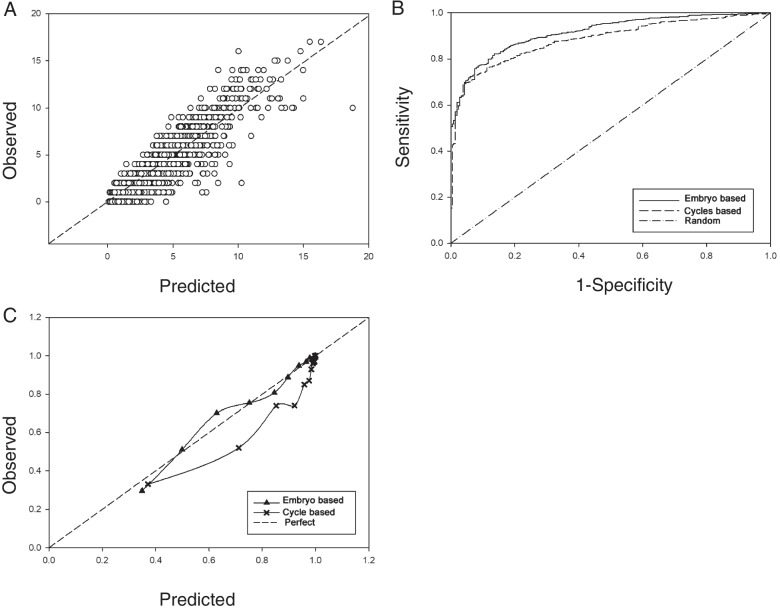
Retrospective evaluation of data from 15,613 patients receiving blastocyst culture from January 2013 through December 2020 in our institution were reviewed. Generalized estimating equations (GEE) were used to establish the morphology-based model. To estimate whether including more features regarding patient characteristics and cycle parameters improve the predicting power, we also establish models including 27 more features with either LASSO regression or XGbosst. The predicted number of blastocyst were associated with the observed number of the blastocyst and were used to predict the blastocyst transfer cancellation either in fresh or frozen cycles.
Based on early cleavage and routine observed morphological parameters (cell number, fragmentation, and symmetry), the GEE model predicted blastocyst formation with an AUC of 0.779(95%CI: 0.77-0.787) and an accuracy of 74.7%(95%CI: 73.9%-75.5%) in the validation set. LASSO regression model and XGboost model based on the combination of cycle characteristics and embryo morphology yielded similar predicting power with AUCs of 0.78(95%CI: 0.771-0.789) and 0.754(95%CI: 0.745-0.763), respectively. For per-cycle blastocyst yield, the predicted number of blastocysts using morphological parameters alone strongly correlated with observed blastocyst number (r = 0.897, P < 0.0001) and predicted blastocyst transfer cancel with an AUC of 0.926((95%CI: 0.911-0.94).
The data suggested that routine morphology observation remained a feasible tool to support an informed decision regarding the day of transfer. However, models based on the combination of cycle characteristics and embryo morphology do not increase the predicting power significantly.
包括延时成像和人工智能技术在内的先进模型已被用于预测囊胚形成。然而,传统的胚胎形态学评估仍被广泛使用。本研究的目的是评估传统形态学评估对囊胚形成的预测能力。
回顾性评估了2013年1月至2020年12月在本机构接受囊胚培养的15613例患者的数据。使用广义估计方程(GEE)建立基于形态学的模型。为了评估纳入更多患者特征和周期参数是否能提高预测能力,我们还使用LASSO回归或XGboost建立了包含另外27个特征的模型。预测的囊胚数量与观察到的囊胚数量相关,并用于预测新鲜周期或冷冻周期中囊胚移植取消的情况。
基于早期分裂和常规观察的形态学参数(细胞数量、碎片和对称性),GEE模型在验证集中预测囊胚形成的AUC为0.779(95%CI:0.77 - 0.787),准确率为74.7%(95%CI:73.9% - 75.5%)。基于周期特征和胚胎形态学组合的LASSO回归模型和XGboost模型具有相似的预测能力,AUC分别为0.78(95%CI:0.771 - 0.789)和0.754(95%CI:0.745 - 0.763)。对于每个周期的囊胚产量,仅使用形态学参数预测的囊胚数量与观察到的囊胚数量高度相关(r = 0.897,P < 0.0001),预测囊胚移植取消的AUC为0.926(95%CI:0.911 - 0.94)。
数据表明,常规形态学观察仍然是支持关于移植日做出明智决策的可行工具。然而,基于周期特征和胚胎形态学组合的模型并没有显著提高预测能力。