Tuominen Laura S, Helle Samuli, Helanterä Heikki, Karell Patrik, Rapeli Lauri, Richmond Douglas, Vuorisalo Timo, Brommer Jon E
Department of Biology, University of Turku, 20014, Turku, Finland.
Department of Social Research, University of Turku, 20014, Turku, Finland.
Sci Rep. 2022 Apr 19;12(1):6425. doi: 10.1038/s41598-022-10178-z.
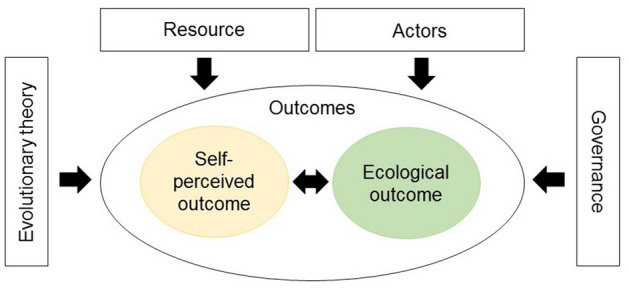
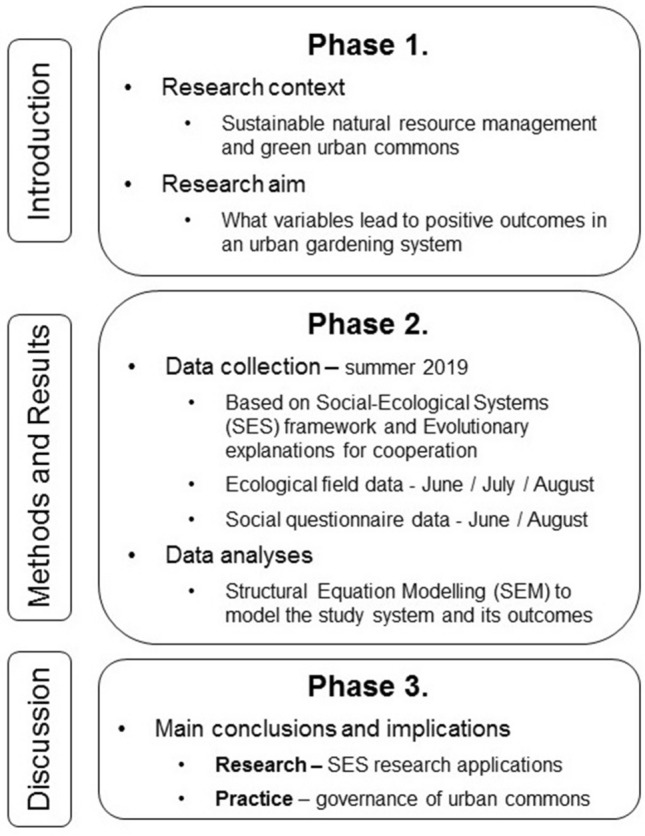
It is well known that green urban commons enhance mental and physical well-being and improve local biodiversity. We aim to investigate how these outcomes are related in an urban system and which variables are associated with better outcomes. We model the outcomes of an urban common-box gardening-by applying the Social-Ecological Systems (SES) framework. We expand the SES framework by analyzing it from the perspective of social evolution theory. The system was studied empirically through field inventories and questionnaires and modeled quantitatively by Structural Equation Modeling (SEM). This method offers powerful statistical models of complex social-ecological systems. Our results show that objectively evaluated ecological outcomes and self-perceived outcomes are decoupled: gardening groups that successfully govern the natural resource ecologically do not necessarily report many social, ecological, or individual benefits, and vice versa. Social capital, box location, gardener concerns, and starting year influenced the changes in the outcomes. In addition, the positive association of frequent interactions with higher self-perceived outcomes, and lack of such association with relatedness of group members suggests that reciprocity rather than kin selection explains cooperation. Our findings exemplify the importance of understanding natural resource systems at a very low "grassroot" level.
众所周知,城市绿色公共空间能增进身心健康,并改善当地生物多样性。我们旨在研究在城市系统中这些成果是如何相互关联的,以及哪些变量与更好的成果相关。我们通过应用社会生态系统(SES)框架,对城市公共箱式园艺的成果进行建模。我们从社会进化理论的角度分析SES框架,对其进行扩展。通过实地调查和问卷调查对该系统进行实证研究,并通过结构方程模型(SEM)进行定量建模。这种方法为复杂的社会生态系统提供了强大的统计模型。我们的结果表明,客观评估的生态成果和自我感知的成果是脱钩的:成功进行生态自然资源管理的园艺小组不一定会报告许多社会、生态或个人效益,反之亦然。社会资本、箱式园艺地点、园艺者的关注点和起始年份影响了成果的变化。此外,频繁互动与较高的自我感知成果呈正相关,而与小组成员的亲近感缺乏这种关联,这表明互惠而非亲属选择解释了合作。我们的研究结果例证了在非常低的“草根”层面理解自然资源系统的重要性。