von Hippel Paul T
University of Texas, Austin, TX, USA.
Sociol Methods Res. 2020 Aug;49(3):699-718. doi: 10.1177/0049124117747303. Epub 2018 Jan 18.
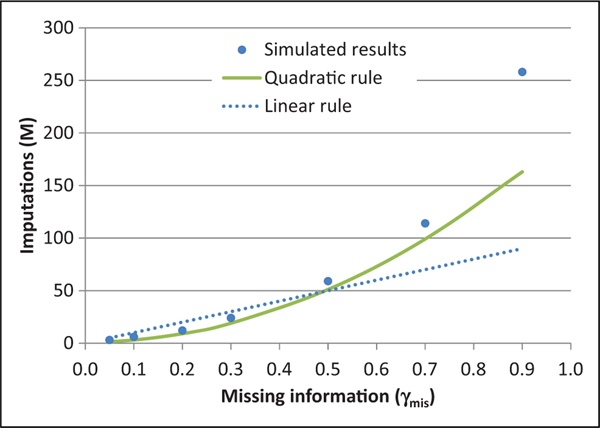
When using multiple imputation, users often want to know how many imputations they need. An old answer is that 2-10 imputations usually suffice, but this recommendation only addresses the efficiency of point estimates. You may need more imputations if, in addition to efficient point estimates, you also want standard error () estimates that would not change (much) if you imputed the data again. For replicable estimates, the required number of imputations increases quadratically with the fraction of missing information (not linearly, as previous studies have suggested). I recommend a two-stage procedure in which you conduct a pilot analysis using a small-to-moderate number of imputations, then use the results to calculate the number of imputations that are needed for a final analysis whose estimates will have the desired level of replicability. I implement the two-stage procedure using a new SAS macro called and a new Stata command called how_many_imputations.
在使用多重填补时,用户常常想知道需要进行多少次填补。一个老答案是2到10次填补通常就足够了,但这个建议仅涉及点估计的效率。如果除了高效的点估计之外,你还想要在再次填补数据时不会(大幅)改变的标准误估计,那么你可能需要更多次的填补。对于可复制的估计,所需的填补次数会随着缺失信息的比例呈二次方增加(而非如先前研究表明的呈线性增加)。我推荐一种两阶段程序,即先使用少量到中等数量的填补进行初步分析,然后利用结果来计算最终分析所需的填补次数,最终分析的估计将具有所需的可复制水平。我使用一个名为 的新SAS宏和一个名为how_many_imputations的新Stata命令来实现这个两阶段程序。