Dacon Cherrelle, Tucker Courtney, Peng Linghang, Lee Chang-Chun D, Lin Ting-Hui, Yuan Meng, Cong Yu, Wang Lingshu, Purser Lauren, Williams Jazmean K, Pyo Chul-Woo, Kosik Ivan, Hu Zhe, Zhao Ming, Mohan Divya, Cooper Andrew, Peterson Mary, Skinner Jeff, Dixit Saurabh, Kollins Erin, Huzella Louis, Perry Donna, Byrum Russell, Lembirik Sanae, Zhang Yi, Yang Eun Sung, Chen Man, Leung Kwanyee, Weinberg Rona S, Pegu Amarendra, Geraghty Daniel E, Davidson Edgar, Douagi Iyadh, Moir Susan, Yewdell Jonathan W, Schmaljohn Connie, Crompton Peter D, Holbrook Michael R, Nemazee David, Mascola John R, Wilson Ian A, Tan Joshua
Antibody Biology Unit, Laboratory of Immunogenetics, National Institute of Allergy and Infectious Diseases, National Institutes of Health, Rockville, MD 20852, USA.
Department of Immunology and Microbiology, The Scripps Research Institute, La Jolla, CA 92037, USA.
bioRxiv. 2022 Apr 12:2022.04.11.487879. doi: 10.1101/2022.04.11.487879.
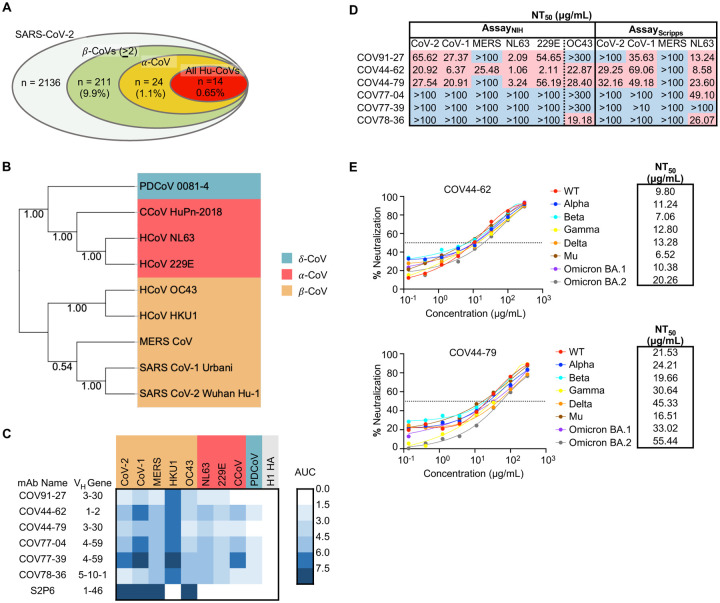
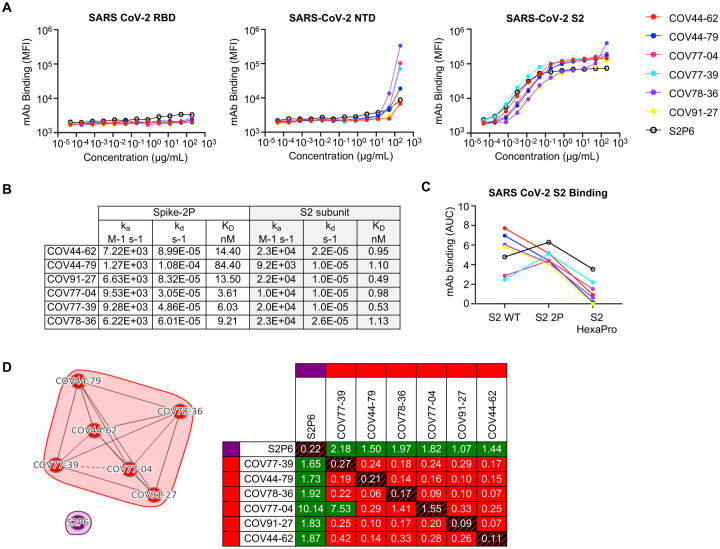
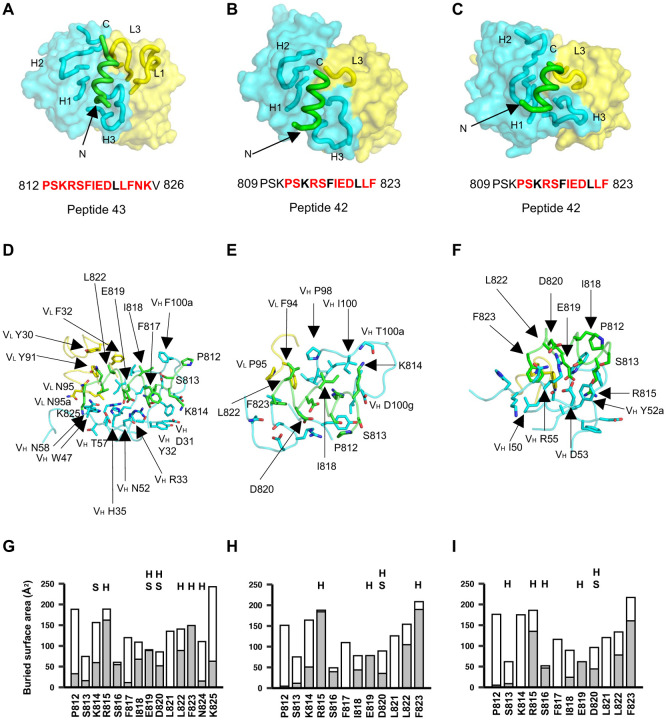
The potential for future coronavirus outbreaks highlights the need to develop strategies and tools to broadly target this group of pathogens. Here, using an epitope-agnostic approach, we identified six monoclonal antibodies that bound to spike proteins from all seven human-infecting coronaviruses. Epitope mapping revealed that all six antibodies target the conserved fusion peptide region adjacent to the S2' cleavage site. Two antibodies, COV44-62 and COV44-79, broadly neutralize a range of alpha and beta coronaviruses, including SARS-CoV-2 Omicron subvariants BA.1 and BA.2, albeit with lower potency than RBD-specific antibodies. In crystal structures of Fabs COV44-62 and COV44-79 with the SARS-CoV-2 fusion peptide, the fusion peptide epitope adopts a helical structure and includes the arginine at the S2' cleavage site. Importantly, COV44-79 limited disease caused by SARS-CoV-2 in a Syrian hamster model. These findings identify the fusion peptide as the target of the broadest neutralizing antibodies in an epitope-agnostic screen, highlighting this site as a candidate for next-generation coronavirus vaccine development.
ONE-SENTENCE SUMMARY: Rare monoclonal antibodies from COVID-19 convalescent individuals broadly neutralize coronaviruses by targeting the fusion peptide.
未来冠状病毒爆发的可能性凸显了制定广泛针对这类病原体的策略和工具的必要性。在此,我们采用一种不依赖表位的方法,鉴定出六种单克隆抗体,它们能与所有七种感染人类的冠状病毒的刺突蛋白结合。表位作图显示,所有六种抗体都靶向S2'切割位点附近的保守融合肽区域。两种抗体,COV44-62和COV44-79,能广泛中和一系列α和β冠状病毒,包括SARS-CoV-2奥密克戎亚型BA.1和BA.2,尽管效力低于靶向受体结合域(RBD)的抗体。在COV44-62和COV44-79与SARS-CoV-2融合肽的Fab片段的晶体结构中,融合肽表位呈现螺旋结构,且包括S2'切割位点处的精氨酸。重要的是,COV44-79在叙利亚仓鼠模型中减轻了SARS-CoV-2引起的疾病。这些发现确定了融合肽是不依赖表位筛选中最广泛中和抗体的靶点,突出了该位点作为下一代冠状病毒疫苗开发候选靶点的地位。
来自新冠康复个体的罕见单克隆抗体通过靶向融合肽广泛中和冠状病毒。