Lipu/BirdLife Italia, Parma, Italy.
MUSE-Museo delle Scienze, Sezione Zoologia dei Vertebrati, Trento, Italy.
Glob Chang Biol. 2022 Jul;28(14):4276-4291. doi: 10.1111/gcb.16187. Epub 2022 Apr 20.
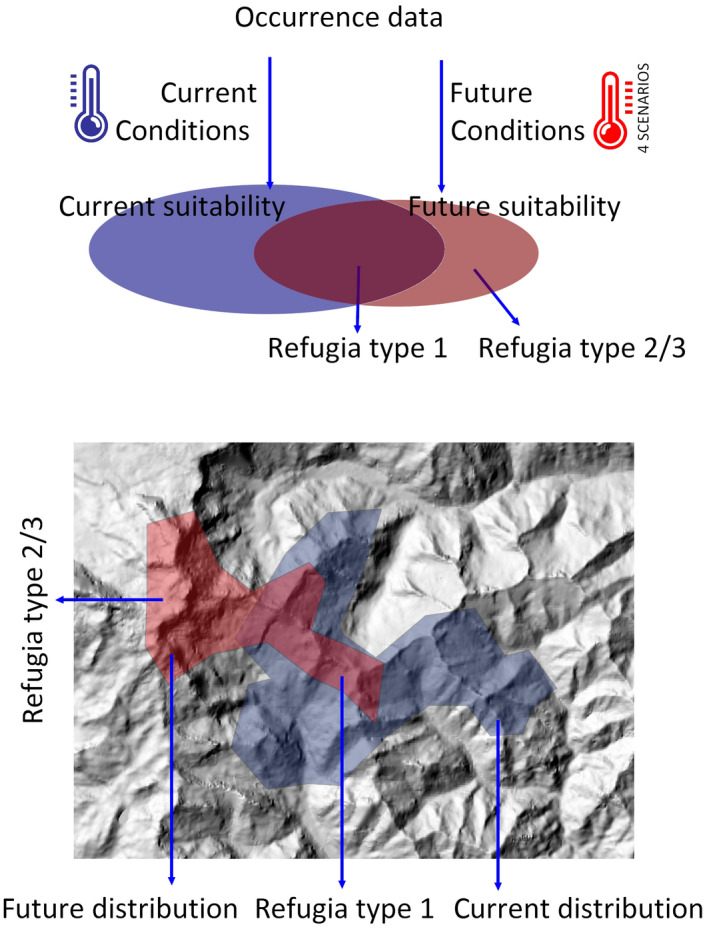
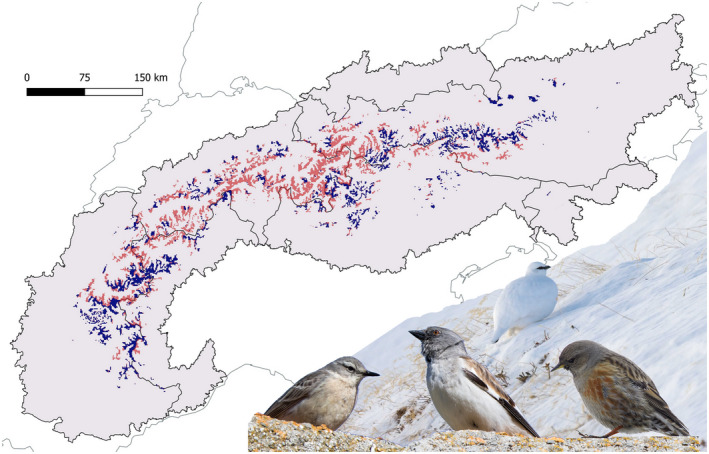
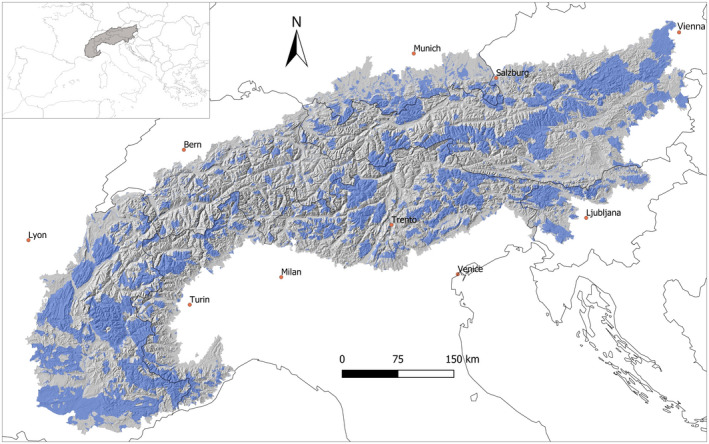
Identifying climate refugia is key to effective biodiversity conservation under a changing climate, especially for mountain-specialist species adapted to cold conditions and highly threatened by climate warming. We combined species distribution models (SDMs) with climate forecasts to identify climate refugia for high-elevation bird species (Lagopus muta, Anthus spinoletta, Prunella collaris, Montifringilla nivalis) in the European Alps, where the ecological effects of climate changes are particularly evident and predicted to intensify. We considered future (2041-2070) conditions (SSP585 scenario, four climate models) and identified three types of refugia: (1) in-situ refugia potentially suitable under both current and future climate conditions, ex-situ refugia suitable (2) only in the future according to all future conditions, or (3) under at least three out of four future conditions. SDMs were based on a very large, high-resolution occurrence dataset (2901-12,601 independent records for each species) collected by citizen scientists. SDMs were fitted using different algorithms, balancing statistical accuracy, ecological realism and predictive/extrapolation ability. We selected the most reliable ones based on consistency between training and testing data and extrapolation over distant areas. Future predictions revealed that all species (with the partial exception of A. spinoletta) will undergo a range contraction towards higher elevations, losing 17%-59% of their current range (larger losses in L. muta). We identified ~15,000 km of the Alpine region as in-situ refugia for at least three species, of which 44% are currently designated as protected areas (PAs; 18%-66% among countries). Our findings highlight the usefulness of spatially accurate data collected by citizen scientists, and the importance of model testing by extrapolating over independent areas. Climate refugia, which are only partly included within the current PAs system, should be priority sites for the conservation of Alpine high-elevation species and habitats, where habitat degradation/alteration by human activities should be prevented to ensure future suitability for alpine species.
确定气候避难所是应对气候变化下生物多样性保护的关键,特别是对于适应寒冷条件且受气候变暖威胁极大的高山特有物种而言。我们将物种分布模型(SDMs)与气候预测相结合,以确定欧洲阿尔卑斯山高海拔鸟类物种(Lagopus muta、Anthus spinoletta、Prunella collaris、Montifringilla nivalis)的气候避难所,这些物种在气候变化的生态影响尤为明显,并预计会加剧。我们考虑了未来(2041-2070 年)的情况(SSP585 情景,四个气候模型),并确定了三种类型的避难所:(1)在当前和未来气候条件下都潜在适宜的原地避难所,(2)根据所有未来条件都适宜的异地避难所,或(3)至少在四个未来条件中的三个条件下适宜的避难所。SDMs 基于由公民科学家收集的非常大的、高分辨率的出现数据集(每种物种 2901-12601 个独立记录)。SDMs 使用不同的算法进行拟合,平衡统计准确性、生态现实性和预测/外推能力。我们根据训练和测试数据之间的一致性以及对遥远地区的外推选择最可靠的模型。未来预测表明,所有物种(除了 A. spinoletta 部分物种外)的分布范围将向高海拔收缩,丧失其当前分布范围的 17%-59%(L. muta 物种的损失更大)。我们确定了阿尔卑斯地区约 15000 公里的区域为至少三种物种的原地避难所,其中 44%目前被指定为保护区(各国之间的比例为 18%-66%)。我们的研究结果突出了公民科学家收集的空间准确数据的有用性,以及通过在独立区域进行外推来测试模型的重要性。气候避难所仅部分包含在当前的保护区系统中,应成为保护高山高海拔物种和栖息地的优先地点,应防止人类活动导致的栖息地退化/改变,以确保未来对高山物种的适宜性。