Department of Global Health, Boston University School of Public Health, Boston, Massachusetts, United States of America.
Innovation for Poverty Action, Nairobi, Kenya.
PLoS One. 2022 Apr 20;17(4):e0266715. doi: 10.1371/journal.pone.0266715. eCollection 2022.
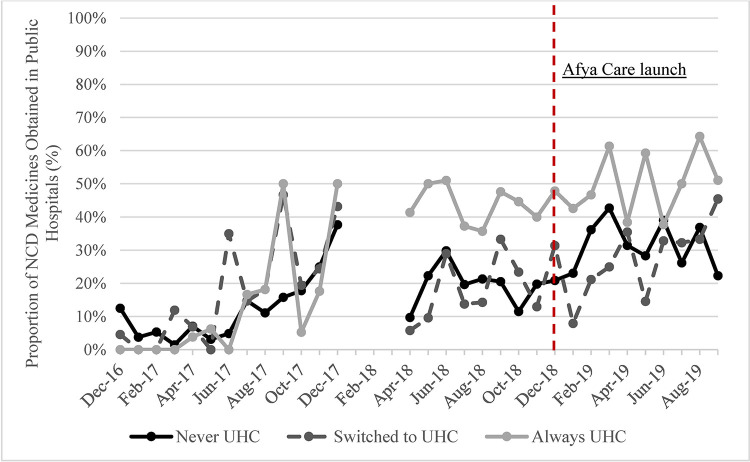
This study aims to describe trends and estimate impact of county-level universal health coverage expansion in Kenya on household availability of non-communicable disease medicines, medicine obtainment at public hospitals and proportion of medicines obtained free of charge.
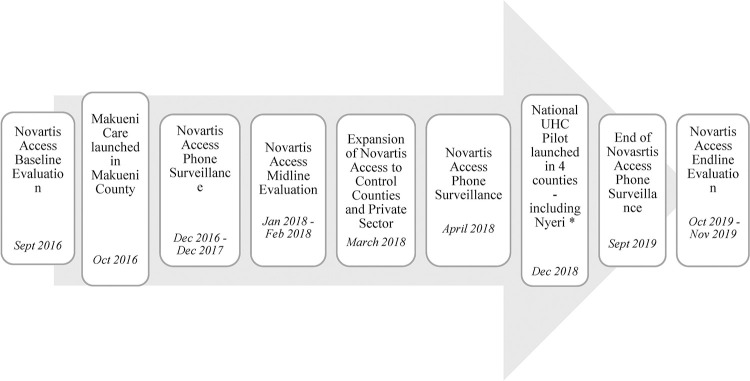
Data from phone surveillance of households in eight Kenyan counties between December 2016 and September 2019 were used. Three primary outcomes related to access were assessed based on patient report: availability of non-communicable disease medicines at the household; non-communicable disease medicine obtainment at a public hospital versus a different outlet; and non-communicable disease medicine obtainment free of cost versus at a non-zero price. Mixed models adjusting for fixed and random effects were used to estimate associations between outcomes of interest and UHC exposure.
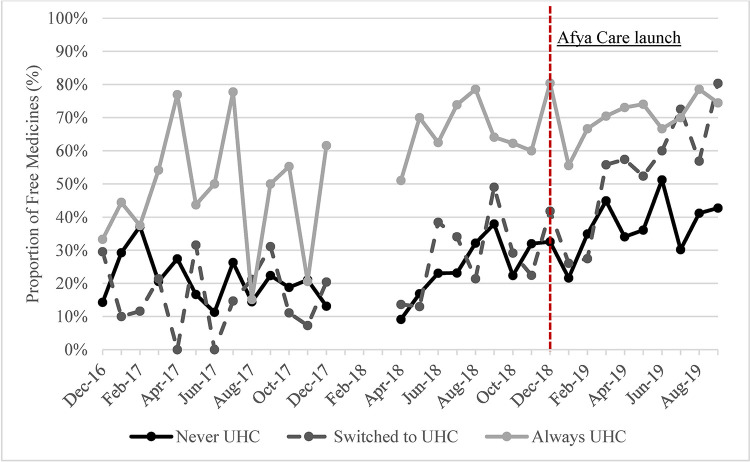
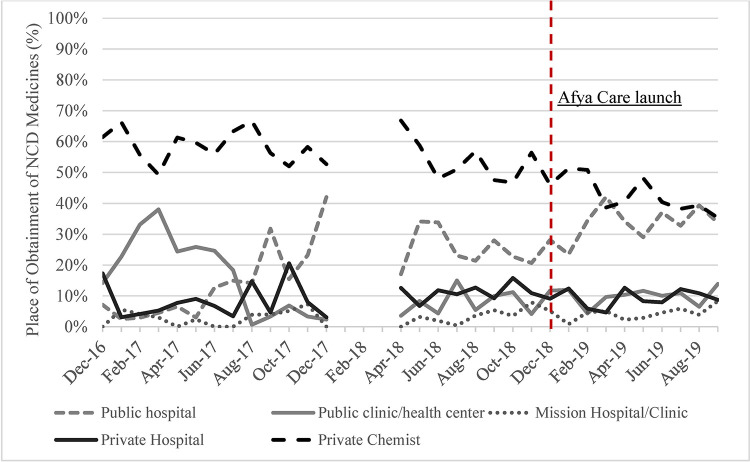
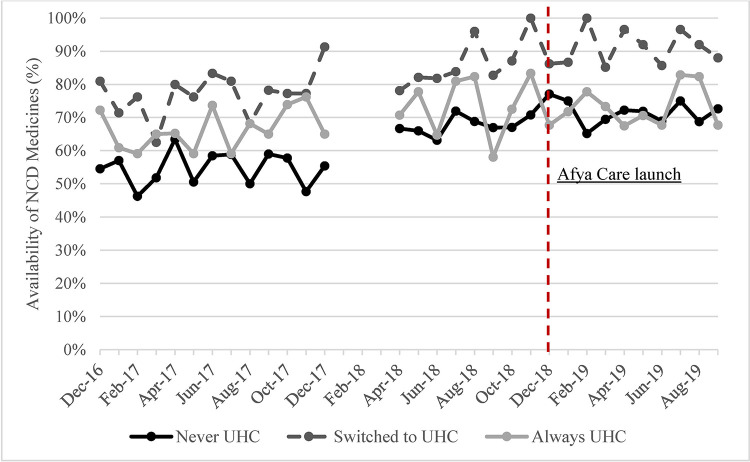
The 197 respondents with universal health coverage were similar on all demographic factors to the 415 respondents with no universal health coverage. Private chemists were the most popular place of purchase throughout the study. Adjusting for demographic factors, county and time fixed effects, there was a significant increase in free medicines (aOR 2.55, 95% CI 1.73, 3.76), significant decrease in medicine obtainment at public hospitals (aOR 0.68, 95% CI 0.47, 0.97), and no impact on the availability of non-communicable disease medicines in households (aβ -0.004, 95% CI -0.058, 0.050) with universal health coverage.
Access to universal health coverage caused a significant increase in free non-communicable disease medicines, indicating financial risk protection. Interestingly, this is not accompanied with increases in public hospitals purchases or household availability of non-communicable disease medicines, with public health centers playing a greater role in supply of free medicines. This raises the question as to the status of supply-side investments at the public hospitals, to facilitate availability of quality-assured medicines.
本研究旨在描述肯尼亚县级全民健康覆盖扩展的趋势,并评估其对家庭中非传染性疾病药物可得性、在公立医院获取药物以及免费获取药物比例的影响。
使用了 2016 年 12 月至 2019 年 9 月期间在肯尼亚 8 个县对家庭进行电话监测的数据。根据患者报告,评估了与获得相关的三个主要结果:家庭中非传染性疾病药物的可得性;在公立医院与其他渠道获得非传染性疾病药物;以及免费与非零价格获得非传染性疾病药物。使用混合模型调整固定和随机效应,估计感兴趣的结果与全民健康覆盖之间的关联。
在所有人口统计学因素上,197 名有全民健康覆盖的受访者与 415 名没有全民健康覆盖的受访者相似。私人药店是整个研究过程中最受欢迎的购买地点。在调整人口统计学因素、县和时间固定效应后,免费药物的数量显著增加(优势比 2.55,95%置信区间 1.73,3.76),在公立医院获取药物的数量显著减少(优势比 0.68,95%置信区间 0.47,0.97),家庭中非传染性疾病药物的可得性没有影响(β-0.004,95%置信区间 -0.058,0.050)。
获得全民健康覆盖显著增加了免费的非传染性疾病药物,表明存在财务风险保护。有趣的是,这并没有伴随着公立医院购买或家庭中非传染性疾病药物可得性的增加,公共卫生中心在提供免费药物方面发挥了更大的作用。这就提出了一个问题,即公立医院的供应方投资状况如何,以促进高质量药物的供应。