Department of General, Visceral, Cancer And Transplant Surgery, University of Cologne, Cologne, Germany.
Department of General and Visceral Surgery, Evangelisches Klinikum Bethel, Universitätsklinikum OWL, Bielefeld, Germany.
BMC Med Educ. 2022 Apr 20;22(1):295. doi: 10.1186/s12909-022-03215-y.
The usage of smartphones in the daily clinical routine is an essential aspect however it seems that they also present an important distractor that needs to be evaluated. The aim of this prospective study was the evaluation of the influence of phone calls as distractors on the performance levels of medical students during an objective structured clinical examination (OSCE), simulating the normal clinical practice.
As the goal of an OSCE presents the examination of clinical skills of medical students in a realistic setting, more than 100 students recruited from the university hospital of Cologne participated in either OSCE I or II. During the OSCE I intravenous cannulation was simulated while OSCE II simulated an acute abdominal pain station. Participants had to perform each of these stations under two circumstances: a normal simulated OSCE and an OSCE station with phone call distraction. Their performance during both simulations was then evaluated.
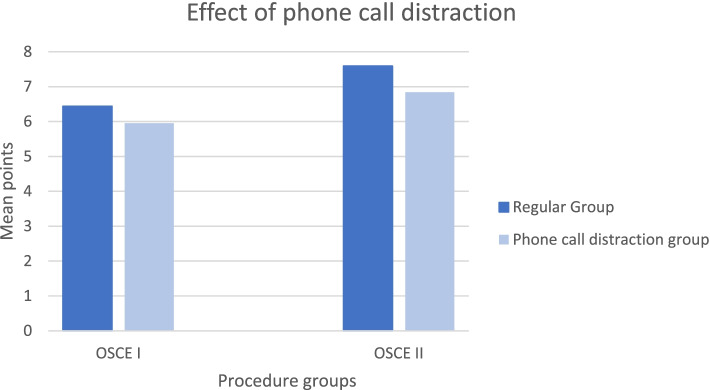
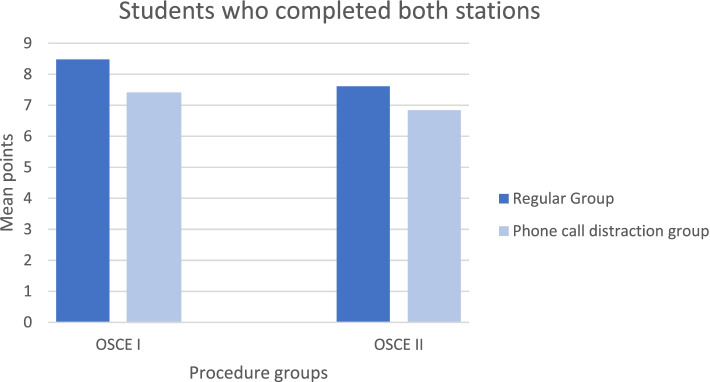
In OSCE I students achieved significantly more points in the intravenous cannulation station if they were not distracted by phone calls (M=6.44 vs M=5.95). In OSCE II students achieved significantly more points in the acute abdominal pain station if they were not distracted by phone calls (M=7.59 vs M=6.84). While comparing only those students that completed both stations in OSCE I/II participating students achieved significantly more points in both OSCE I and II if they were not distracted by phone calls.
The presented data shows that phone call distraction decreases the performance level of medical students during an OSCE station. Therefore, it is an indicator that distraction especially for younger doctors should be held to a minimum. On a second note distraction should be integrated in the medical education system as it plays an important role in clinical routine.
智能手机在日常临床工作中的使用是一个重要方面,但它们似乎也是一个需要评估的重要干扰因素。本前瞻性研究的目的是评估在客观结构化临床考试(OSCE)中,电话干扰对医学生表现水平的影响,模拟正常的临床实践。
由于 OSCE 的目标是在真实环境中检查医学生的临床技能,因此来自科隆大学医院的 100 多名学生参加了 OSCE I 或 OSCE II。在 OSCE I 中模拟了静脉穿刺,而 OSCE II 模拟了急性腹痛站。参与者必须在两种情况下完成这些站点中的每一个:正常模拟 OSCE 和带电话干扰的 OSCE 站点。然后评估他们在这两种模拟中的表现。
在 OSCE I 中,如果学生不受电话干扰,他们在静脉穿刺站的得分明显更高(M=6.44 与 M=5.95)。在 OSCE II 中,如果学生不受电话干扰,他们在急性腹痛站的得分明显更高(M=7.59 与 M=6.84)。在仅比较那些完成 OSCE I/II 中两个站点的学生的情况下,如果学生不受电话干扰,他们在 OSCE I 和 OSCE II 中的得分都明显更高。
所提供的数据表明,电话干扰会降低医学生在 OSCE 站的表现水平。因此,它是一个指示,表明特别是对于年轻医生,干扰应尽量减少。其次,干扰应纳入医学教育系统,因为它在临床常规中起着重要作用。