Department of Medical Oncology, The First Affiliated Hospital of Hainan Medical University, Haikou 570102, Hainan, People's Republic of China.
Department of Gynecology, The Second Affiliated Hospital of Hainan Medical University, Haikou 570311, Hainan, People's Republic of China.
Aging (Albany NY). 2022 Apr 20;14(8):3425-3445. doi: 10.18632/aging.204021.
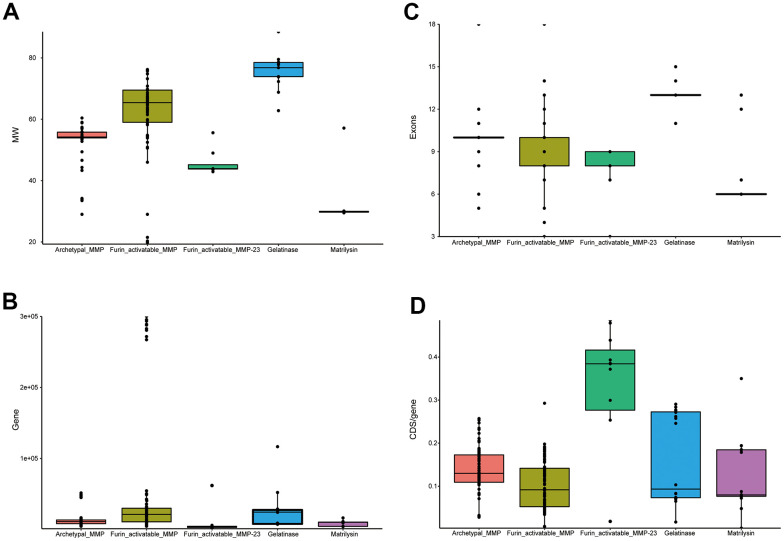
Deregulation of matrix metalloproteinases (MMPs) contributes considerably to cancers, psychiatric disorders, macular degeneration and bone diseases. The use of humans in the development of MMPs as prognostic biomarkers and therapeutic targets is complicated by many factors, while primate models can be useful alternatives for this purpose. Here, we performed genome-enabled identification of putative MMPs across primate species, and comprehensively investigated the genes. Phylogenetic topology of the MMP family showed each type formulates a distinct clade, and was further clustered to classes, largely agreeing with classification based on biochemical properties and domain organization. Across primates, the excess of candidate sites of positive selection was detected for MMP-19, in addition to 1-3 sites in MMP-8, MMP-10 and MMP-26. MMP-26 showed value above 1 between human and chimpanzee copies. We observed two copies of MMP-19 in the old-world monkey genomes, suggesting gene duplication at the early stage of or prior to the emergence of the lineage. Furin-activatable MMPs demonstrate the most variable properties regarding Domain organization and gene structure. During human aging, MMP-11 showed gradually decreased expression in testis, so as MMP-2, MMP-14, MMP15 and MMP-28 in ovary, while MMP-7 and MMP-21 showed elevated expression, implying their distinct roles in different reproductive organs. Co-expression clusters were formed among human MMPs both within and across classes, and expression correlation was observed in MMP genes across primates. Our results illuminate the utilization of MMPs for the discovery of prognostic biomarkers and therapeutic targets for aging-related diseases and carry new messages on MMP classification.
基质金属蛋白酶(MMPs)的失调对癌症、精神疾病、黄斑变性和骨疾病有很大的影响。由于许多因素的影响,将人类用于 MMPs 作为预后生物标志物和治疗靶点的开发变得复杂,而灵长类动物模型可以作为替代方法。在这里,我们在灵长类物种中进行了基于基因组的 MMP 鉴定,并对这些基因进行了全面的研究。MMP 家族的系统发育拓扑结构表明每种类型都形成一个独特的分支,并且进一步聚类为不同的类别,这在很大程度上与基于生化特性和结构域组织的分类一致。在灵长类动物中,除了 MMP-8、MMP-10 和 MMP-26 中的 1-3 个候选正选择位点外,还检测到 MMP-19 的候选正选择位点过多。MMP-26 在人与黑猩猩拷贝之间的 值高于 1。我们在旧世界猴的基因组中观察到两个 MMP-19 拷贝,表明在谱系出现之前或早期发生了基因复制。弗林激活的 MMPs 在结构域组织和基因结构方面表现出最具变异性的特性。在人类衰老过程中,MMP-11 在睾丸中的表达逐渐降低,而 MMP-2、MMP-14、MMP15 和 MMP-28 在卵巢中的表达也逐渐降低,而 MMP-7 和 MMP-21 的表达则升高,表明它们在不同的生殖器官中具有不同的作用。人类 MMPs 内部和跨类别的共表达簇形成,并且在灵长类动物中观察到 MMP 基因之间的表达相关性。我们的研究结果阐明了 MMPs 在发现与衰老相关的疾病的预后生物标志物和治疗靶点方面的应用,并为 MMP 分类提供了新的信息。