Souilm Nagwa, Elsakhy Nancy Mahmoud, Alotaibi Yasir A, Ali Safaa Abdelazem Osman
Faculty of Nursing, Beni-Suef University, Beni-Suef, Egypt.
Faculty of Nursing, Matrouh University, Matrouh, Egypt.
Sci Rep. 2022 Apr 20;12(1):6521. doi: 10.1038/s41598-022-10456-w.
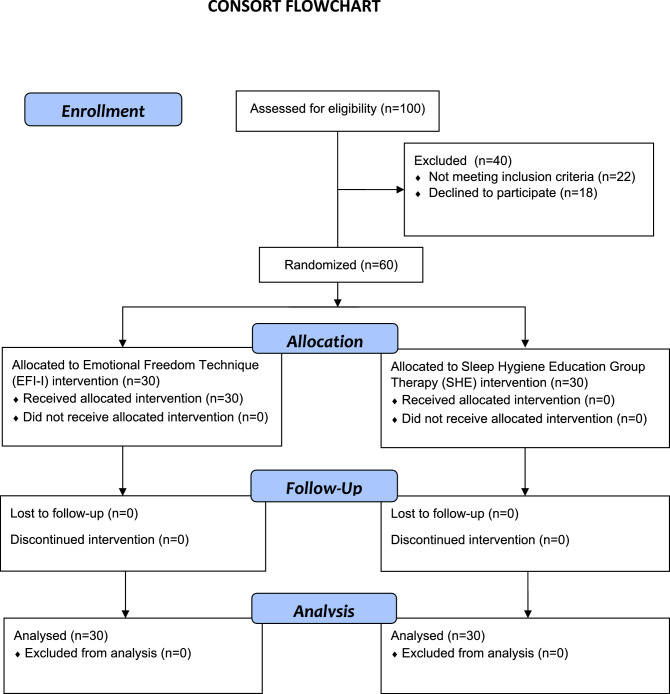
Sleep disorders are common among elderly persons, with deleterious effects on their physical and mental health. Many approaches are used to manage such disorders. To compare the Emotional Freedom Techniques-Insomnia (EFT-I) and Sleep Hygiene Education (SHE) group therapy as two treatments for insomnia in a geriatric population when delivered, and their effects on sleep quality, depression, and life satisfaction. This open-label randomized controlled trial study was conducted at El-Abbasia Mental Hospital and Osana family wellness elderly nursing home at Maadi, Cairo. It included 60 elderly patients suffering insomnia sleep problems randomized into two equal groups: one group received a Sleep Hygiene Education (SHE) intervention, the other had a form of Emotional Freedom Techniques (EFT) adapted for use with insomnia (EFT-I). A self-administered questionnaire with tools for sleep quality (Pittsburgh Sleep Quality Index [PSQI]), depression, and life satisfaction was used to collect data. The fieldwork was from January to March 2021. The two groups had equal median age (70 years), and almost similar gender and place of residence distribution. After the intervention, 73.3% of the EFT group had good sleep quality, compared to 100.0% in the SHE group (P = 0.005); the median score of depression (3.00) was higher in the EFT group compared with 0.00 in the SHE group (P < 0.001); as for life satisfaction, the difference was not statistically significant. The multivariate analyses identified the study intervention as the main statistically significant negative predictor of PSQI and depression scores, and a positive predictor of life satisfaction. Being in the SHE group was a negative predictor of PSQI and depression scores. Both SHE and EFT approaches are beneficial for elderly patients' sleep quality, with SHE being more effective in ameliorating sleep. Further replication of this study is needed on a large probability sample from different geographical areas to help for the generalization of the results.
睡眠障碍在老年人中很常见,会对他们的身心健康产生有害影响。人们采用了多种方法来管理此类障碍。为了比较情绪自由技术 - 失眠症(EFT - I)和睡眠卫生教育(SHE)团体治疗作为老年人群失眠的两种治疗方法,以及它们对睡眠质量、抑郁和生活满意度的影响。这项开放标签随机对照试验研究在开罗马阿迪的阿巴西亚精神病院和奥萨纳家庭健康老年疗养院进行。研究纳入了60名患有失眠睡眠问题的老年患者,随机分为两组:一组接受睡眠卫生教育(SHE)干预,另一组采用一种适用于失眠症的情绪自由技术(EFT)形式(EFT - I)。使用一份包含睡眠质量工具(匹兹堡睡眠质量指数[PSQI])、抑郁和生活满意度的自填问卷来收集数据。实地调查于2021年1月至3月进行。两组的年龄中位数相等(70岁),性别和居住地点分布也几乎相似。干预后,EFT组73.3%的患者睡眠质量良好,而SHE组为100.0%(P = 0.005);EFT组的抑郁中位数得分(3.00)高于SHE组的0.00(P < 0.001);至于生活满意度,差异无统计学意义。多变量分析确定研究干预是PSQI和抑郁得分的主要统计学显著负预测因子,以及生活满意度的正预测因子。处于SHE组是PSQI和抑郁得分的负预测因子。SHE和EFT方法对老年患者的睡眠质量都有益,其中SHE在改善睡眠方面更有效。需要在来自不同地理区域的大概率样本上进一步重复这项研究,以帮助推广研究结果。