Cozzi Ilaria, Rossi Giovanni, Rullo Emma, Ascoli Valeria
Department of Radiological, Oncological and Pathological Sciences, Sapienza University, Rome.
Mediterr J Hematol Infect Dis. 2022 Mar 1;14(1):e2022020. doi: 10.4084/MJHID.2022.020. eCollection 2022.
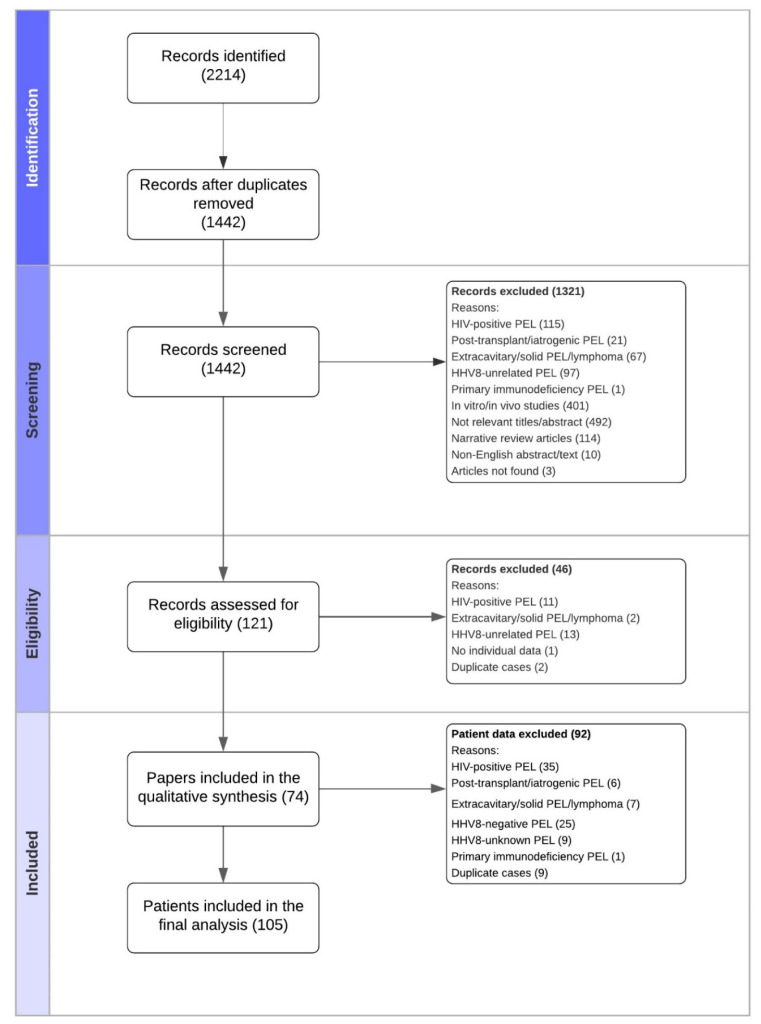
Primary effusion lymphoma (PEL) is a large B-cell lymphoma growing within body-cavities caused by the Kaposi sarcoma-associated herpesvirus (KSHV)/human herpesvirus-8 (KSHV/HHV-8). It is mainly reported in HIV-infected patients. The uncommon occurrence in the elderly supports a form paralleling classic Kaposi sarcoma (KS), i.e. classic PEL, whose characteristics are relatively underexplored. To better understand the diagnostic modalities and clinical-epidemiological features of classic PEL, articles reporting cases of PEL were identified through MEDLINE/EMBASE databases (January 1998-July 2020) and screened according to PRISMA guidelines to extract individual-level data. A comparison was also performed between classic PEL and classic KS to evaluate similarities and differences. We identified 105 subjects (median age 77 years; 86% males), mainly from Mediterranean countries (52%, first Italy) and Eastern Europe (7%). Common comorbidities were heart failure (32%), cirrhosis (16%), and malignancy (20%) including lymphoid neoplasms. Pleural cavity was the commonest site (67%). PEL diagnosis was based on cytomorphology (89%), evidence of KSHV/HHV-8 infection (94%), EBV co-infection (28%) and clonality of IGH (59%), IGK (14%), TRG (9%) alone or in multiple combinations. Compared to KS, age (P<.001), gender-ratio (P=.08) and mortality (P<.001) were significantly higher in PEL, whereas the frequency of PEL as a second primary was similar (P=.44). This is the first systematic review of classic PEL case reports highlighting heterogeneity and lack of a uniform multidisciplinary approach at diagnosis, in the absence of specific guidelines as it happens for rare cancers. It is conceivable that classic PEL is still underdiagnosed in Mediterranean countries wherein KSHV/HHV-8 is endemic.
原发性渗出性淋巴瘤(PEL)是一种由卡波西肉瘤相关疱疹病毒(KSHV)/人类疱疹病毒8型(KSHV/HHV-8)引起的、在体腔内生长的大B细胞淋巴瘤。它主要在HIV感染患者中报道。在老年人中罕见的发生情况支持了一种与经典卡波西肉瘤(KS)相似的形式,即经典PEL,其特征相对未被充分探索。为了更好地了解经典PEL的诊断方式和临床流行病学特征,通过MEDLINE/EMBASE数据库(1998年1月至2020年7月)识别了报告PEL病例的文章,并根据PRISMA指南进行筛选以提取个体水平的数据。还对经典PEL和经典KS进行了比较,以评估异同。我们确定了105名受试者(中位年龄77岁;86%为男性),主要来自地中海国家(52%,首先是意大利)和东欧(7%)。常见的合并症有心力衰竭(32%)、肝硬化(16%)和恶性肿瘤(20%),包括淋巴肿瘤。胸腔是最常见的部位(67%)。PEL的诊断基于细胞形态学(89%)、KSHV/HHV-8感染的证据(94%)、EBV合并感染(28%)以及IGH(59%)、IGK(14%)、TRG(9%)单独或多种组合的克隆性。与KS相比,PEL的年龄(P<0.001)、性别比(P=0.08)和死亡率(P<0.001)显著更高,而PEL作为第二原发性肿瘤的频率相似(P=0.44)。这是对经典PEL病例报告的首次系统综述,突出了其异质性以及在诊断时缺乏统一的多学科方法。由于罕见癌症的情况就是如此,目前尚无具体指南。可以想象,在地中海地区KSHV/HHV-8流行的国家,经典PEL仍未得到充分诊断。