Zheng Guanghui, Shi Yijun, Cao Yanfei, Qian Lingye, Lv Hong, Zhang Lina, Zhang Guojun
Department of Clinical Diagnosis, Laboratory of Beijing Tiantan Hospital and Capital Medical University, Beijing, China.
NMPA Key Laboratory for Quality Control of In Vitro Diagnostics, Beijing, China.
Front Cell Infect Microbiol. 2022 Apr 4;12:839257. doi: 10.3389/fcimb.2022.839257. eCollection 2022.
This is a comparative cohort study aiming to evaluate the mortality risk factors for patients with nosocomial meningitis (NM) induced by multidrug-resistant Enterobacteriaceae (MDRE) in China. The clinical features and therapies of patients and the resistance mechanisms of MDRE pathogens were also assessed.
MDRE-NM patients from two neurosurgical centers in China from 2014 to 2019 were included in this study. Clinical features were extracted from the medical record databases of the two centers. The molecular mechanisms underlying the microbiological resistance mechanisms of each MDRE pathogen were determined, Kaplan-Meier survival analysis was conducted, and multivariable analyses were performed using a Cox proportional hazard model.
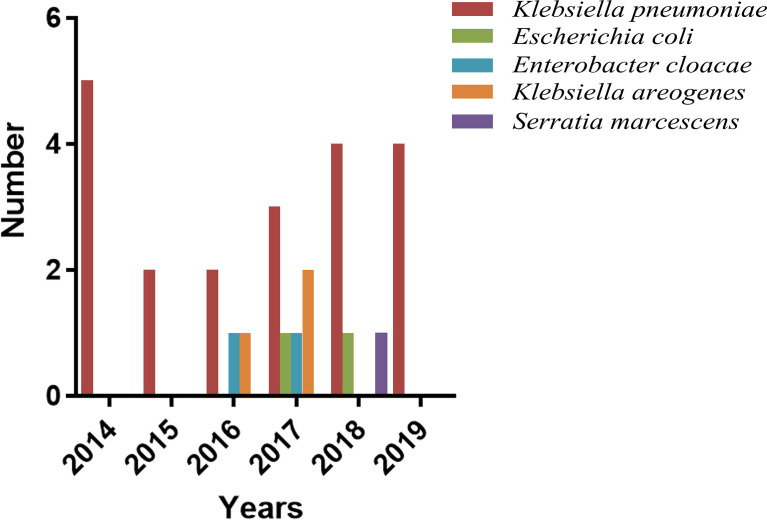
Ninety MDRE-NM patients were included in this study. accounted for the highest proportion of causative pathogens (46/90, 51.1%), and 40 causative pathogens (44.4%) were meropenem-resistant. blaKPC (27/40, 67.5%) was the predominant carbapenem resistance gene. Multivariate Cox analysis showed that external ventricular drainage (EVD) [hazard ratio (HR) = 2.524, 95% confidence interval (CI) = 1.101-5.787, p = 0.029] and a Glasgow Coma Scale (GCS) score ≤;8 (HR = 4.033, 95% CI = 1.526-10.645, p = 0.005) were mortality risk factors for patients with MDRE-NM. A total of 90.0%, 94.4%, and 97.8% of MDRE-NM patients received antibiotic prophylaxis (AP), antibiotic empirical therapy (AET), and antibiotic definitive therapy (ADT), respectively.
NM caused by MDRE is an important sign of the failure of neurosurgery. MDRE possesses multiple drug resistance genotypes, and EVD and a GCS score ≤;8 are independent mortality risk factors for patients with MDRE-NM, which deserve the attention of microbiologists and neurosurgical clinicians.
本研究为一项比较队列研究,旨在评估中国耐多药肠杆菌科细菌(MDRE)所致医院获得性脑膜炎(NM)患者的死亡风险因素。同时评估患者的临床特征、治疗方法以及MDRE病原体的耐药机制。
纳入2014年至2019年来自中国两个神经外科中心的MDRE-NM患者。从两个中心的病历数据库中提取临床特征。确定每种MDRE病原体微生物耐药机制的分子机制,进行Kaplan-Meier生存分析,并使用Cox比例风险模型进行多变量分析。
本研究共纳入90例MDRE-NM患者。 为主要致病病原体(46/90,51.1%),40种致病病原体(44.4%)对美罗培南耐药。blaKPC(27/40,67.5%)是主要的碳青霉烯类耐药基因。多变量Cox分析显示,外置脑室引流(EVD)[风险比(HR)=2.524,95%置信区间(CI)=1.101-5.787,p=0.029]和格拉斯哥昏迷量表(GCS)评分≤8(HR=4.033,95%CI=1.526-10.645,p=0.005)是MDRE-NM患者的死亡风险因素。分别有90.0%、94.4%和97.8%的MDRE-NM患者接受了抗生素预防(AP)、抗生素经验性治疗(AET)和抗生素确定性治疗(ADT)。
MDRE所致NM是神经外科手术失败的重要标志。MDRE具有多种耐药基因型,EVD和GCS评分≤8是MDRE-NM患者独立的死亡风险因素,值得微生物学家和神经外科临床医生关注。