Saad Shannon L, Richmond Cassandra, Jones Karina, Schlipalius Michelle, Rienits Helen, Malau-Aduli Bunmi S
School of Medicine, Notre Dame University, Sydney, NSW, Australia.
College of Medicine and Dentistry, James Cook University, Townsville, QLD, Australia.
Front Med (Lausanne). 2022 Apr 4;9:844884. doi: 10.3389/fmed.2022.844884. eCollection 2022.
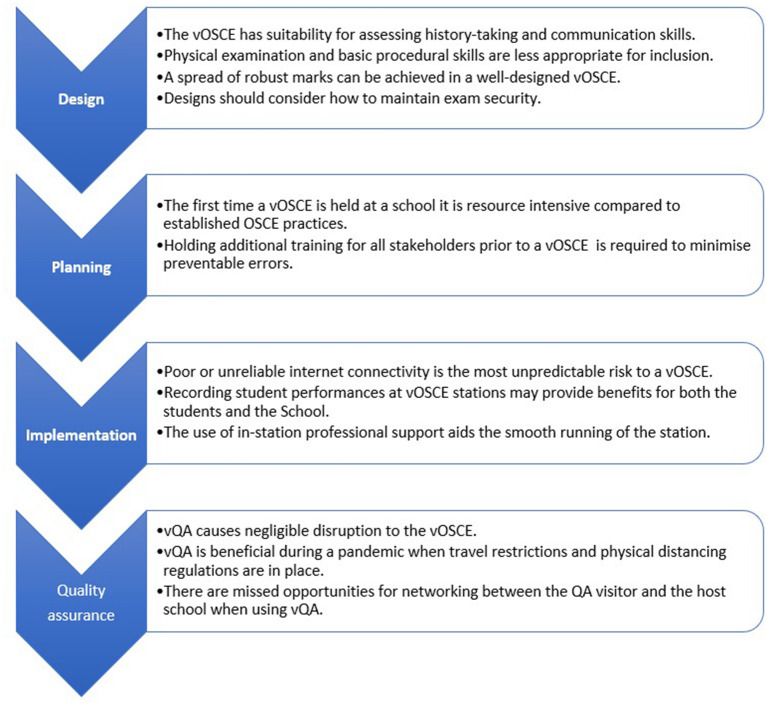
During 2020, the COVID-19 pandemic caused worldwide disruption to the delivery of clinical assessments, requiring medicals schools to rapidly adjust their design of established tools. Derived from the traditional face-to-face Objective Structured Clinical Examination (OSCE), the virtual OSCE (vOSCE) was delivered online, using a range of school-dependent designs. The quality of these new formats was evaluated remotely through virtual quality assurance (vQA). This study synthesizes the vOSCE and vQA experiences of stakeholders from participating Australian medical schools based on a Quality framework.
This study utilized a descriptive phenomenological qualitative design. Focus group discussions (FGD) were held with 23 stakeholders, including examiners, academics, simulated patients, professional staff, students and quality assurance examiners. The data was analyzed using a theory-driven conceptual Quality framework.
The vOSCE was perceived as a relatively fit-for purpose assessment during pandemic physical distancing mandates. Additionally, the vOSCE was identified as being value-for-money and was noted to provide procedural benefits which lead to an enhanced experience for those involved. However, despite being largely delivered fault-free, the current designs are considered limited in the scope of skills they can assess, and thus do not meet the established quality of the traditional OSCE.
Whilst virtual clinical assessments are limited in their scope of assessing clinical competency when compared with the traditional OSCE, their integration into programs of assessment does, in fact, have significant potential. Scholarly review of stakeholder experiences has elucidated quality aspects that can inform iterative improvements to the design and implementation of future vOSCEs.
2020年期间,新冠疫情导致全球临床评估工作受到干扰,医学院校需要迅速调整既定工具的设计。虚拟客观结构化临床考试(vOSCE)源自传统的面对面客观结构化临床考试(OSCE),通过一系列依赖学校的设计在线进行。这些新形式的质量通过虚拟质量保证(vQA)进行远程评估。本研究基于一个质量框架,综合了澳大利亚参与研究的医学院校利益相关者的vOSCE和vQA经验。
本研究采用描述性现象学定性设计。与23名利益相关者进行了焦点小组讨论(FGD),包括考官、学者、模拟患者、专业工作人员、学生和质量保证考官。使用理论驱动的概念性质量框架对数据进行分析。
在疫情期间的物理距离要求下,vOSCE被认为是一种相对适用的评估方式。此外,vOSCE被认为具有成本效益,并被指出提供了程序上的好处,为相关人员带来了更好的体验。然而,尽管在很大程度上运行无误,但目前的设计在可评估技能的范围方面被认为是有限的,因此不符合传统OSCE既定的质量标准。
虽然与传统OSCE相比,虚拟临床评估在评估临床能力的范围上有限,但将其纳入评估计划实际上具有巨大潜力。对利益相关者经验的学术性审查阐明了质量方面的问题,可为未来vOSCE的设计和实施的迭代改进提供参考。