Bruno Balke Biodynamics Laboratory, Department of Kinesiology, University of Wisconsin-Madison, Madison, Wisconsin.
Department of Kinesiology, Faculty of Medicine, Université Laval, Quebec City, Québec, Canada.
J Appl Physiol (1985). 2022 May 1;132(5):1310-1317. doi: 10.1152/japplphysiol.00782.2021. Epub 2022 Apr 21.
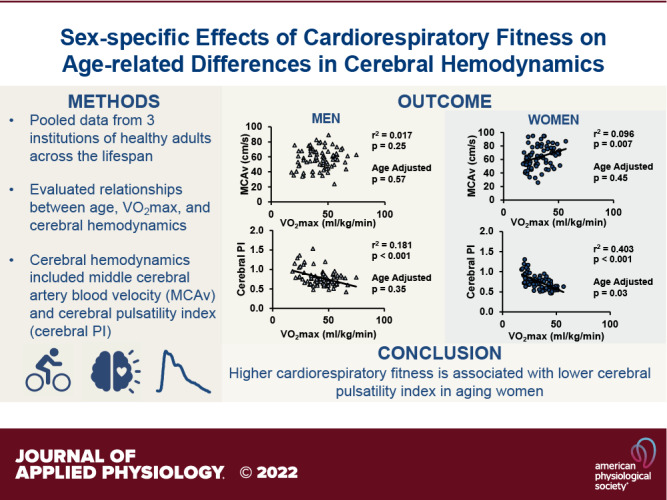
There is a positive association between cardiorespiratory fitness and cognitive health, but the interaction between cardiorespiratory fitness and aging on cerebral hemodynamics is unclear. These potential interactions are further influenced by sex differences. The purpose of this study was to determine the sex-specific relationships between cardiorespiratory fitness, age, and cerebral hemodynamics in humans. Measurements of unilateral middle cerebral artery blood velocity (MCAv) and cerebral pulsatility index obtained using transcranial Doppler ultrasound and cardiorespiratory fitness [maximal oxygen consumption (V̇o)] obtained from maximal incremental exercise tests were retrieved from study records at three institutions. A total of 153 healthy participants were included in the analysis (age = 42 ± 20 yr, range = 18-83 yr). There was no association between V̇o and MCAv in all participants ( = 0.20). The association between V̇o and MCAv was positive in women, but no longer significant after age adjustment (univariate: = 0.01; age-adjusted: = 0.45). In addition, there was no association between V̇o and MCAv in men (univariate: = 0.25, age-adjusted: = 0.57). For V̇o and cerebral pulsatility index, there were significant negative associations in all participants ( < 0.001), in men ( < 0.001) and women ( < 0.001). This association remained significant when adjusting for age in women only ( = 0.03). In summary, higher cardiorespiratory fitness was associated with a lower cerebral pulsatility index in all participants, and the significance remained only in women when adjusting for age. Future studies are needed to determine the sex-specific impact of cardiorespiratory fitness improvements on cerebrovascular health. We present data pooled from three institutions to study the impact of age, sex, and cardiorespiratory fitness on cerebral hemodynamics. Cardiorespiratory fitness was positively associated with middle cerebral artery blood velocity in women, but not in men. Furthermore, cardiorespiratory fitness was inversely associated with cerebral pulsatility index in both men and women, which remained significant in women when adjusting for age. These data suggest a sex-specific impact of cardiorespiratory fitness on resting cerebral hemodynamics.
心肺适能与认知健康呈正相关,但心肺适能与衰老对大脑血液动力学的相互作用尚不清楚。这些潜在的相互作用进一步受到性别差异的影响。本研究旨在确定心肺适能、年龄和人类大脑血液动力学之间的性别特异性关系。使用经颅多普勒超声测量单侧大脑中动脉血流速度(MCAv)和大脑搏动指数,并从三个机构的最大递增运动测试中获得心肺适能[最大摄氧量(V̇o)]。共纳入 153 名健康参与者进行分析(年龄=42±20 岁,范围 18-83 岁)。在所有参与者中,V̇o 与 MCAv 之间无关联(=0.20)。V̇o 与 MCAv 在女性中呈正相关,但在年龄调整后不再显著(单变量:=0.01;年龄调整后:=0.45)。此外,在男性中,V̇o 与 MCAv 之间也无关联(单变量:=0.25,年龄调整后:=0.57)。对于 V̇o 和大脑搏动指数,所有参与者均呈显著负相关(<0.001),男性(<0.001)和女性(<0.001)均如此。仅在女性中调整年龄时,这种相关性仍然显著(=0.03)。综上所述,在所有参与者中,较高的心肺适能与较低的大脑搏动指数相关,仅在调整年龄时,这种相关性在女性中仍然显著。需要进一步的研究来确定心肺适能改善对脑血管健康的性别特异性影响。我们展示了来自三个机构的数据,以研究年龄、性别和心肺适能对大脑血液动力学的影响。心肺适能与女性的大脑中动脉血流速度呈正相关,但与男性无关。此外,心肺适能与男性和女性的大脑搏动指数呈负相关,在调整年龄后,女性的相关性仍然显著。这些数据表明心肺适能对静息大脑血液动力学具有性别特异性影响。