Department of Sociology, Harvard University, Cambridge, MA, United States of America.
Department of Sociology, Cornell University, Ithaca, NY, United States of America.
PLoS One. 2022 Apr 21;17(4):e0266562. doi: 10.1371/journal.pone.0266562. eCollection 2022.
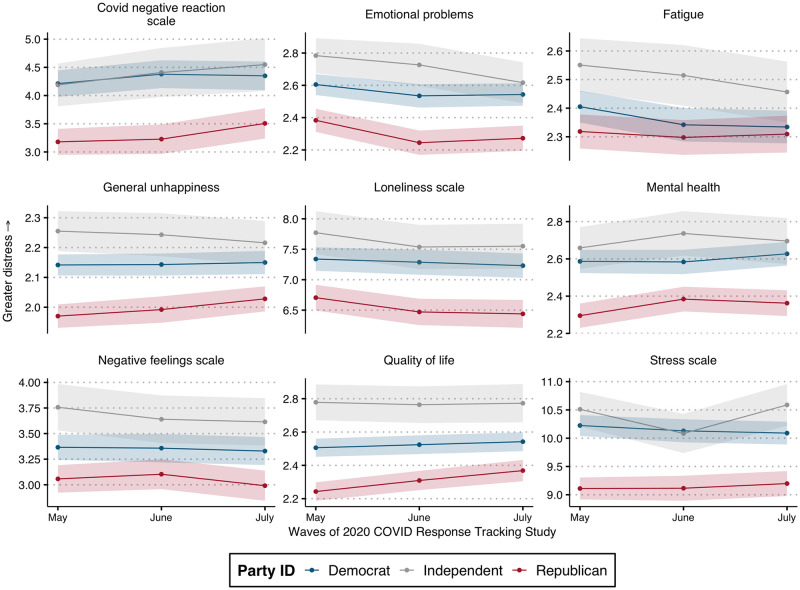
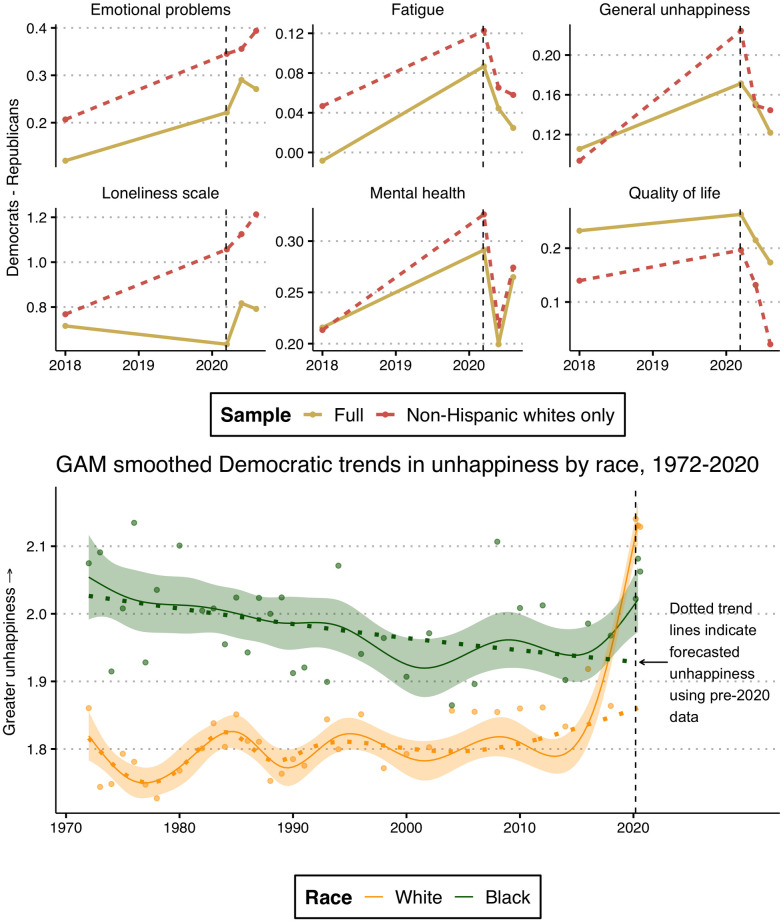
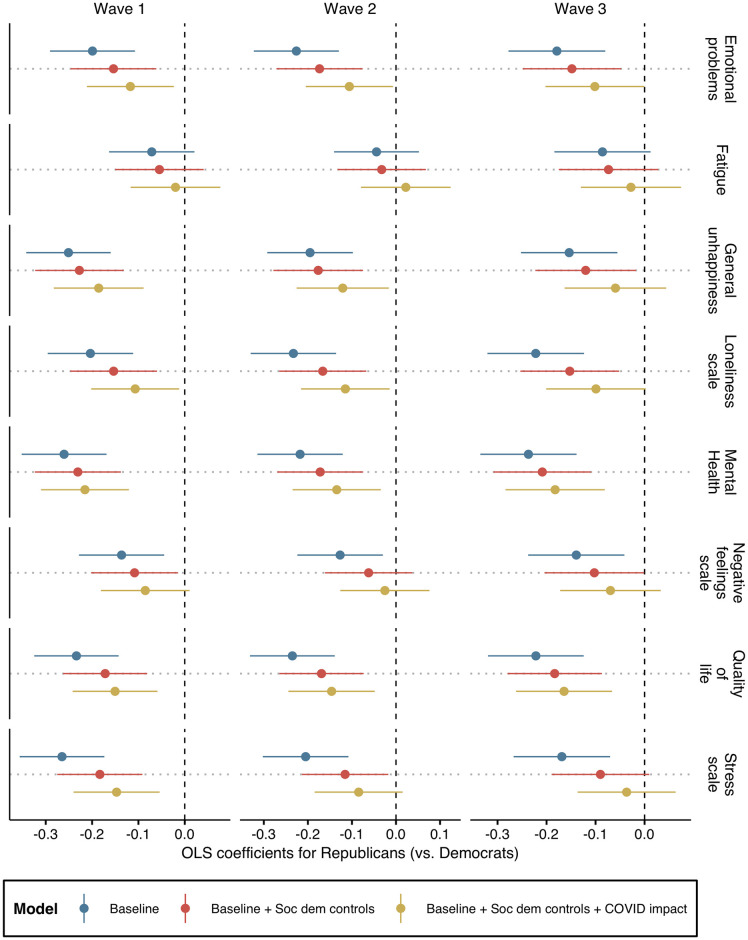
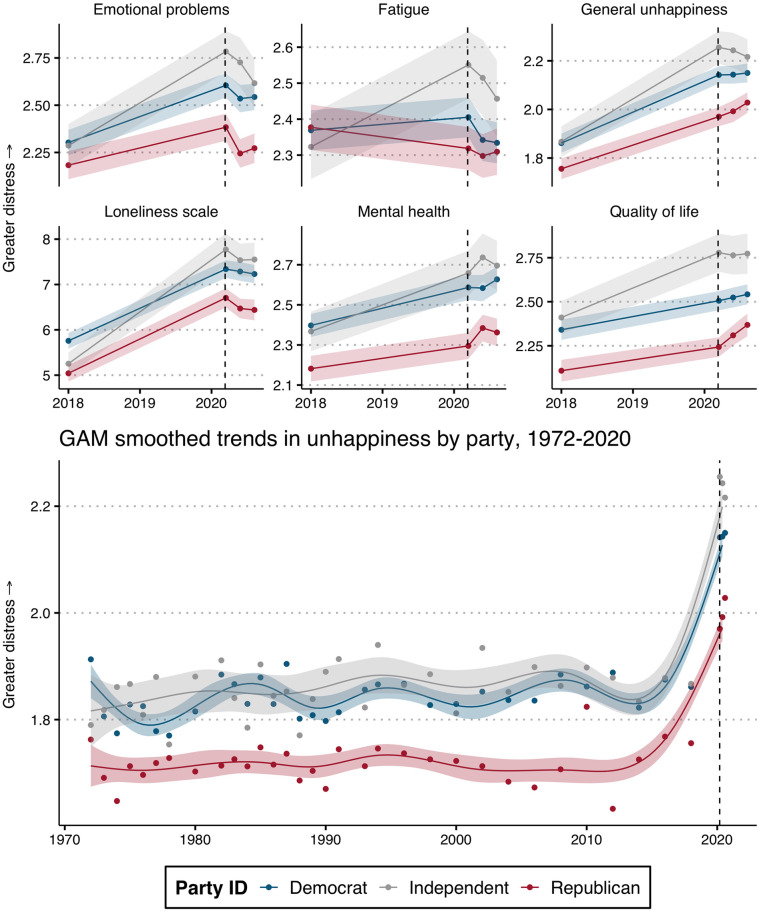
The COVID-19 pandemic was a potent stressor, yielding unprecedented levels of mental distress. However, public health responses and personal reactions to the pandemic were politically polarized, with Democrats highlighting and Republicans downplaying its severity. Did Republicans subsequently experience as much mental distress as Democrats during the COVID-19 pandemic? This study examines partisan patterns in mental health outcomes at three time points throughout the pandemic. Results demonstrate a clear partisan distress gap, with Democrats consistently reporting worse mental health than Republicans. Trend data suggest that the 2020 pandemic patterns are a continuation and exacerbation of an existing partisan distress gap. Consideration of race, however, demonstrates a widening partisan distress gap, specific to white Americans. Among white Americans, therefore, Democrats experienced a substantially greater increase in distress in response to the pandemic than Republicans.
新冠疫情是一个强有力的压力源,导致了前所未有的精神痛苦水平。然而,公共卫生应对措施和个人对疫情的反应在政治上存在两极分化,民主党强调疫情的严重性,而共和党则淡化其严重性。在新冠疫情期间,共和党人随后是否经历了与民主党人一样多的精神痛苦?本研究在疫情期间的三个时间点检查了心理健康结果的党派模式。结果表明存在明显的党派痛苦差距,民主党人报告的心理健康状况持续差于共和党人。趋势数据表明,2020 年的疫情模式是现有党派痛苦差距的延续和加剧。然而,对种族的考虑表明,白种美国人的党派痛苦差距正在扩大。因此,在白种美国人中,民主党人在应对疫情时的痛苦增加幅度大大高于共和党人。