Swiss Centre of Expertise in the Social Sciences (FORS), University of Lausanne, Lausanne, Switzerland.
Centre for Social Sciences, Hungarian Academy of Sciences Centre of Excellence, Cornivus University of Budapest, Budapest, Hungary.
PLoS One. 2022 Apr 21;17(4):e0266801. doi: 10.1371/journal.pone.0266801. eCollection 2022.
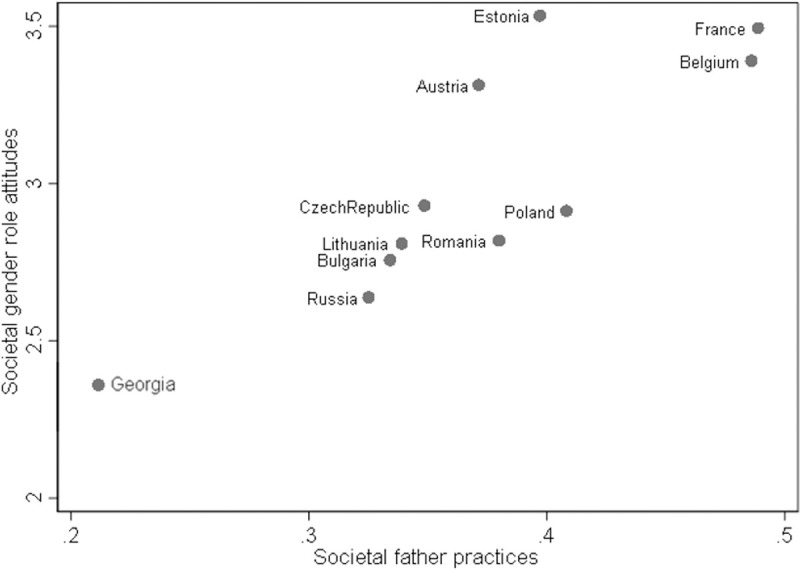
Due to an increasing number of parental union dissolutions, a growing number of fathers does not cohabit with their biological children. This article analyses individual and societal gender role attitudes as well as societal father practices as determinants of nonresident father-child contact. Previous research shows that individual-level factors influence the relationship between nonresident fathers and their children. Research on resident fathers indicates that individual attitudes and societal contexts affect father-child involvement. Little is known on the relationship between individual gender role attitudes as well as societal gender role attitudes and father practices and nonresident fathers' involvement in their children's lives. To shed more light thereon, we examine data from eleven Eastern and Western European countries from the first wave of the Gender and Generations Survey. We analyze two samples: One consisting of nonresident fathers of children aged 0 to 13 and one of fathers of adolescents aged 14 to 17. Logistic regression models assess if individual and societal gender role attitudes as well as societal father practices predict the probability of monthly father-child contact. Contact between nonresident fathers is affected by different factors depending on whether the focus is on children or adolescents. Societal gender role attitudes and societal father practices predict the probability of monthly contact between fathers and their children; individual gender role attitudes are less important. Individual gender role attitudes, on the other hand, predict the probability of monthly contact between nonresident fathers and their adolescent children; societal factors matter less for this age group.
由于越来越多的父母离异,越来越多的父亲不再与他们的亲生子女共同生活。本文分析了个人和社会性别角色态度以及社会父亲实践作为非居住父亲与子女接触的决定因素。先前的研究表明,个人因素会影响非居住父亲与子女之间的关系。对居住父亲的研究表明,个人态度和社会背景会影响父亲与子女的参与度。关于个人性别角色态度以及社会性别角色态度与父亲实践和非居住父亲参与子女生活之间的关系,知之甚少。为了更深入地了解这一点,我们分析了来自 11 个东欧和西欧国家的第一波性别与代际调查的数据。我们分析了两个样本:一个是 0 至 13 岁儿童的非居住父亲样本,另一个是 14 至 17 岁青少年的父亲样本。逻辑回归模型评估了个人和社会性别角色态度以及社会父亲实践是否可以预测每月与子女接触的可能性。非居住父亲与子女的接触受到不同因素的影响,具体取决于关注的是儿童还是青少年。社会性别角色态度和社会父亲实践可以预测父亲与子女之间每月接触的可能性;个人性别角色态度则不那么重要。另一方面,个人性别角色态度可以预测非居住父亲与青少年子女之间每月接触的可能性;对于这个年龄组来说,社会因素的重要性较小。