Department of Medical Psychology, University Medical Center Hamburg-Eppendorf, Hamburg, Germany.
Health Expect. 2022 Aug;25(4):1529-1538. doi: 10.1111/hex.13494. Epub 2022 Apr 21.
To effectively foster patient-centeredness (PC), it is crucial to measure its implementation. So far, there is no German measure to assess PC comprehensively. The aim of this study is to develop and select items for the Experienced Patient-Centeredness (EPAT) Questionnaire, a patient-reported experience measure (PREM). The EPAT intends to assess PC from the perspective of adult patients treated for different chronic diseases in inpatient and outpatient settings in Germany. Furthermore, we aim at providing a best-practice example for developing PREMs from qualitative data.
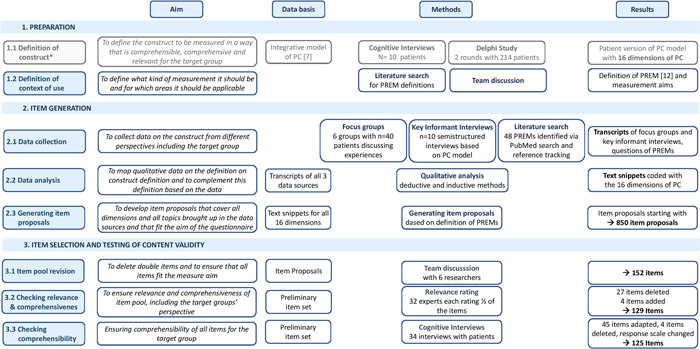
The development process comprised a three-phase mixed-method design: (1) preparation, (2) item generation and (3) item selection and testing of content validity. We generated items using qualitative content analysis based on information from focus groups, key informant interviews and literature search. We selected items using relevance rating and cognitive interviews. Participants were patients from four chronic disease groups (cancer, cardiovascular disease, mental disorder, musculoskeletal disorder) and healthcare experts (e.g., clinicians, researchers, patient representatives).
We conducted six focus groups with a total of 40 patients, key informant interviews with 10 experts and identified 48 PREMs from international literature. After team discussion, we reached a preliminary pool of 152 items. We conducted a relevance rating with 32 experts and 34 cognitive interviews with 21 patients. We selected 125 items assessing 16 dimensions of PC and showed high relevance and comprehensibility.
The EPAT questionnaire is currently undergoing psychometric testing. The transparent step-by-step report provides a best practice example that other researchers may consider for developing PREMs. Integrating literature and experts with a strong focus on patient feedback ensured good content validity. The EPAT questionnaire will be helpful in assessing PC in routine clinical practice in inpatient and outpatient settings for research and quality improvement.
Patients were not involved as active members of the research team. While developing the funding proposal, we informally reached out to several patient organizations who all gave us positive feedback on the study aims, thereby confirming their relevance. Those patient organizations endorsed the funding proposal with formal letters of support and supported recruitment by disseminating advertisements for study participation.
为了有效地培养以患者为中心(PC)的理念,衡量其实施情况至关重要。到目前为止,德国还没有全面评估 PC 的措施。本研究旨在开发并选择用于经验性患者为中心(EPAT)问卷的项目,这是一种患者报告的体验测量工具(PREM)。EPAT 旨在从接受住院和门诊治疗的不同慢性疾病的成年患者的角度评估 PC。此外,我们旨在为从定性数据开发 PREM 提供最佳实践示例。
开发过程包括一个三阶段混合方法设计:(1)准备,(2)项目生成,(3)项目选择和内容有效性测试。我们使用基于焦点小组、关键知情人访谈和文献搜索信息的定性内容分析来生成项目。我们使用相关性评分和认知访谈来选择项目。参与者来自四个慢性疾病组(癌症、心血管疾病、精神障碍、肌肉骨骼疾病)和医疗保健专家(例如临床医生、研究人员、患者代表)。
我们进行了六次共 40 名患者的焦点小组、十次关键知情人访谈,并从国际文献中确定了 48 个 PREM。经过团队讨论,我们得到了一个初步的 152 个项目库。我们进行了 32 名专家的相关性评分和 21 名患者的 34 次认知访谈。我们选择了 125 个项目来评估 16 个 PC 维度,结果表明这些项目具有高度相关性和可理解性。
EPAT 问卷目前正在进行心理测量测试。透明的逐步报告提供了一个最佳实践示例,其他研究人员可以考虑用于开发 PREM。将文献和专家与对患者反馈的强烈关注相结合,确保了良好的内容有效性。EPAT 问卷将有助于在住院和门诊环境中评估常规临床实践中的 PC,以进行研究和质量改进。
患者没有作为研究团队的积极成员参与。在制定资助提案时,我们非正式地联系了几个患者组织,他们都对研究目标给予了积极的反馈,从而确认了其相关性。这些患者组织通过正式的支持信来支持资助提案,并通过传播研究参与的广告来支持招募。