Guo Wei, Chen Xin-Rong, Liu Hu-Chen
School of Management, Shanghai University, Shanghai 200444, China.
Academy for Engineering and Technology, Fudan University, Shanghai 200433, China.
Behav Sci (Basel). 2022 Mar 25;12(4):92. doi: 10.3390/bs12040092.
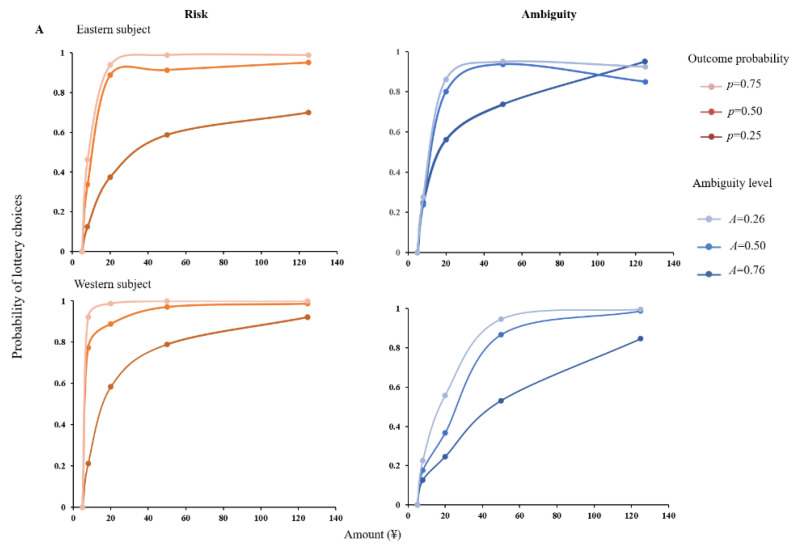
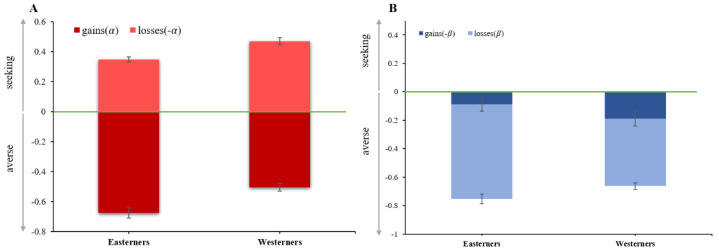
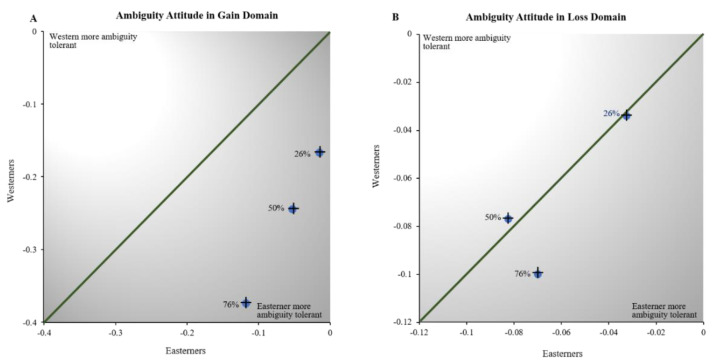
It has long been known that Easterners exhibit more conservative attitudes, cautiousness behaviors, and self-control ability than Westerners; people in Eastern countries show stronger defensive reactions to societal threats than Western people. Are East Asians really risk averters or do some richer underlying preferences drive their behaviors in their decision-making under uncertainty? To answer this question, we examined the risk and ambiguity attitudes of East Asian populations in both gain and loss domains using classical behavioral economic experimental methods. Based on our sample of university students, we found that Easterners are more risk intolerant but more willing to accept ambiguous conditions than their Westerner counterparts in the gain domain. Perhaps surprisingly, Eastern people and Western people have a similar attitude toward risk and ambiguity in the loss domain. The higher level of risk aversion observed among East Asians may be due to the cultural difference between Western countries and Eastern countries. Historically, such risk aversion may make sense, because it would minimize the influence of numerous ecological and historical threats and socio-political practices. Our findings suggest that models that were designed to analyze and predict aggregate behaviors and markets may be ineffective for Eastern populations, and, in the future, it is of significance to develop appropriate representative agent models from the eastern perspective.
长期以来,人们一直认为,与西方人相比,东方人表现出更保守的态度、更谨慎的行为和更强的自我控制能力;东方国家的人们对社会威胁的防御反应比西方国家的人更强烈。东亚人真的是风险规避者,还是在不确定性决策中,一些更丰富的潜在偏好驱动了他们的行为?为了回答这个问题,我们使用经典行为经济学实验方法,研究了东亚人群在收益和损失领域的风险和模糊态度。基于我们的大学生样本,我们发现,在收益领域,东方人比西方人更不耐风险,但更愿意接受模糊条件。也许令人惊讶的是,东方人和西方人在损失领域对风险和模糊性的态度相似。东亚人较高的风险规避水平可能是由于西方国家和东方国家之间的文化差异。从历史上看,这种风险规避可能是有意义的,因为它将最大限度地减少众多生态和历史威胁以及社会政治实践的影响。我们的研究结果表明,旨在分析和预测总体行为和市场的模型可能对东方人群无效,未来,从东方视角开发合适的代表性主体模型具有重要意义。