Joy Teresa, Chen Minhao, Arnbrister Joshua, Williamson Daniel, Li Shujuan, Nair Shakunthala, Brophy Maureen, Garcia Valerie Madera, Walker Kathleen, Ernst Kacey, Gouge Dawn H, Carrière Yves, Riehle Michael A
Department of Entomology, University of Arizona, Tucson, AZ 85721, USA.
Department of Epidemiology and Biostatistics, University of Arizona, Tucson, AZ 85724, USA.
Insects. 2022 Apr 7;13(4):360. doi: 10.3390/insects13040360.
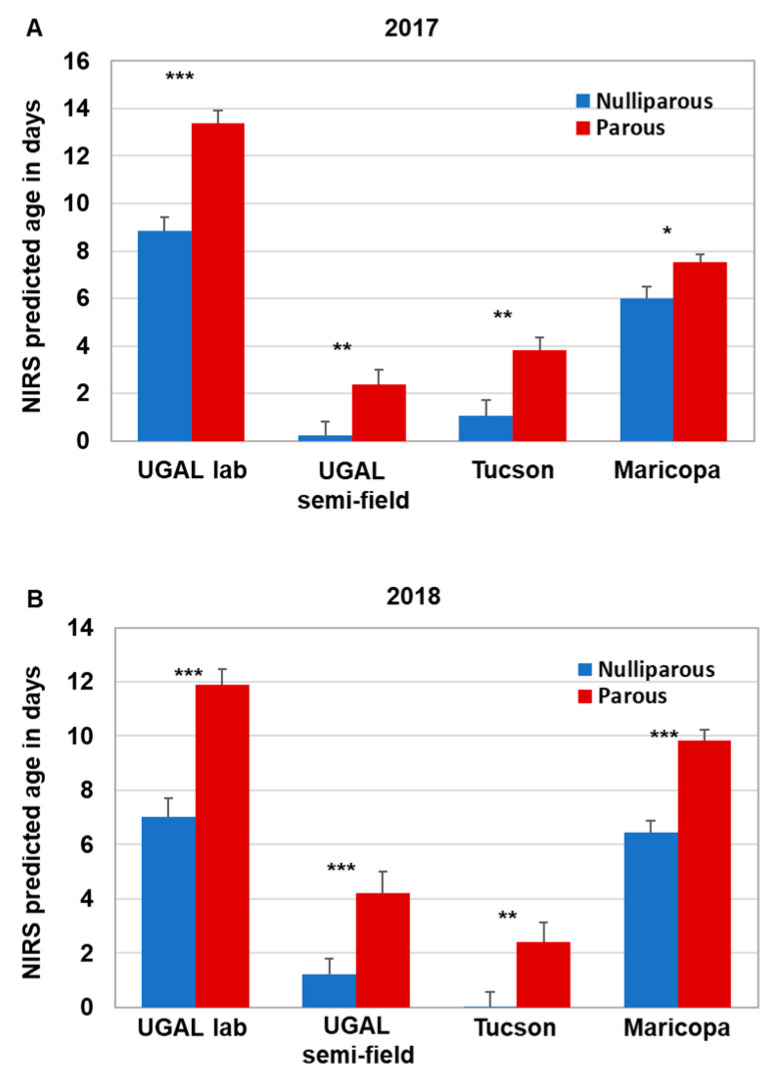
Given that older (L.) mosquitoes typically pose the greatest risk of pathogen transmission, the capacity to age grade wild mosquito populations would be a valuable tool in monitoring the potential risk of arboviral transmission. Here, we compared the effectiveness of near-infrared spectroscopy (NIRS) to age grade field-collected with two alternative techniques-parity analysis and transcript abundance of the age-associated gene . Using lab-reared mosquitoes of known ages from three distinct populations maintained as adults under laboratory or semi-field conditions, we developed and validated four NIRS models for predicting the age of field-collected . To assess the accuracy of these models, female mosquitoes were collected from Maricopa County, AZ, during the 2017 and 2018 monsoon season, and a subset were age graded using the three different age-grading techniques. For both years, each of the four NIRS models consistently graded parous mosquitoes as significantly older than nulliparous mosquitoes. Furthermore, a significant positive linear association occurred between and NIRS age predictions in seven of the eight year/model combinations, although considerable variation in the predicted age of individual mosquitoes was observed. Our results suggest that although the NIRS models were not adequate in determining the age of individual field-collected mosquitoes, they have the potential to quickly and cost effectively track changes in the age structure of populations across locations and over time.
鉴于较老的(L.)蚊子通常构成病原体传播的最大风险,对野生蚊子种群进行年龄分级的能力将是监测虫媒病毒传播潜在风险的一项有价值的工具。在此,我们将近红外光谱法(NIRS)与另外两种技术—— parity分析和与年龄相关基因的转录本丰度——对野外采集的蚊子进行年龄分级的有效性进行了比较。利用在实验室或半野外条件下作为成虫饲养的来自三个不同种群的已知年龄的实验室饲养蚊子,我们开发并验证了四个用于预测野外采集蚊子年龄的NIRS模型。为了评估这些模型的准确性,在2017年和2018年季风季节从亚利桑那州马里科帕县采集雌性蚊子,并使用三种不同的年龄分级技术对其中一部分进行年龄分级。在这两年中,四个NIRS模型中的每一个都始终将已产卵的蚊子分级为明显比未产卵的蚊子年龄大。此外,在八个年份/模型组合中的七个中,在[原文此处可能有缺失信息]和NIRS年龄预测之间出现了显著的正线性关联,尽管观察到个体蚊子预测年龄存在相当大的差异。我们的结果表明,尽管NIRS模型在确定单个野外采集蚊子的年龄方面并不充分,但它们有潜力快速且经济高效地追踪不同地点和不同时间的蚊子种群年龄结构的变化。