School of Biological Sciences, University of Queensland, Brisbane, Australia.
PLoS Negl Trop Dis. 2010 Feb 23;4(2):e608. doi: 10.1371/journal.pntd.0000608.
New strategies to eliminate dengue have been proposed that specifically target older Aedes aegypti mosquitoes, the proportion of the vector population that is potentially capable of transmitting dengue viruses. Evaluation of these strategies will require accurate and high-throughput methods of predicting mosquito age. We previously developed an age prediction assay for individual Ae. aegypti females based on the transcriptional profiles of a selection of age responsive genes. Here we conducted field testing of the method on Ae. aegypti that were entirely uncaged and free to engage in natural behavior.
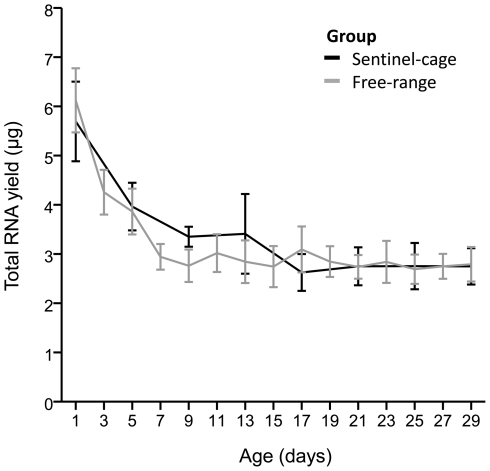
METHODOLOGY/PRINCIPAL FINDINGS: We produced "free-range" test specimens by releasing 8007 adult Ae. aegypti inside and around an isolated homestead in north Queensland, Australia, and recapturing females at two day intervals. We applied a TaqMan probe-based assay design that enabled high-throughput quantitative RT-PCR of four transcripts from three age-responsive genes and a reference gene. An age prediction model was calibrated on mosquitoes maintained in small sentinel cages, in which 68.8% of the variance in gene transcription measures was explained by age. The model was then used to predict the ages of the free-range females. The relationship between the predicted and actual ages achieved an R(2) value of 0.62 for predictions of females up to 29 days old. Transcriptional profiles and age predictions were not affected by physiological variation associated with the blood feeding/egg development cycle and we show that the age grading method could be applied to differentiate between two populations of mosquitoes having a two-fold difference in mean life expectancy.
CONCLUSIONS/SIGNIFICANCE: The transcriptional profiles of age responsive genes facilitated age estimates of near-wild Ae. aegypti females. Our age prediction assay for Ae. aegypti provides a useful tool for the evaluation of mosquito control interventions against dengue where mosquito survivorship or lifespan reduction are crucial to their success. The approximate cost of the method was US$7.50 per mosquito and 60 mosquitoes could be processed in 3 days. The assay is based on conserved genes and modified versions are likely to support similar investigations of several important mosquito and other disease vectors.
已经提出了新的消灭登革热的策略,这些策略专门针对潜在能够传播登革热病毒的老年埃及伊蚊。评估这些策略需要准确且高通量的预测蚊子年龄的方法。我们之前开发了一种基于一组年龄反应基因的转录谱对单个埃及伊蚊雌性进行年龄预测的方法。在这里,我们在完全不笼养且自由进行自然行为的埃及伊蚊上进行了该方法的现场测试。
方法/主要发现:我们通过在澳大利亚北昆士兰州的一个孤立的农舍内和周围释放 8007 只成年埃及伊蚊,并每两天捕获一次雌性来产生“自由放养”的测试标本。我们应用了一种 TaqMan 探针基测定设计,使来自三个年龄反应基因和一个参考基因的四个转录本能够进行高通量定量 RT-PCR。年龄预测模型是在小哨兵笼中饲养的蚊子上进行校准的,其中基因转录测量的 68.8%的方差可以用年龄来解释。然后,我们使用该模型预测自由放养的雌性的年龄。预测年龄与实际年龄之间的关系对于预测 29 天以内的雌性,达到了 0.62 的 R²值。转录谱和年龄预测不受与血液摄入/卵发育周期相关的生理变化的影响,我们表明,年龄分级方法可用于区分预期寿命相差两倍的两个蚊子种群。
结论/意义:年龄反应基因的转录谱有助于估算接近野生的埃及伊蚊雌性的年龄。我们的埃及伊蚊年龄预测测定为评估针对登革热的蚊虫控制干预措施提供了有用的工具,因为蚊虫的存活率或寿命缩短对其成功至关重要。该方法的近似成本为每只蚊子 7.50 美元,每天可处理 60 只蚊子。该测定基于保守基因,类似的改良版本可能支持对几种重要的蚊子和其他病媒的类似研究。