Shi Wenbo, Zhang Yaodong, Xu Yangkai, Zeng Xianshang, Fu Hongjing, Yu Weiguang
Department of Anesthesiology, Wuhan Fourth Hospital; Puai Hospital, Tongji Medical College, Huazhong University of Science and Technology, No.473, Hanzheng Street, Qiaokou District, Wuhan, 430033, China.
Department of Anesthesiology, The First Affiliated Hospital, Sun Yat-Sen University, No. 58, Zhongshan 2nd Road, Yuexiu District, Guangzhou, 510080, China.
BMC Musculoskelet Disord. 2022 Apr 21;23(1):375. doi: 10.1186/s12891-022-05323-8.
Conversion of a failed proximal femoral nail antirotation (PFNA) to a total hip arthroplasty (THA) is becoming increasingly universal. However, consensus has not been reached regarding which device (uncemented or hybrid THA) to use. The aim of this retrospective study was to compare the clinical outcomes of the conversion of failed PFNAs to uncemented versus hybrid THAs in the elderly population.
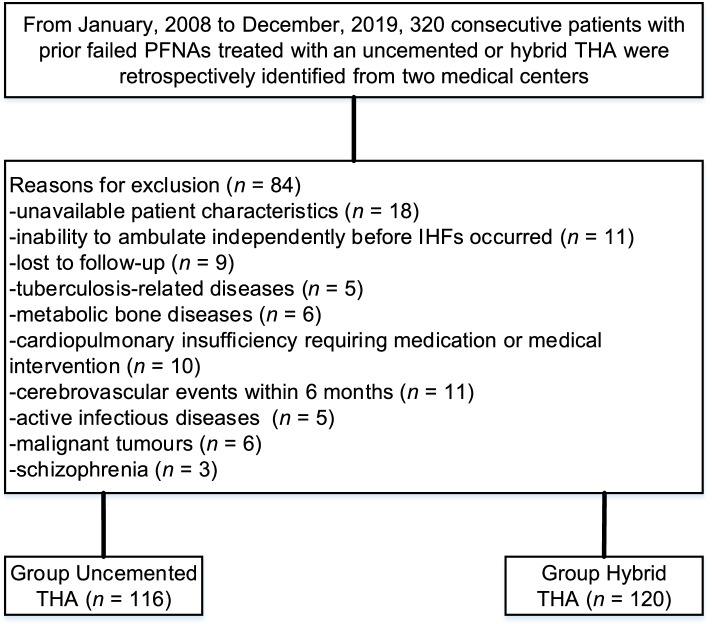
Consecutive elderly patients with prior failed PFNAs treated with uncemented or hybrid THA from January 2008 to December 2019 were retrospectively identified from two medical centres. The primary outcome was implant survival after THA revision; secondary outcomes were the functional outcomes assessed using the Harris Hip Score (HHS) and the incidence of key THA-related complications.
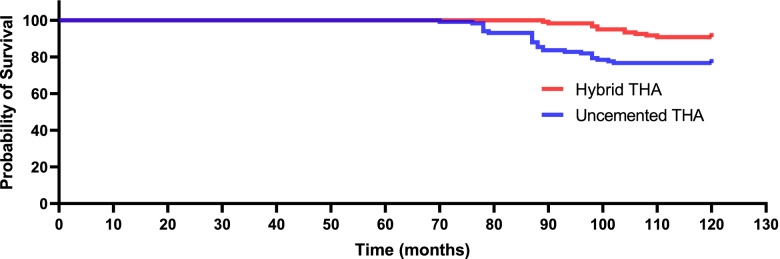
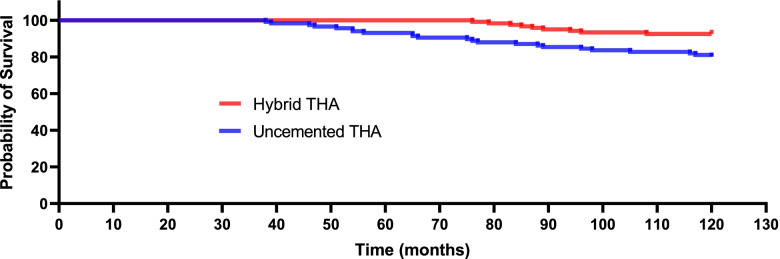
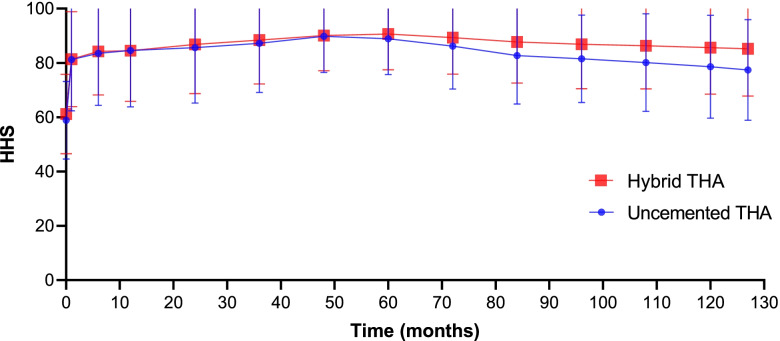
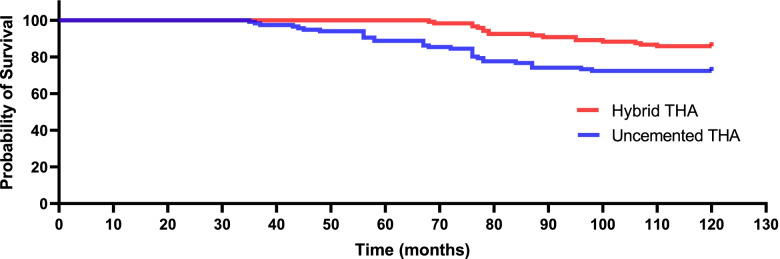
A total of 236 patients (uncemented THA, n = 116; hybrid THA, n = 120) were eligible for this study. Kaplan-Meier survival curves demonstrated that the 10-year cumulative survival rates were 0.801 (95% confidence interval [CI], 0.783-0.852) in the uncemented THA group versus 0.925 (95% CI, 0.861-0.964) in the hybrid THA group (hazard ratio [HR] 0.36 [95% CI 0.24-0.56], p = 0.004). From the 72nd month after the revision to the last follow-up, functional outcomes differed considerably between cohorts (each p < 0.05), and the rate of key THA-related complications was comparable between cohorts (p = 0.004).
For elderly patients with prior failed PFNAs who experienced uncemented or hybrid THA, hybrid THA revision may provide a clinically significant improvement over uncemented THA revision with regard to implant survival, functional outcomes, and THA-related complications compared to uncemented THA revision.
将失败的股骨近端防旋髓内钉(PFNA)转换为全髋关节置换术(THA)的情况越来越普遍。然而,对于使用哪种假体(非骨水泥型或混合型THA)尚未达成共识。这项回顾性研究的目的是比较老年人群中失败的PFNA转换为非骨水泥型与混合型THA的临床结果。
从两个医疗中心回顾性确定2008年1月至2019年12月期间接受非骨水泥型或混合型THA治疗且先前PFNA失败的连续老年患者。主要结局是THA翻修术后假体生存率;次要结局是使用Harris髋关节评分(HHS)评估的功能结局以及与THA相关的关键并发症的发生率。
共有236例患者(非骨水泥型THA组,n = 116;混合型THA组,n = 120)符合本研究条件。Kaplan-Meier生存曲线显示,非骨水泥型THA组的10年累积生存率为0.801(95%置信区间[CI],0.783 - 0.852),而混合型THA组为0.925(95%CI,0.861 - 0.964)(风险比[HR] 0.36 [95%CI 0.24 - 0.56],p = 0.004)。从翻修后第72个月至最后一次随访,各队列之间的功能结局差异很大(各p < 0.05),且与THA相关的关键并发症发生率在各队列之间相当(p = 0.004)。
对于先前PFNA失败后接受非骨水泥型或混合型THA的老年患者,与非骨水泥型THA翻修相比,混合型THA翻修在假体生存率、功能结局和与THA相关的并发症方面可能提供临床上显著的改善。