Department of Medical Oncology, Ordos Central Hospital, Ordos, 017000, China.
Department of Radiation Oncology, State Key Laboratory of Oncology in South China, Collaborative Innovation Center for Cancer Medicine, Sun Yat-Sen University Cancer Center, Guangzhou, Guangdong, People's Republic of China.
Support Care Cancer. 2022 Jul;30(7):6225-6232. doi: 10.1007/s00520-022-07067-6. Epub 2022 Apr 21.
A prospective randomized controlled trial was conducted to compare 5 mg olanzapine plus standard triple antiemetic therapy for the prevention of nausea and vomiting induced by multiple-day cisplatin chemotherapy.
Patients who received a 3-day cisplatin-based chemotherapy (25 mg/m/d) were given either 5 mg olanzapine plus triple therapy with aprepitant, tropisetron, and dexamethasone (quadruple group) or 5 mg olanzapine plus tropisetron and dexamethasone, omitting aprepitant (triplet group). The primary endpoint was the complete response (CR) in the overall phase (OP) (0-120 h) between quadruple group and triplet group. The secondary endpoints were the CR in the acute phase (AP) (0-24 h) and delayed phase (DP) (25-120 h) between two groups. The first time of vomiting was also compared by Kaplan-Meier curves. The impact of chemotherapy-induced nausea and vomiting (CINV) on the quality of life was assessed by the Functional Living Index-Emesis (FLIE). Aprepitant-related adverse effects (AEs) were also recorded.
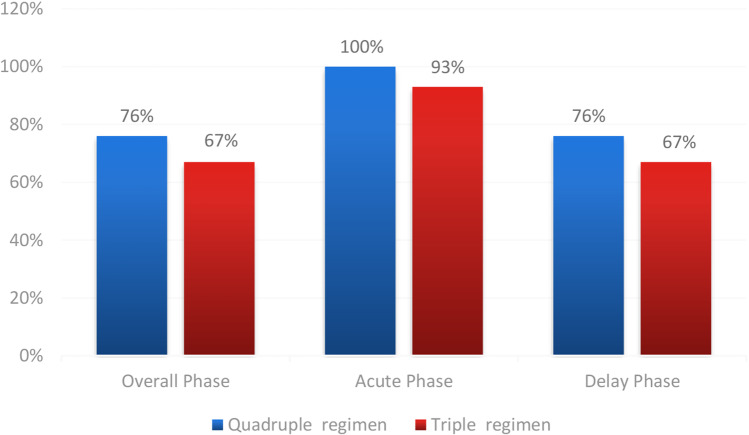
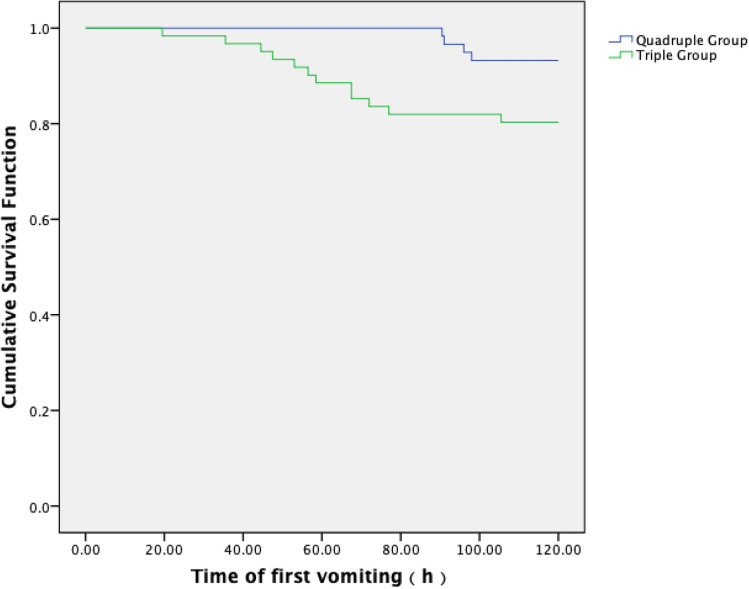
(1) The primary endpoint CR during OP was 76.0% (45/59) vs 67.0% (41/61) between the quadruple group and triplet group (P = 0.271). The secondary endpoint CR during the AP was significantly higher in the quadruple group than in the triplet group, which was 100.0% (59/59) vs 93.0% (57/61) (P = 0.045). The difference of CR during delayed phase between the groups was especially higher in the quadruple group compared to the triplet group (76.0% (45/59) vs 67.0% (41/61) (P = 0.271)). The rate of patients who achieved total protection in the overall phase was also higher in the quadruple group than the triplet group (28.8% (17/59) vs 23.0% (14/61) (P = 0.463)). During the OP, the incidence of no vomiting in the quadruple group and the triplet group was 93.2% (55/59) vs 80.3% (49/61) (P = 0.038), respectively. (2) Kaplan-Meier curves of time to first emesis were obviously longer in the quadruple group compared with the triplet group (P = 0.031). According to FLIE, no impact of CINV on daily life was defined as total score of questionnaire > 108; this study exhibited identical life quality between two groups. (3) The most common aprepitant- or olanzapine-related AEs included sedation, fatigue, and constipation. The occurrences between two groups were identical.
It may been recommended that 5 mg olanzapine plus tropisetron and dexamethasone, omitting aprepitant triplet regimen as an alternative therapy in prevention CINV induced by multiple-day cisplatin chemotherapy due to the excellent CINV control rate and safety.
一项前瞻性随机对照试验比较了 5mg 奥氮平联合标准三联止吐疗法预防多日顺铂化疗引起的恶心和呕吐。
接受 3 天顺铂为基础的化疗(25mg/m/d)的患者接受 5mg 奥氮平联合阿瑞匹坦、托烷司琼和地塞米松三联疗法(四联组)或 5mg 奥氮平联合托烷司琼和地塞米松,不使用阿瑞匹坦(三联组)。主要终点是两组之间整个阶段(0-120 小时)的完全缓解(CR)。次要终点是两组之间急性相(0-24 小时)和迟发性相(25-120 小时)的 CR。还通过 Kaplan-Meier 曲线比较首次呕吐时间。采用功能生活指数-呕吐(FLIE)评估化疗引起的恶心和呕吐(CINV)对生活质量的影响。还记录了阿瑞匹坦相关的不良反应(AE)。
(1)主要终点 OP 期间的 CR 为 76.0%(45/59)vs 67.0%(41/61)四联组和三联组之间(P=0.271)。四联组的次要终点 AP 期间的 CR 明显高于三联组,为 100.0%(59/59)vs 93.0%(57/61)(P=0.045)。两组之间延迟期 CR 的差异,四联组明显高于三联组(76.0%(45/59)vs 67.0%(41/61)(P=0.271))。在整个阶段实现完全保护的患者比例在四联组也高于三联组(28.8%(17/59)vs 23.0%(14/61)(P=0.463))。在 OP 期间,四联组和三联组无呕吐的发生率分别为 93.2%(55/59)和 80.3%(49/61)(P=0.038)。(2)Kaplan-Meier 曲线显示,四联组首次呕吐的时间明显长于三联组(P=0.031)。根据 FLIE,无 CINV 对日常生活影响的定义为问卷总分>108;本研究显示两组生活质量相同。(3)最常见的阿瑞匹坦或奥氮平相关不良反应包括镇静、疲劳和便秘。两组的发生情况相同。
由于出色的 CINV 控制率和安全性,5mg 奥氮平联合托烷司琼和地塞米松,不使用阿瑞匹坦三联方案可能被推荐作为多日顺铂化疗引起的 CINV 的替代治疗方法。