Jung Young-Hoon, Kim Haekyu, Kim Hyaejin, Kim Eunsoo, Baik Jiseok, Kang Hyunjong
Department of Anesthesia and Pain Medicine, Pusan National University Hospital, Busan, Korea.
Department of Anesthesia and Pain Medicine, School of Medicine, Pusan National University, Busan, Korea.
J Dent Anesth Pain Med. 2022 Apr;22(2):97-105. doi: 10.17245/jdapm.2022.22.2.97. Epub 2022 Mar 25.
The pentadecapeptide BPC-157 has been shown to have anti-inflammatory and wound healing effects on multiple target tissues and organs. Peptides have potent anti-inflammatory effects on periodontal tissues in rats with periodontitis. Few studies have investigated the effect of BPC-157 on pain after dental procedures or oral surgeries. The purpose of the present study was to investigate the antinociceptive effects of BPC-157 on postoperative incisional pain in rats.
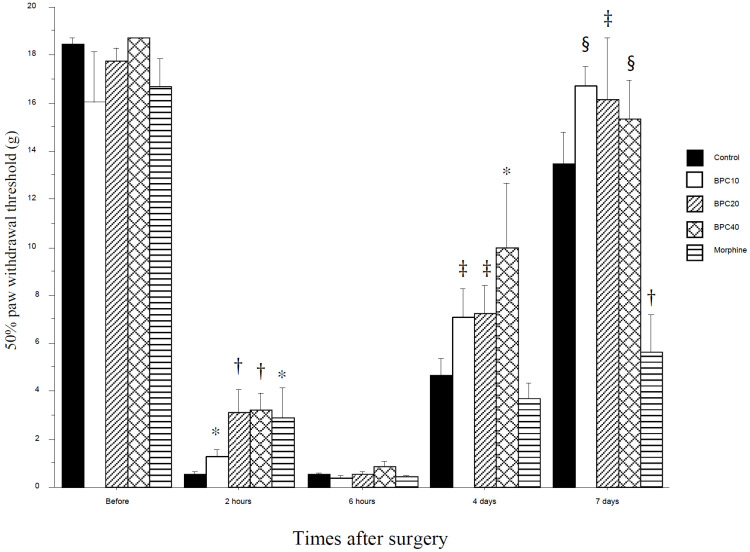
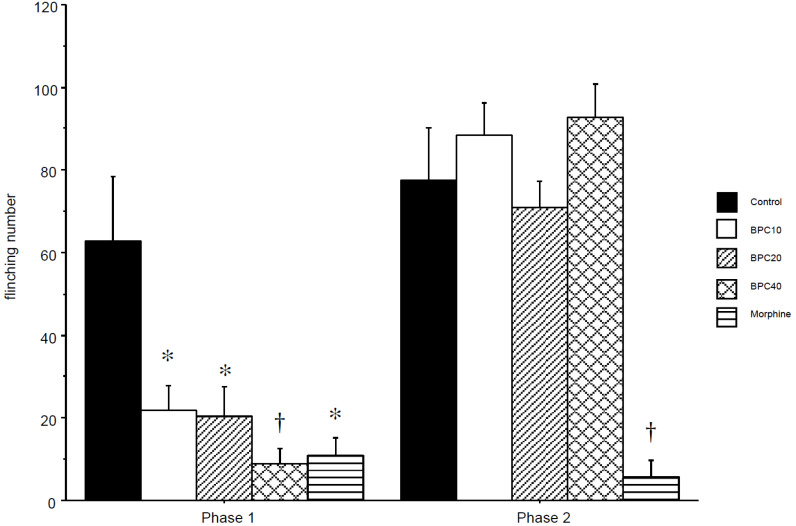
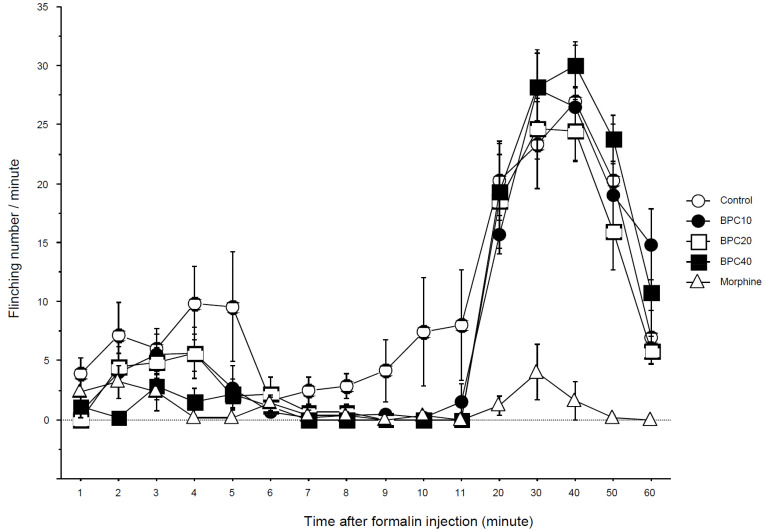
Sprague-Dawley rats were randomly divided into five groups: control (saline with the same volume), BPC10 (10 µg/kg of BPC-157), BPC20 (20 µg/kg of BPC-157), BPC40 (40 µg/kg of BPC-157), and morphine (5 mg/kg of morphine). A 1-cm longitudinal incision was made through the skin, fascia, and muscle of the plantar aspect of the hind paw in isoflurane-anesthetised rats. Withdrawal responses were measured using von Frey filaments at 0, 2, 6 h and 4, 7 d after incision. The formalin test was also performed to differentiate its anti-nociceptive effect from an inflammatory reaction or central sensitization. Pain behavior was quantified periodically in phases 1 and 2 by counting the number of flinches in the ipsilateral paw after injection with 30 µL of 5% formalin.
The threshold of mechanical allodynia was significantly increased in the BPC10, BPC20, BPC40 and morphine groups compared with that in the control group at 2 h. These increasing thresholds then returned to the levels of the control group. The BPC-157 group showed a much higher threshold at 4 days after incision than the control group. The thresholds of the BPC groups, except the morphine group, were normalized 7 days after incision.The flinching numbers of the BPC10, BPC20, BPC40 and morphine groups were significantly decreased in phase 1, but there was no decrease in the BPC-157 groups except the morphine group in phase 2.
BPC-157 was effective only for a short period after incision. It was also effective during phase 1 but not during phase 2, as determined by the formalin test. BPC-157 might have a short antinociceptive effect, even though it has anti-inflammatory and wound healing effects.
十五肽BPC-157已被证明对多种靶组织和器官具有抗炎和促进伤口愈合的作用。肽对患有牙周炎的大鼠的牙周组织具有强大的抗炎作用。很少有研究调查BPC-157对牙科手术或口腔手术后疼痛的影响。本研究的目的是调查BPC-157对大鼠术后切口疼痛的镇痛作用。
将Sprague-Dawley大鼠随机分为五组:对照组(等体积生理盐水)、BPC10组(10μg/kg BPC-157)、BPC20组(20μg/kg BPC-157)、BPC40组(40μg/kg BPC-157)和吗啡组(5mg/kg吗啡)。在异氟烷麻醉的大鼠后爪足底侧的皮肤、筋膜和肌肉上做一个1厘米长的纵向切口。在切口后0、2、6小时以及4、7天时,使用von Frey细丝测量缩足反应。还进行了福尔马林试验,以区分其镇痛作用与炎症反应或中枢敏化。通过计算注射30μL 5%福尔马林后同侧爪的退缩次数,定期对第1阶段和第2阶段的疼痛行为进行量化。
与对照组相比,BPC10、BPC20、BPC40和吗啡组在2小时时机械性异常性疼痛阈值显著升高。然后这些升高的阈值恢复到对照组的水平。BPC-157组在切口后4天时的阈值比对照组高得多。除吗啡组外,BPC组的阈值在切口后7天恢复正常。BPC10、BPC20、BPC40和吗啡组在第1阶段的退缩次数显著减少,但在第2阶段,除吗啡组外,BPC-157组没有减少。
BPC-157仅在切口后短时间内有效。根据福尔马林试验,它在第1阶段有效,但在第2阶段无效。BPC-157可能具有短暂的镇痛作用,尽管它具有抗炎和促进伤口愈合的作用。