Papi Alberto, Singh Dave, Virchow J Christian, Canonica G Walter, Vele Andrea, Georges George
Respiratory Medicine Unit, University of Ferrara, University Hospital S. Anna, Ferrara, Italy.
Medicines Evaluation Unit, The University of Manchester, Manchester University NHS Foundation Trust, Manchester, UK.
Clin Transl Allergy. 2022 Apr 17;12(4):e12145. doi: 10.1002/clt2.12145. eCollection 2022 Apr.
In asthma, persistent airflow limitation (PAL) is associated with poorer control, lung function decline and exacerbations. Using post-hoc analyses we evaluated: the relationship between post-salbutamol PAL at screening, airflow limitation (AL) during 52 weeks treatment with extrafine beclometasone dipropionate/formoterol fumarate/glycopyrronium (BDP/FF/G) versus BDP/FF and the risk of moderate/severe asthma exacerbations.
TRIMARAN and TRIGGER were double-blind studies comparing BDP/FF/G with BDP/FF (TRIMARAN medium-dose ICS; TRIGGER high-dose) in adults with uncontrolled asthma. Patients were subgrouped according to post-salbutamol PAL status at screening, and AL over the 52-week treatment period.
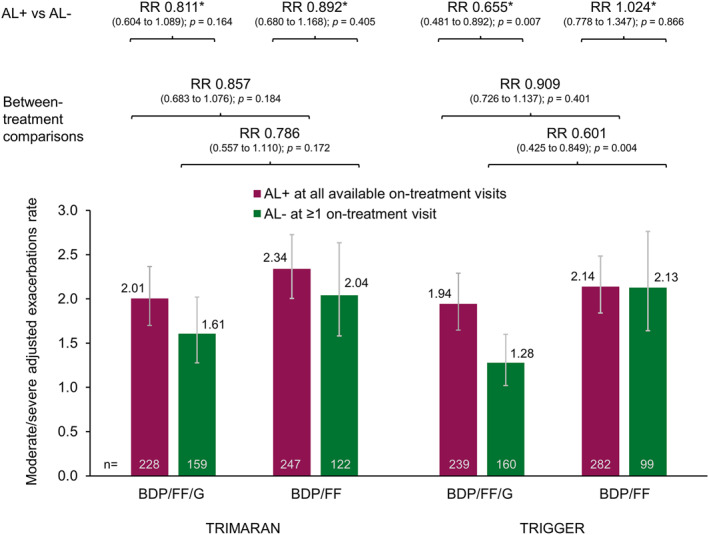
Most patients with post-salbutamol PAL at screening had AL at all on-treatment visits (TRIMARAN 62.8%; TRIGGER 66.8%). A significantly higher proportion of patients had normalised airflow on ≥1 follow-up visit when receiving BDP/FF/G than BDP/FF (TRIMARAN 44.1 vs. 33.1% [ = 0.003]; TRIGGER 40.1 vs. 26.0% [ < 0.001]). In patients with post-salbutamol PAL at screening and normalised AL at ≥1 follow-up visit, exacerbation rates were 15% ( = 0.105) and 19% ( = 0.039) lower in TRIMARAN and TRIGGER versus those with AL on all visits. There was a trend to lower exacerbation rates in patients receiving BDP/FF/G than BDP/FF, particularly in patients in whom AL was normalised.
In these analyses, AL in asthma was associated with an increased exacerbation incidence. Inhaled triple therapy with extrafine BDP/FF/G was more likely to normalise airflow, and was associated with a trend to a lower exacerbation rate than BDP/FF, particularly in the subgroup of patients in whom treatment was associated with airflow normalisation.ClinicalTrials.gov: TRIMARAN, NCT02676076; TRIGGER, NCT02676089.
在哮喘中,持续性气流受限(PAL)与控制不佳、肺功能下降和病情加重相关。我们通过事后分析评估了:筛查时沙丁胺醇后PAL与使用丙酸倍氯米松/富马酸福莫特罗/格隆溴铵(BDP/FF/G)与BDP/FF进行52周治疗期间的气流受限(AL)之间的关系,以及中度/重度哮喘加重的风险。
TRIMARAN和TRIGGER是双盲研究,比较BDP/FF/G与BDP/FF(TRIMARAN中剂量ICS;TRIGGER高剂量)在未控制哮喘的成人中的疗效。患者根据筛查时沙丁胺醇后PAL状态以及52周治疗期内的AL进行亚组划分。
筛查时沙丁胺醇后PAL的大多数患者在所有治疗访视时均存在AL(TRIMARAN为62.8%;TRIGGER为66.8%)。与接受BDP/FF相比,接受BDP/FF/G治疗的患者在≥1次随访时气流正常化的比例显著更高(TRIMARAN为44.1%对33.1%[P = 0.003];TRIGGER为40.1%对26.0%[P < 0.001])。在筛查时沙丁胺醇后PAL且在≥1次随访时AL正常化的患者中,TRIMARAN和TRIGGER的加重率分别比所有访视时均存在AL的患者低15%(P = 0.105)和19%(P = 0.039)。接受BDP/FF/G治疗的患者的加重率有低于接受BDP/FF治疗患者的趋势,尤其是在AL正常化的患者中。
在这些分析中,哮喘中的AL与加重发生率增加相关。吸入用超细BDP/FF/G三联疗法更有可能使气流正常化,并且与BDP/FF相比有降低加重率的趋势,尤其是在治疗与气流正常化相关的患者亚组中。ClinicalTrials.gov:TRIMARAN, NCT02676076;TRIGGER, NCT02676089。