Department of Internal Medicine, Erasmus MC, University Medical Center, Rotterdam, the Netherlands.
Division of Reproductive Endocrinology and Infertility, Department of Obstetrics and Gynaecology, Erasmus MC, University Medical Center, Rotterdam, the Netherlands.
Hum Reprod. 2022 Jun 30;37(7):1544-1556. doi: 10.1093/humrep/deac082.
Do polymorphisms in the anti-Müllerian hormone (AMH) promoter have an effect on AMH levels in patients with polycystic ovary syndrome (PCOS)?
We have identified a novel AMH promoter polymorphism rs10406324 that is associated with lower serum AMH levels and is suggested to play a role in the mechanism of regulation of AMH gene expression in women.
Follicle number is positively correlated with serum AMH levels, reflected by elevated AMH levels in women with PCOS. In addition, it is suggested that AMH production per follicle is higher in women with PCOS than in normo-ovulatory women, implying an altered regulation of AMH in PCOS.
STUDY DESIGN, SIZE, DURATION: A discovery cohort of 655 PCOS women of Northern European ancestry and both an internal and external validation PCOS cohort (n = 458 and n = 321, respectively) were included in this study. Summary-level data of an AMH genome-wide association study meta-analysis including 7049 normo-ovulatory women was included as a control cohort. A genetic approach was taken through association analysis and in silico analysis of the associated variants in the AMH promoter. In vitro analysis was performed to investigate the functional mechanisms.
PARTICIPANTS/MATERIALS, SETTING, METHODS: All common two-allelic single-nucleotide polymorphisms (SNPs) in the region Chr19:2 245 353-2 250 827 bp (Build 37) were selected for the analysis. Linear regression analyses were performed to determine the association between SNPs in the AMH promoter region and serum AMH levels. For the in silico analysis, the webtools 'HaploReg' v4.1 for ENCODE prediction weight matrices and 'atSNP' were used. In vitro analysis was performed using KK1 cells, a mouse granulosa cell line and COV434 cells, a human granulosa tumor cell line. Cells were transfected with the reference or the variant human AMH promoter reporter construct together with several transcription factors (TFs). Dual-Glo® Luciferase Assay was performed to measure the luciferase activity.
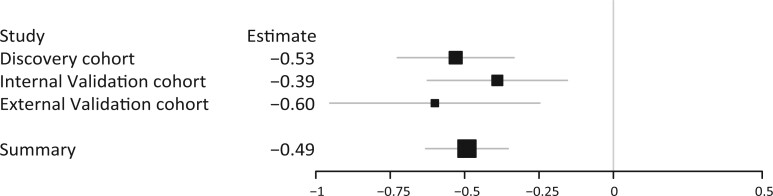
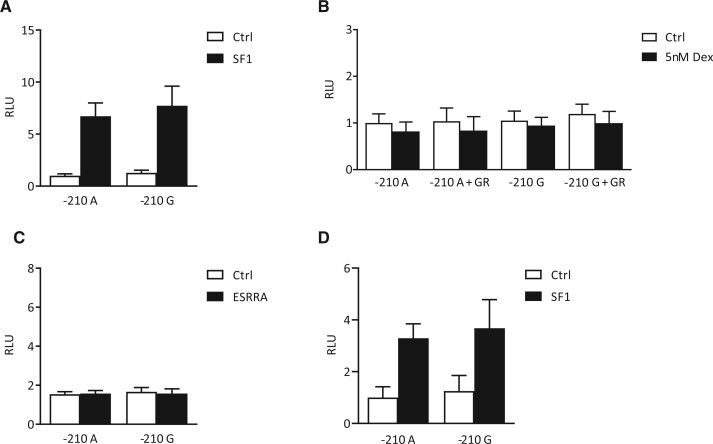
Polymorphism rs10406324 was significantly associated with serum AMH levels in all three PCOS cohorts. Carriers of the minor allele G had significantly lower log-transformed serum AMH levels compared to non-carriers (P = 8.58 × 10⁻⁸, P = 1.35 × 10⁻³ and P = 1.24 × 10⁻³, respectively). This result was validated in a subsequent meta-analysis (P = 3.24 × 10⁻¹²). Interestingly, rs10406324 was not associated with follicle count, nor with other clinical traits. Also, in normo-ovulatory women, the minor allele of this variant was associated with lower serum AMH levels (P = 1.04 × 10⁻⁵). These findings suggest that polymorphism rs10406324 plays a role in the regulation of AMH expression, irrespective of clinical background. In silico analysis suggested a decreased binding affinity of the TFs steroidogenenic factor 1, estrogen-related receptor alpha and glucocorticoid receptor to the minor allele G variant, however in vitro analysis did not show a difference in promoter activity between the A and G allele.
LIMITATIONS, REASONS FOR CAUTION: Functional analyses were performed in a mouse and a human granulosa cell line using an AMH promoter reporter construct. This may have limited assessment of the impact of the polymorphism on higher order chromatin structures. Human granulosa cells generated from induced pluripotent stem cells, combined with gene editing, may provide a method to elucidate the exact mechanism behind the decrease in serum AMH levels in carriers of the -210 G allele. We acknowledge that the lack of follicle number in the external validation and the control cohort is a limitation of the paper. Although we observed that the association between rs10406324 and AMH levels was independent of follicle number in our discovery and internal validation PCOS cohorts, we cannot fully rule out that the observed effects on serum AMH levels are, in part, caused by differences in follicle number.
These results suggest that variations in serum AMH levels are not only caused by differences in follicle number but also by genetic factors. Therefore, the genetic context should be taken into consideration when assessing serum AMH levels in women. This may have clinical consequences when serum AMH levels are used as a marker for the polycystic ovarian morphology phenotype.
STUDY FUNDING/COMPETING INTEREST(S): No external funding was used. J.S.E.L. has received consultancy fees from the following companies: Ferring, Roche Diagnostics and Ansh Labs and has received travel reimbursement from Ferring. J.A.V. has received royalties from AMH assays, paid to the institute/lab with no personal financial gain. The other authors declare no competing interests.
N/A.
抗苗勒氏管激素(AMH)启动子中的多态性是否对多囊卵巢综合征(PCOS)患者的 AMH 水平有影响?
我们已经确定了一个新的 AMH 启动子多态性 rs10406324,它与血清 AMH 水平降低有关,并被认为在女性 AMH 基因表达调控机制中发挥作用。
卵泡数量与血清 AMH 水平呈正相关,这反映在 PCOS 女性中 AMH 水平升高。此外,据推测,PCOS 女性中每个卵泡的 AMH 产量高于正常排卵女性,这意味着 AMH 在 PCOS 中的调节发生了改变。
研究设计、规模、持续时间:本研究纳入了 655 名北欧血统的 PCOS 女性的发现队列,以及 458 名和 321 名分别来自内部和外部验证 PCOS 队列的女性。纳入了一项包括 7049 名正常排卵女性的 AMH 全基因组关联研究荟萃分析的汇总水平数据作为对照队列。通过关联分析和 AMH 启动子相关变异的计算分析,采用遗传方法进行研究。进行了体外分析以研究功能机制。
参与者/材料、设置、方法:选择了 Chr19:2245353-2250827 bp(Build 37)区域中所有常见的两个等位基因单核苷酸多态性(SNP)进行分析。进行线性回归分析,以确定 AMH 启动子区域中的 SNP 与血清 AMH 水平之间的关系。对于计算分析,使用了 webtools 'HaploReg' v4.1 用于 ENCODE 预测权重矩阵和 'atSNP'。使用 KK1 细胞(一种小鼠颗粒细胞系)和 COV434 细胞(一种人颗粒状肿瘤细胞系)进行体外分析。将参考或变体人类 AMH 启动子报告构建体与几个转录因子(TFs)一起转染到细胞中。使用 Dual-Glo® Luciferase Assay 测定荧光素酶活性。
多态性 rs10406324 与所有三个 PCOS 队列的血清 AMH 水平显著相关。与非携带者相比,携带 minor 等位基因 G 的个体的 log 转换血清 AMH 水平显着降低(P=8.58×10⁻⁸,P=1.35×10⁻³ 和 P=1.24×10⁻³,分别)。这一结果在随后的荟萃分析中得到了验证(P=3.24×10⁻¹²)。有趣的是,rs10406324 与卵泡计数无关,也与其他临床特征无关。此外,在正常排卵女性中,该变体的 minor 等位基因与血清 AMH 水平降低相关(P=1.04×10⁻⁵)。这些发现表明,多态性 rs10406324 在外周正常人群中发挥作用,与临床背景无关。调节 AMH 表达。计算分析表明,TFs 甾体生成因子 1、雌激素相关受体 alpha 和糖皮质激素受体对 minor 等位基因 G 变体的结合亲和力降低,然而体外分析并未显示 A 和 G 等位基因之间的启动子活性差异。
局限性、谨慎的原因:使用 AMH 启动子报告构建体在小鼠和人颗粒细胞系中进行了功能分析。这可能限制了对多态性对更高阶染色质结构影响的评估。使用诱导多能干细胞生成的人类颗粒细胞与基因编辑相结合,可能提供一种方法来阐明携带-210 G 等位基因的个体血清 AMH 水平降低的确切机制。我们承认,外部验证和对照组中缺乏卵泡数是本文的一个局限性。尽管我们在我们的发现和内部验证 PCOS 队列中观察到 rs10406324 与 AMH 水平之间的关联独立于卵泡数,但我们不能完全排除观察到的血清 AMH 水平变化部分是由卵泡数差异引起的。
这些结果表明,血清 AMH 水平的变化不仅是由卵泡数的差异引起的,还与遗传因素有关。因此,在评估女性血清 AMH 水平时,应考虑遗传背景。当血清 AMH 水平用作多囊卵巢形态表型的标志物时,这可能具有临床意义。
研究资金/利益冲突:未使用外部资金。J.S.E.L. 已从以下公司获得咨询费:Ferring、Roche Diagnostics 和 Ansh Labs,并从 Ferring 获得旅行报销。J.A.V. 从 AMH 检测的版税中获得了收益,这些收益支付给了研究所/实验室,没有个人经济收益。其他作者没有利益冲突。
无。